New research guide: The Confidence Economy, how AI is changing fashion commerce.
Read it →
Features
Use Cases
Pricing
Consumer
Resources
Company
Experience
Book a demo
ELARA JOURNAL
Practical thinking on AI styling, virtual try-on, fashion commerce, and the systems that turn shopper intent into measurable growth.
October 5, 2026
McKinsey's State of Fashion 2026 calls AI a business necessity, not a competitive edge. Here are the 7 AI tools every Shopify fashion brand should evaluate — ranked by the problem they solve.
Read article →
There are 48 virtual try-on apps on the Shopify App Store as of 2026. Here are the ones worth evaluating — ranked by what they actually do and which type of store each one is right for.
AI-attributed orders on Shopify grew 11x between January 2025 and January 2026. Here are the 5 specific ways fashion brands are deploying AI to convert more shoppers — with the mechanics and the data behind each.
The average Shopify fashion brand has 12 installed apps but only 4-6 generating measurable revenue impact. Here is the complete recommended tech stack — organized by layer, with the right tool for each job.
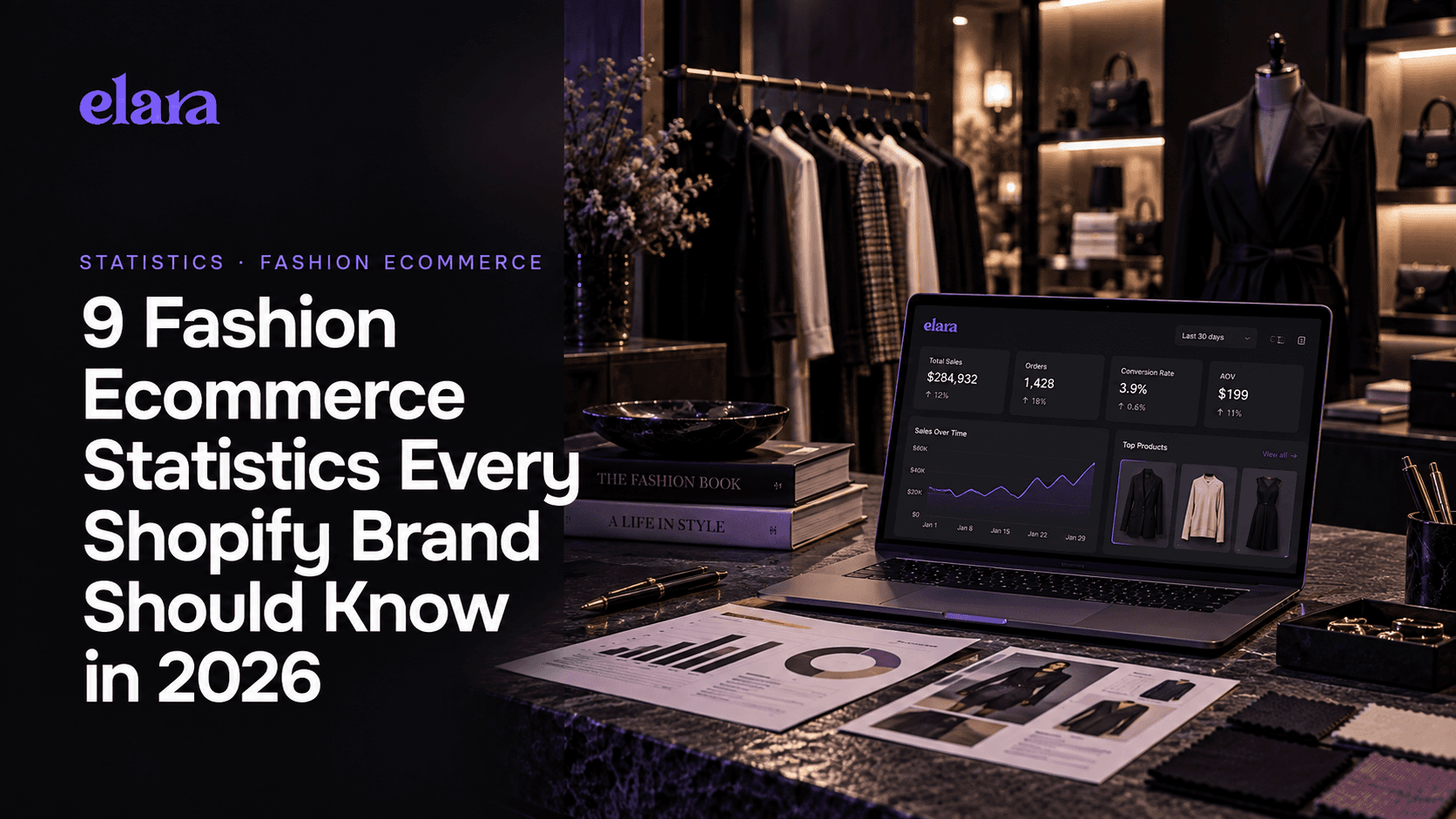
The average fashion ecommerce conversion rate is 1.4%. The average return rate is 28-40%. AI-driven traffic on Shopify grew 8x in 2025-2026. Here are the 9 statistics that shape every decision a Shopify fashion brand makes this year.
October 2, 2026
OpenAI launched a Try On button in ChatGPT on October 1, 2026. Here is what changed, what it means for your Shopify fashion store, and how a complete AI styling experience compares to single-product virtual try-on.
Fashion sales on TikTok Shop grew 108% in 2026. Here is what TikTok Shop actually is, how it differs from organic TikTok, the creator affiliate model, live shopping mechanics, and how to connect TikTok Shop traffic back to your Shopify store.
Shopify activated Agentic Storefronts for all stores in March 2026. AI-attributed orders grew 11x between January 2025 and January 2026. Here is what fashion brands need to do to be discoverable and recommended by AI shopping agents.
Total US resale volume reaches $123 billion in 2026. 93% of consumers have bought secondhand in the past year. Here is how Shopify fashion brands are building branded recommerce programs using Archive, Trove, and SuperCircle.
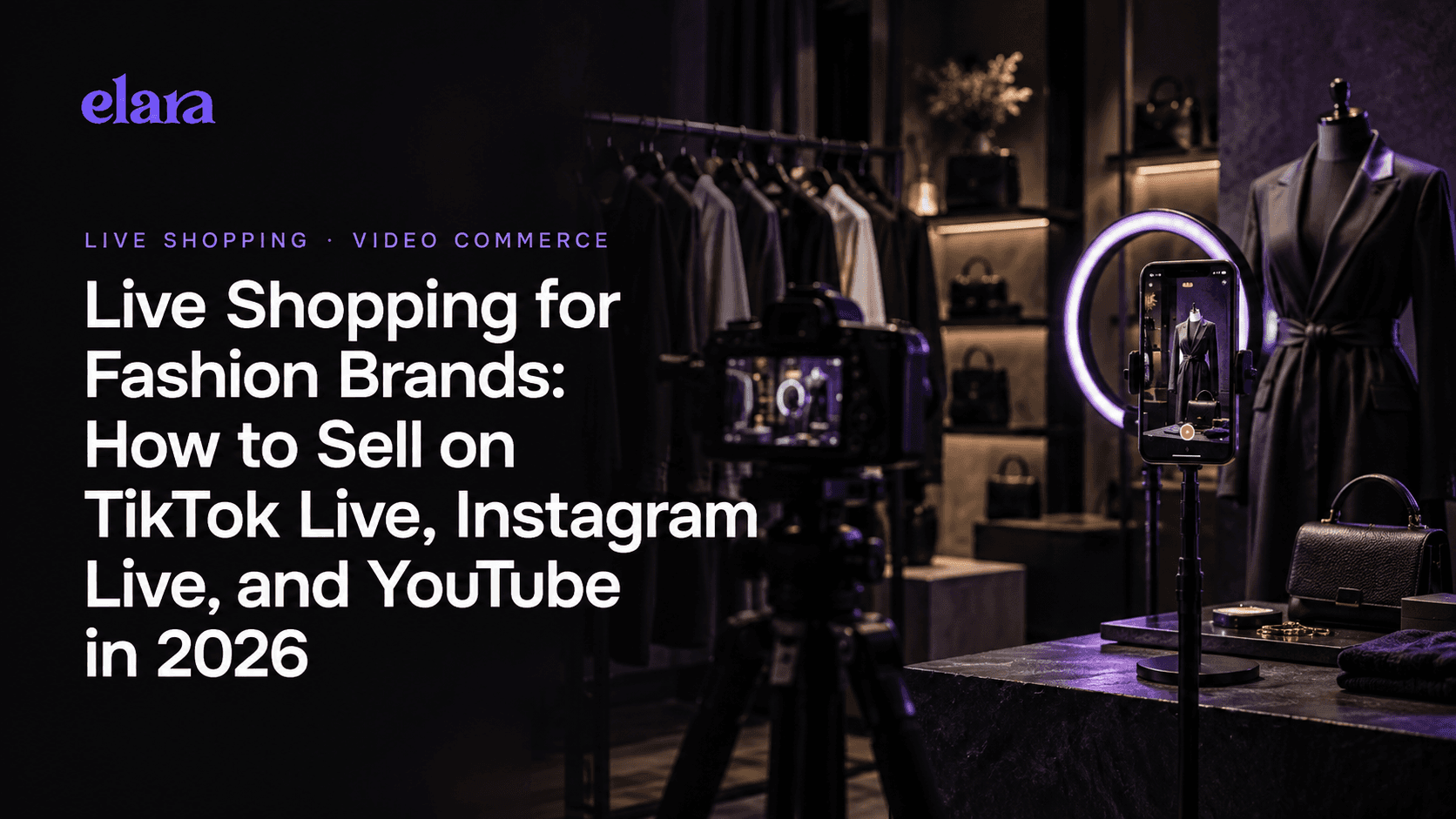
Live shopping converts at 15-20% versus 2-3% for standard ecommerce. US social commerce surpasses $100 billion in 2026. Here is how fashion brands set up live shopping on TikTok, Instagram, and YouTube and what makes fashion live sessions convert.
US tariffs are driving short-term sourcing cost increases of 35% for apparel in 2026. The de minimis exemption was suspended in February. Here is what this means for Shopify fashion brand economics and the sourcing and pricing decisions founders are making right now.
September 28, 2026
Fashion brands with physical stores converting at 23-30% and online stores converting at 2% are operating two disconnected businesses. Shopify POS unified with your online store changes both numbers. Here is how to connect them — inventory sync, unified customer profiles, and the AI styling layer that works across both.
35% of Shopify traffic comes from international visitors, and 33% of those shoppers abandon if prices show in a foreign currency. Here is the complete guide to international expansion for Shopify fashion brands — Shopify Markets, duties, sizing conventions, and AI discoverability in new markets.
Bad photos are a financial drain, contributing to 22% of returns because the item looked different in real life. Here is the complete fashion photography brief — the shots that convert, the shots that reduce returns, the technical specs, and how your catalog images affect AI styling accuracy.
The global secondhand apparel market is projected to reach $393 billion by 2030. Three in four consumers prefer sustainable products and will pay a premium for them — if the brand can prove the impact. Here is the complete operational guide to building a sustainable fashion brand on Shopify.
September 26, 2026
Most Shopify theme guides are beauty contests. This one evaluates themes on what actually moves revenue for fashion brands — mobile PDP structure, Core Web Vitals, AI integration readiness, and conversion architecture.
A personal stylist does 5 specific things. AI styling tools now do 4 of them at scale — but the fifth is where the real question lives. Here is the honest 2026 answer for fashion brands and shoppers.
Most fashion brand launch guides start with paid ads. Paid ads start a clock you cannot turn off. Here is the organic-first launch playbook for Shopify fashion brands — SEO, GEO, social, email, and the on-site conversion layer that makes organic traffic worth more.
67% of fashion shoppers read the return policy before buying. Most policies are written to protect the brand from liability. The ones that actually reduce returns are written to resolve the shopper's doubt before they buy. Here's how.
September 17, 2026
Everything you need to launch a Shopify fashion store that actually sells — from catalog setup and photography to your first traffic and the conversion layer most new stores skip entirely.
The full marketing stack for a fashion brand in 2026 — organic social, paid, email, influencer, SEO, AI-referred discovery, and on-site conversion. What each channel does, what it costs, and in what order to build it.
The best Shopify fashion stores in 2026 don't just look better — they're structured differently. Here's what separates the stores converting at 4%+ from the ones stuck at 1.4%, with specific examples and the decisions behind each one.
Most Shopify fashion brands are recovering the wrong abandonment problem. Abandoned cart and abandoned checkout are different events, different shoppers, and require completely different fixes. Here's how to tell them apart and what actually works.
Email generates £42 for every £1 spent — the highest ROI of any marketing channel. Here's the complete email strategy for Shopify fashion brands: the 8 flows that drive 80% of revenue, how to segment a fashion list, and how AI taste data changes everything.
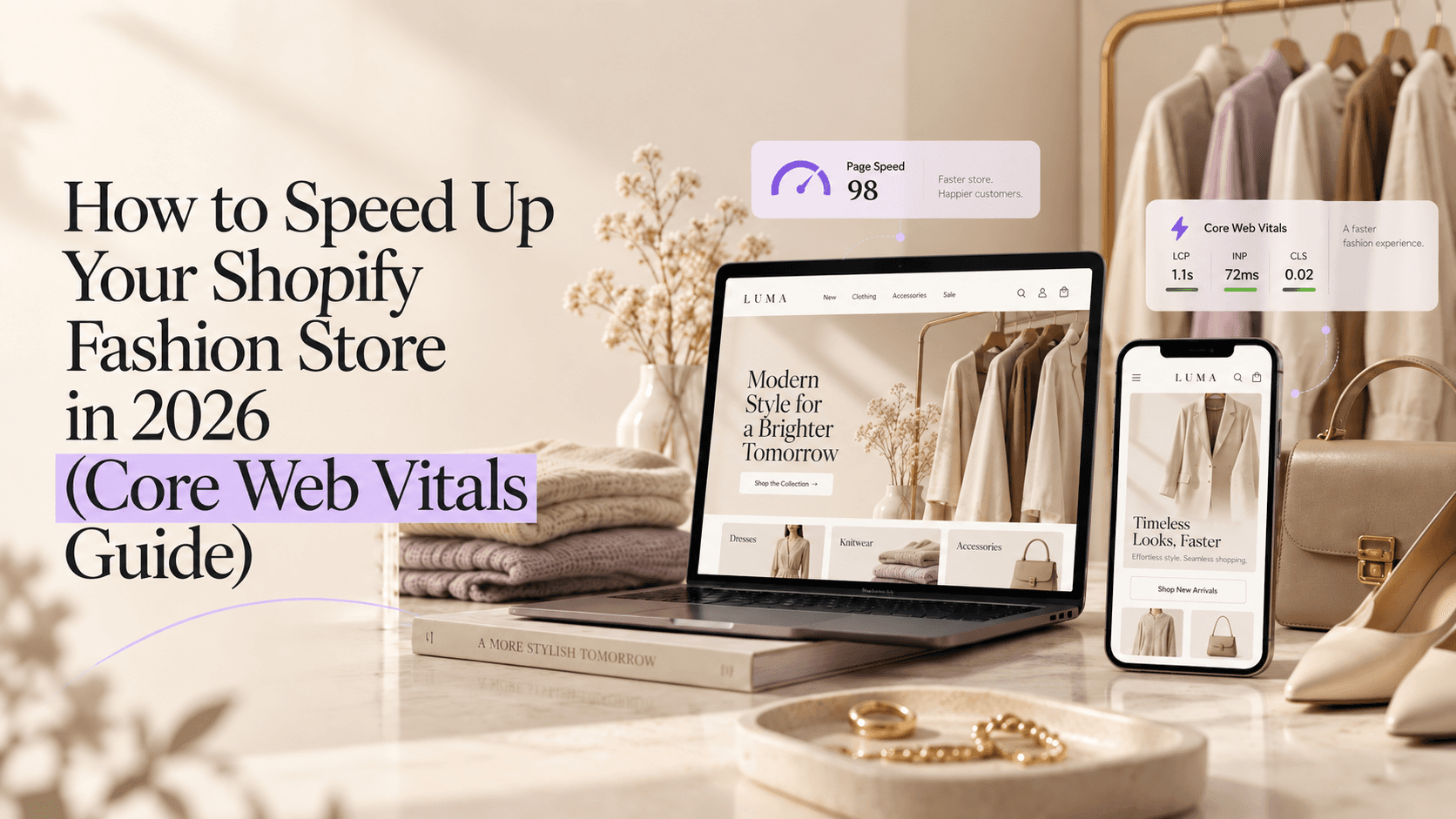
Every extra second of load time costs a fashion store 7% of conversions. Fashion stores are particularly vulnerable to speed issues because of image-heavy layouts. Here's the complete fix — no developer required for most of it.
85% of Shopify stores price using intuition, not strategy. Here's the complete pricing toolkit for fashion brands: the price floor, the four pricing approaches, markdown strategy that doesn't train customers to wait, and how AI selling data reveals pricing gaps.
Inventory days on hand hit a 14-year high in fashion. Here's the complete inventory system: the three metrics that matter, ABC analysis, in-season markdown timing, and how AI selling data reveals what to buy next season.
Social commerce is 22% of all ecommerce revenue in 2026. Here's the complete playbook for Shopify fashion brands: what converts on each platform, how to set up the integrations, and what happens when social shoppers arrive on your store.
Fashion generates more support tickets than any other ecommerce category. Here's the complete customer service system: the support ticket taxonomy, the returns experience as a retention lever, and how AI pre-purchase answers prevent tickets before they start.
September 15, 2026
Looking for the best AI stylist for your Shopify fashion store? We ranked 7 tools on outfit building, virtual try-on, taste modeling, and real conversion lift. One clear winner for fashion brands.
September 14, 2026
Fashion brands on Shopify convert at 1–3%. The gap between that and 4–5% is not about more traffic — it's about better decisions. Here's every lever that moves Shopify sales, in priority order.
The 10 most important shifts in fashion ecommerce heading into 2027 — from agentic commerce and AI-first discovery to the taste model economy and the collapse of the generic recommendation widget.
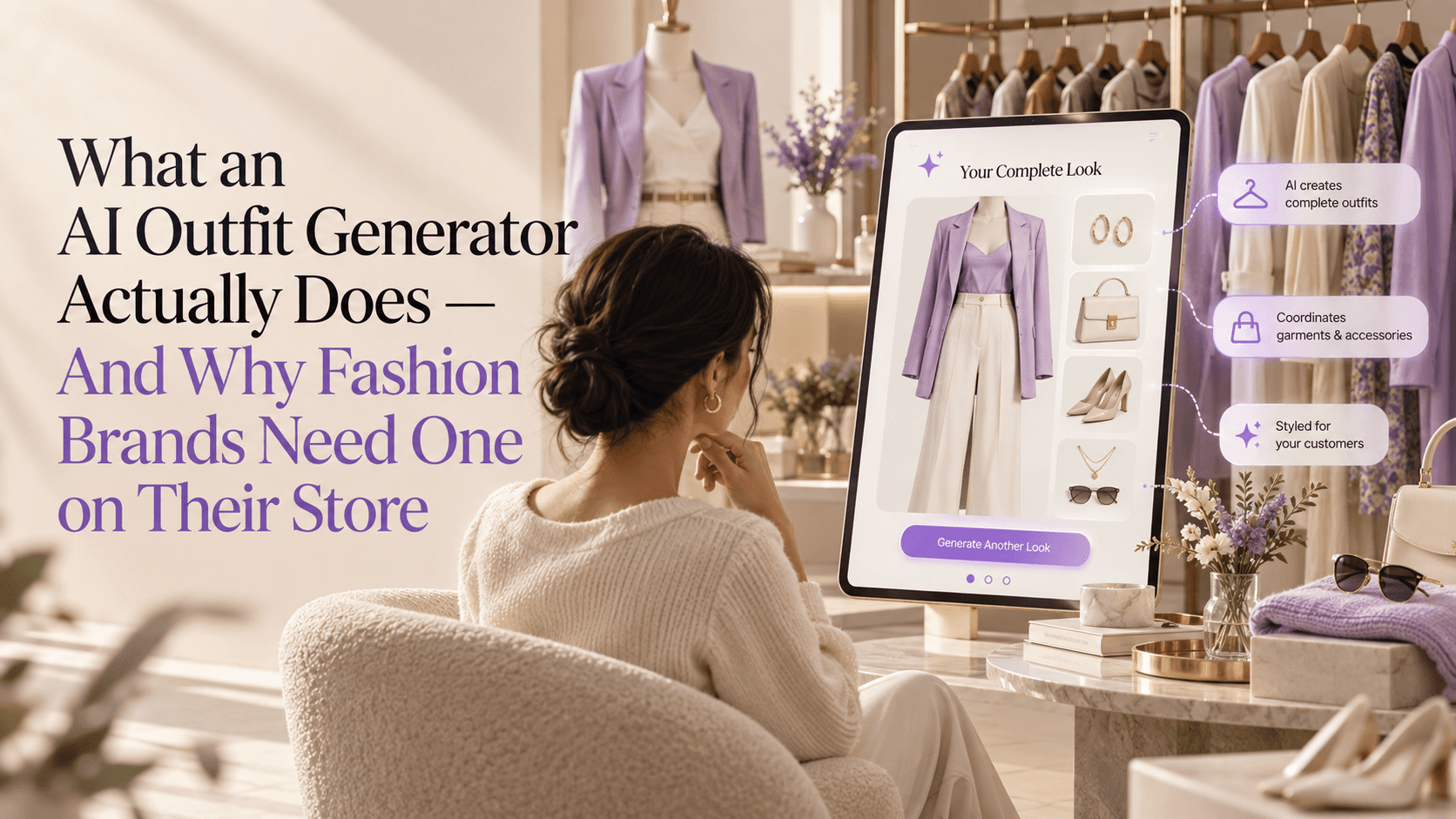
An AI outfit generator takes a shopper's brief — "something for a Diwali party" — and builds a complete look from your catalog in seconds. Here's how it works, what it does to conversion and AOV, and why it's different from a recommendation widget.
AI-referred retail traffic grew 4,700% in a year. Fashion brands appearing in ChatGPT Shopping, Google AI Mode, and Perplexity get this traffic. Here's exactly how to get recommended.
70-80% of fashion customers never buy twice. The brands that reverse this have one thing the others don't — a system that improves with every visit. Here's the complete retention playbook for Shopify fashion brands.
September 12, 2026
The storefront of 2026 isn't a better grid. It's a different conversation. Here's what AI-native product discovery actually looks like — and why the brands building it now are pulling away from the ones that aren't.
September 11, 2026
45% of AI vendor tools fail to meet the business performance their vendors promised, according to Gartner. Here's the due diligence framework — and the questions the demo will never answer.
September 10, 2026
India's festive season — Navratri through Diwali — saw 25% YoY D2C growth in 2025. Fashion was 27.73% of Navratri orders. Here's the ecommerce playbook for brands selling to Indian consumers.
68% of major retailers deploy AI styling tools, yet conversion hasn't moved. Here's why taste-model architecture and holdout measurement, not visual try-on alone, are what actually drive retention lift.
September 9, 2026
BFCM 2026 lands November 27-30. The brands that win it started in September. Here's the Q4 preparation checklist — and why AI personalization is the decision that cannot wait until October.
46% of shoppers start research on AI platforms, but 86% verify before buying. Here's the trust gap data, the signals that actually convert, and why fashion needs taste modeling, not just price and reviews.
September 2026
Most Shopify catalogs are built for navigation, not AI. Here's the metadata framework, occasion tags, style attributes, complete-look data, fit notes, that gives an AI shopping assistant enough to build great recommendations.
Fashion has always been a conversation. Online, that conversation disappeared. Here's what conversational commerce is, the three levels of implementation, and the data behind 3-4x conversion lift.
Fashion shoppers don't think in SKUs. They think in occasions. Here's why that gap between shopping intent and store architecture is where most fashion ecommerce conversions are actually lost.
Most VTO tools reduce return uncertainty, not returns. Here's the difference between the three implementation types, and why VTO embedded in a conversational buying flow outperforms a standalone product-page widget.
Most AI shopping assistant lift numbers are attributed, not incremental. Here's how to run a proper holdout test, the questions to ask any vendor, and what good numbers actually look like.
We reviewed Elara, Alhena, Rep AI, Octane AI, Rebuy, Tidio, AskTimmy, and Shopify Inbox — features, real pricing, honest limitations, and who each tool is actually built for.
September 8, 2026
The fashion industry produces 30-40% more inventory than it sells. AI outfit curation surfaces dead SKUs by placing them in complete looks alongside bestsellers — a merchandising strategy no team can execute at catalog scale.
Live sales conversations convert at 15-20% versus 2.35% online. Here's why offline retail's salesperson and stylist roles are missing from most stores, and the math on what fixing that is worth.
September 7, 2026
Keyword search fails fashion shoppers because it demands product language for a human need. Here's how intent-based interactions close that gap, and why it also cuts returns.
September 6, 2026
Top-performing stores convert at 4.5-6%+ while the industry average sits at 2-3%. Here's how to benchmark correctly, fix checkout friction, and close the upstream personalization gap.
Shoppers who use site search convert at up to 3x the rate of those who don't, yet 10-15% of Shopify queries return zero results. Here's why native search breaks down, and what fixes it.
Unexpected costs drive up to 48% of cart abandonment, but fashion stores carry a second layer generic advice never addresses: taste and styling uncertainty. Here's the fix, in priority order.
WISMO tickets are 35-60% of inbound support volume. Here's the three-lever playbook to cut them by 40-70%, and what to do with the support capacity you recover.
Personalization no longer requires developers or a data science team. Here's the sequenced, no-code path: clean metadata first, native tools second, one app third, measured before you scale.
Sessions and pageviews tell you what happened. These five sequential metrics, run in order, tell you exactly where in your funnel revenue is leaking.
Generic comparisons miss the fashion-specific split: transactional tickets that automate well, and experiential ones (fit, styling, occasion) that don't. Here's the decision framework built for that split.
Generic Shopify recommendations can create a $14,000-$47,000 annual revenue gap. Here are the three failure modes behind it, and the architecture that actually closes it.
A store stuck at 1.5% is below the industry floor, not just below best-in-class. Here's the four-stage friction framework and sequenced playbook to reach 3%.
Commercial keywords belong on collection pages, informational keywords belong on the blog. Here's the intent-mapping framework, content hub architecture, and seasonal strategy that turns search visibility into revenue.
Best-selling fashion stores architect product pages as guided decisions, not static displays. Here are the five specific behaviors, from imagery sequencing to complete-look architecture, that make the difference.
Only 11% of domains appear in both ChatGPT and Perplexity. Here's the sequenced 90-day roadmap, structured data, third-party credibility, crawlability, buyer-intent copy, that gets a Shopify store recommended by AI.
"What should I wear?" is a retail conversion problem, not a personal one. Here's the five-question context framework stylists already use, and how to operationalize it at catalog scale.
Agent usage peaks at 62% during product comparison, then collapses to 23% at checkout. Here's the four-pillar agent-readiness checklist for fashion stores before the 2026 holiday season.
AI-referred shoppers converted 38% worse than average in March 2025. A year later they converted 42% better. Here's what changed, and the three levers that capture this traffic.
96.55% of indexed pages earn zero organic traffic, and variant pages are a primary driver. Here's why fashion stores are exposed more than any other vertical, and the four-step consolidation fix.
Rebuy, LimeSpot, Octane AI, Molin AI, and Elara compared on the dimensions that actually determine fashion-store fit: recommendation philosophy, taste model vs. metadata, and discovery modality.
September 5, 2026
The AI shopping assistant market is projected to grow from $4.33B in 2025 to $46.76B by 2035. Here's the data behind that number, and why 41% of shoppers still don't trust these tools.
Fashion stores using complete-the-look logic report 15-25% AOV increases. Here's why shop-the-look is a measurable revenue lever, where to place it for maximum return, and how to prove the lift with holdout data.
September 4, 2026
46% of shoppers start purchase research on AI platforms, but only 10% complete purchases there. Here's why that gap exists — and the missing decision layer fashion brands need to close it.
September 3, 2026
42-66% of consumers use AI shopping assistants, but only 10% use fashion-specific tools. Here's why generic assistants fail fashion shoppers, and what a taste-driven one does differently.
Virtual try-on plugins, enterprise merchandising platforms, and conversational styling agents all get called "AI stylist." Here's what each one actually does, and how to pick the right one for your store.
Shopify made agentic commerce the platform baseline. Most brands are retrofitting backend infrastructure. The layer that actually decides whether a fashion shopper buys is the one nobody is closing: taste-driven styling.
September 1, 2026
Elara's new AI Stylist for Commerce platform inserts a conversational styling assistant directly into fashion websites, turning vague shopper intentions into complete, buyable outfits.
September 2, 2026
Shopify generated $378.4B in GMV in 2025, yet the average store converts just 1.4% of visitors. Here are the three conversion gaps behind that number — and how to fix them.
AI-referred orders on Shopify grew 15x year-over-year while traffic grew 8x. Here's how AI discovery differs from traditional search, and the personalization gap fashion brands are missing.
August 29, 2026
Most fashion product descriptions answer the wrong question. Here's how to write descriptions that convert shoppers and get found by AI assistants — two jobs that now require the same approach.
Most fashion brands are tracking the wrong metrics, or reading the right ones without the segmentation that makes them actionable. Here's the dashboard that actually tells you what is happening in your store.
Hundreds of Shopify apps claim to use AI. Most use the word loosely. Here's how to distinguish between five categories of AI tools, what each one actually does, and how to evaluate any of them before committing budget.
Customer acquisition cost keeps rising. The answer isn't finding cheaper traffic, it's converting more of what you already pay for. Here's how AI styling reduces CAC through conversion, AI-referred traffic, and retention simultaneously.
Physical retail converts at 23 to 30%. Online fashion converts at 1 to 2%. The gap is not about convenience or fabric-touching, it is about the presence of someone who helps you decide. AI styling is the first technology to replicate that at scale.
August 25, 2026
Discounting isn’t the only way to raise average order value. Here’s how AI-assisted styling builds complete looks — and lifts AOV — without giving away margin.
Most fashion “personalization” is basic behavioral targeting. Here’s what real personalization means, what the data shows, and how to implement it without a data science team.
Fashion cart abandonment averages 70%. Discount codes and reminder emails don’t fix the real cause — shopper uncertainty. Here’s what actually reduces abandonment.
Fashion returns cost far more than the shipping label. Here’s what returns actually cost fashion brands — and how AI styling and virtual try-on are reducing them upstream.
Third-party cookies are gone, and fashion brands built on that data need a new foundation. Here’s why first-party taste data — and AI styling — is the replacement.
Generative Engine Optimization (GEO) determines whether your fashion brand shows up when shoppers ask AI what to buy. Here’s how it works and what to build first.
August 24, 2026
India’s fashion e-commerce market is shifting to AI-driven discovery. Here’s how Indian fashion brands can build a first-mover advantage before global players catch up.
Everything fashion brands need to know about AI shopping assistants: how they work, what results to expect, how to evaluate vendors, and when to deploy one.
Shopify’s built-in search and recommendations are great at browsing but can’t help shoppers decide. Here’s why that gap is costing fashion brands sales — and what closes it.
Agentic commerce — AI agents researching, recommending, and buying on shoppers’ behalf — is reshaping fashion e-commerce. Here’s what fashion brands need to know before 2027.
Fashion ecommerce still often converts around 1–2%. Here’s why shoppers hesitate, what conversion benchmarks actually mean, and what fashion brands can do to improve them.
India’s ecommerce market is moving toward conversational and agentic shopping. Here’s how Indian fashion brands can build an AI-commerce advantage now.
A Style Graph is a persistent model of a shopper’s taste, wardrobe and context. Here’s how it differs from recommendations, embeddings and ordinary customer profiles.
Fashion AI is moving from copilots to embedded intelligence to autonomous agents. Learn which stage your brand is in and what to build next.
August 23, 2026
Fashion e-commerce has converted at 1–2% for twenty years. Here's why every fix has missed the point — and what AI styling does differently.
Most brands evaluate AI personalization the wrong way. Here's the actual calculation — conversion lift, AOV effect, return rate reduction, and payback period.
Most brands think they have personalization. Most have a recommendation widget. Here's why those are not the same thing — and why the difference matters for conversion.
AI-referred traffic went from your worst-converting channel to your best in twelve months. Here's why that shift already happened, and what it means if your store hasn't adapted yet.
For Shopify fashion brands ready to stop losing customers to indecision
August 2026
Why related-product rails miss shopper intent—and how outfit-led styling creates stronger reasons to buy.
How fashion brands turn catalog data, compatibility, and shopper intent into complete, shoppable looks.