Most fashion brands have a recommendation widget. Most fashion brands also think they have personalization. These are not the same thing, and the gap between them is where most of the conversion opportunity in fashion e-commerce sits right now.
The distinction matters more than most brands realize — because the ROI of a recommendation widget and the ROI of an AI shopping assistant are not in the same category. They solve different problems, operate through different mechanisms, and produce results that are not comparable.
Here is the actual difference.
What a recommendation widget does
A product recommendation widget surfaces products. That is its job and it does it well. Based on what a shopper is viewing, what other shoppers with similar behavior have bought, or what is trending in your catalog right now, it shows the shopper additional products they might be interested in.
The best recommendation engines — Nosto, Klevu, Searchspring — do this with genuine sophistication. They process large amounts of behavioral data, build segment-level profiles, and surface products with a high probability of being relevant. For brands that have deployed them properly, they drive meaningful revenue. Marc Jacobs implemented an AI personalization engine that resulted in 137% higher average revenue per session, with 9% of online GMV coming directly from AI-powered recommendations.
But there is a ceiling to what a recommendation widget can do, and it comes from the fundamental nature of what it is: a product-surfacing tool.
A recommendation widget assumes the shopper knows what they want. It says: “You are looking at this dress. Here are six more dresses you might like.” It does not ask what the shopper actually needs. It does not understand that they need something for a specific occasion. It does not know what they already own. It does not build a complete look. It does not help the shopper decide — it gives them more options to scroll through.
For the shopper who is already committed to buying and just needs to find the right product, this works. For the shopper who is uncertain — the 98% who leave without buying — it does not.
What an AI shopping assistant does
An AI shopping assistant is not a product-surfacing tool. It is a decision-making tool.
The difference starts at the input. A recommendation widget takes implicit behavioral signals — what you are viewing, clicking, and hovering over — and uses them to infer interest. An AI shopping assistant takes explicit natural language input: what the shopper tells it they actually need.
“I have a rooftop dinner Saturday. I already have black trousers.” That is a complete styling brief. A recommendation widget cannot process it. An AI shopping assistant can take it, understand the occasion, the constraint, and the existing wardrobe item, and build a complete look from your catalog — top, shoes, accessories — with a rationale for each piece.
The mechanism is fundamentally different:
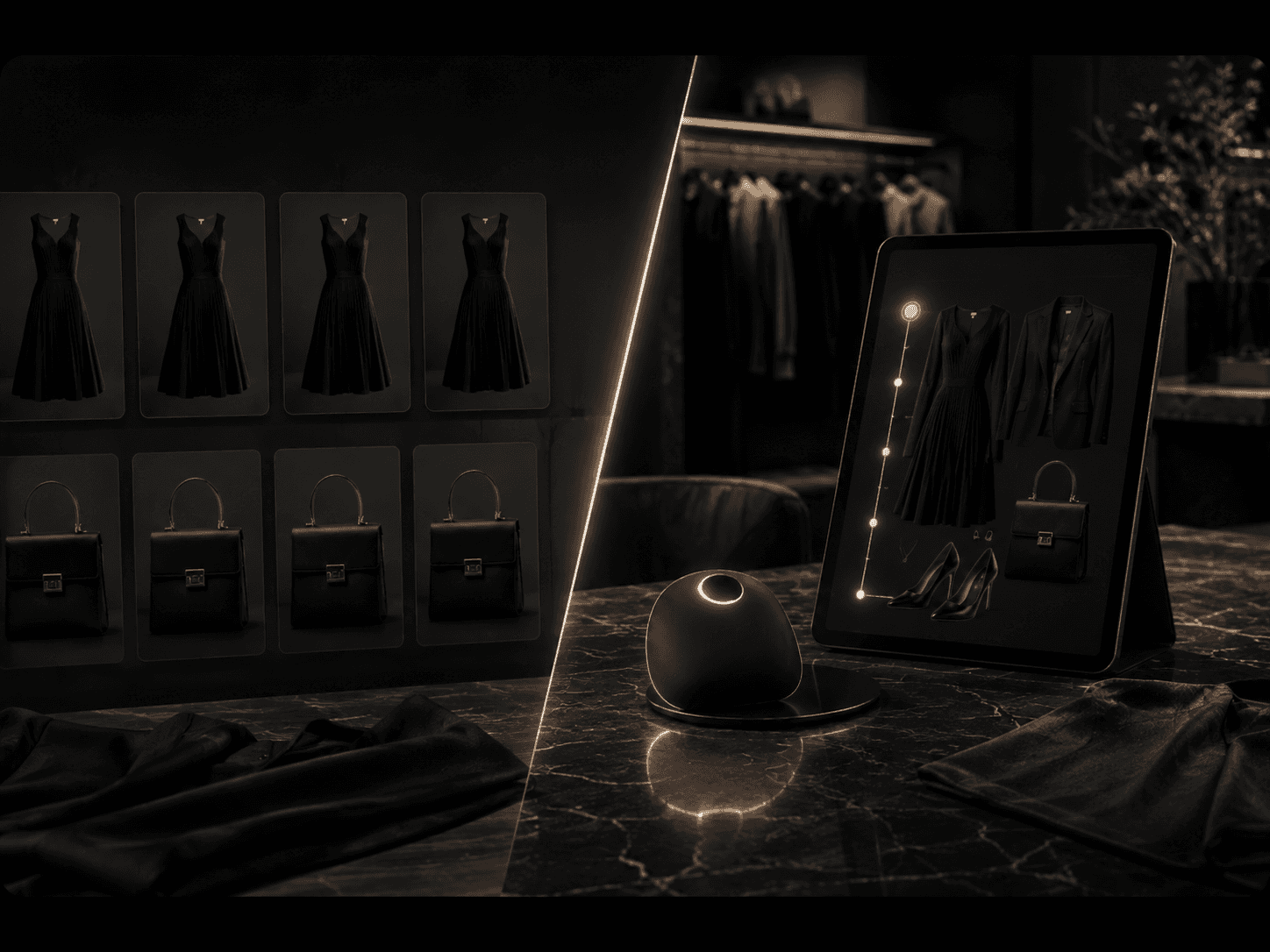
Recommendation widget: Product A → (based on behavioral similarity) → Products B, C, D, E, F
AI shopping assistant: Occasion + context + existing wardrobe → Complete look + rationale → Confident purchase decision
The output is different too. A recommendation carousel gives the shopper more to look at. An AI shopping assistant gives the shopper an answer.
Where they overlap — and where they diverge
Product discovery: Both surface products a shopper might not have found through direct search. The AI assistant wins here because it can surface products across multiple categories in a single recommendation (dress + shoes + bag as a complete look), while a recommendation widget typically operates within a single category at a time.
Personalization: Both personalize to some degree. The critical difference is the level. Recommendation widgets personalize at the segment level — they infer that you are similar to other shoppers who behaved like you and show you what those shoppers liked. AI assistants personalize at the individual level — they know this specific shopper’s taste profile, wardrobe, and stated preferences, and respond to that individual.
This distinction is not semantic. Segment-level personalization is approximation. Individual-level personalization is knowledge. The output quality is different in kind, not just degree.
Retention: This is where the gap is most dramatic. A recommendation widget has no memory. Every session starts from scratch — the shopper is re-inferred from their current behavior. An AI shopping assistant with a persistent taste model remembers everything: what the shopper has tried, liked, skipped, and bought. Returning shoppers get recommendations that are sharper on every visit because the system knows them.
This is why Daydream found that shoppers who completed a style profile had 300 times higher retention than those who did not. The compounding taste profile is not a feature — it is the moat.
The conversion numbers
The conversion difference between the two approaches is not marginal.
Shoppers who engaged with an AI shopping assistant converted at 12.3%, compared to 3.1% for those who did not — nearly 4x higher. The best recommendation engines lift conversion by 10–30% for shoppers who engage with them.
These numbers are not comparable because they are solving different problems. The recommendation widget lifts conversion for shoppers who were already going to buy — it helps them find the right product faster. The AI shopping assistant lifts conversion for shoppers who were not going to buy — it gives them the help they needed to make a decision.
The addressable opportunity is different in scale. The 2–3% of shoppers who were already going to convert are a relatively small group, and helping them find the right product faster produces incremental gains. The 98% who were leaving without buying represent an order-of-magnitude larger opportunity, and reducing that rate — even slightly — produces results that dwarf what recommendation optimization can achieve.
When to use which
The honest answer is that the two tools are not mutually exclusive. A recommendation widget operates primarily within the purchase funnel — it helps shoppers who are already in a buying mindset find the right product. An AI shopping assistant operates before that — it gets shoppers into a buying mindset in the first place.
Use a recommendation widget for: cross-selling on the cart page, “complete the look” modules on product pages, email personalization for post-purchase flows, homepage merchandising for returning visitors with purchase history.
Use an AI shopping assistant for: the primary shopping experience — converting visitors who arrived with a need but no clear product in mind. This is the majority of your traffic and the majority of your unconverted revenue.
The highest-performing stores will eventually use both. But if you are choosing where to start, the math favors the AI shopping assistant by a significant margin — because the problem it solves is larger, and the conversion gap it addresses has been sitting unaddressed for twenty years.
What to look for in an AI shopping assistant
Catalog depth. Can the assistant understand your entire catalog — product attributes, occasions, styling relationships between pieces — or is it working from a shallow product feed? The quality of the recommendations is directly proportional to how deeply the system understands your catalog.
Taste persistence. Does the system build a profile on each shopper that compounds over time, or does it reset every session? The assistants that reset are dramatically less valuable for retention — and retention is where the long-term ROI lives.
Virtual try-on integration. A shopper who can see a piece on themselves before buying is significantly more likely to purchase and less likely to return. An AI assistant that can show virtual try-on inside the conversation — without redirecting to a separate tool — reduces friction at exactly the moment it matters most.
Holdout-based measurement. Any system can claim to have driven conversion. The only way to know the real increment is a holdout study — a control group of shoppers who don’t see the assistant, compared against those who do. If a vendor cannot show you holdout-based lift data, treat their conversion claims with skepticism.
The bottom line
A recommendation widget is a better version of what you already have. An AI shopping assistant is a fundamentally different thing — a system that was not possible five years ago and that addresses a problem the industry has not been able to solve in twenty years.
If your store converts at 2% and you want to convert at 2.2%, optimize your recommendation widget. If you want to understand why 98% of your shoppers leave and do something structural about it, you need an AI shopping assistant.
The tools are different. The problems they solve are different. The returns are different by an order of magnitude.
Elara is an AI stylist that lives on your Shopify store — not a recommendation widget. Shoppers describe what they need, Elara builds the look from your catalog, applies virtual try-on inside the chat, and builds a taste profile that compounds with every visit. Setup takes under an hour. The first holdout-based lift report is ready in 14 days.
Sources: Rep AI 2025 Ecommerce Shopper Behavior Report; Nosto, Marc Jacobs Case Study; Bloomberg, Macy’s Gemini AI chatbot users spend ~400% more, March 2026; BigCommerce AI Shopping Survey 2026; BCG, Capturing the $2 Trillion Personalization Opportunity with AI, 2024.