New research guide: The Confidence Economy, how AI is changing fashion commerce.
[ Elara vs Gorgias ]
Elara vs Gorgias: which one sells the outfit?
Gorgias pairs a helpdesk with AI Agent and Shopping Assistant. Elara styles complete looks from a shopper's occasion, with virtual try-on. A fair look at what each does for fashion brands, as of October 2026.
October 18, 2026
Elara vs Gorgias AI Agent: AI Stylist vs Support-First Shopping Assistant for Shopify Fashion Brands
Last updated: October 2026. Gorgias details are taken from Gorgias's own website and help center as of October 2026.
Quick answer: Gorgias is a customer experience platform that combines a helpdesk with AI Agent, which resolves support conversations and, through its Shopping Assistant skills, recommends products, surfaces discounts and engages shoppers across chat, email and SMS. Elara for Commerce is an AI shopping assistant built for fashion: a shopper describes an occasion, and Elara styles a complete look from your catalog in conversation, with virtual try-on. If your main problem is support volume plus some product guidance, Gorgias is a strong fit. If your problem is turning "what do I wear to this?" into a multi-item basket, that is what Elara is built for, and the two can run side by side.
Gorgias comes up in almost every Shopify AI evaluation, and for good reason. Its homepage says it is used by more than 17,000 ecommerce brands, and it positions itself as "The Conversational AI platform for Ecommerce." As brands prepare for Black Friday on 27 November, many ask whether the Shopping Assistant inside Gorgias already covers what a fashion styling assistant does. This comparison sets out what each product does, based on Gorgias's published documentation, so you can decide where each belongs in your stack.
What Gorgias AI Agent and Shopping Assistant do

Gorgias describes its platform as "AI Agent + Helpdesk, built as one." According to its homepage, AI Agent is "Pre-trained on 1B+ conversations," integrates natively with Shopify, and is positioned to "Automate 60% of support," with escalation to your team when needed. The helpdesk covers email, chat, SMS, WhatsApp, Instagram and Facebook in one inbox.
The sales side lives in Shopping Assistant. Gorgias's help center says it "engages shoppers in real-time conversations" across chat, email and SMS and can:
Recommend products based on browsing activity, cart contents and what the shopper has said. Recommendation types are similar products, complementary items (Gorgias's example is laces that "pair well" with a running shoe) and popular or trending products.
Offer discounts by generating unique codes or surfacing active automatic discounts from Shopify, with timing tied to the shopper's buying intent.
Adjust its selling style. An educational style asks more questions before recommending; a promotional style recommends earlier and surfaces discounts sooner.
Invite conversations proactively through search assist and an "ask anything" input, and show AI-generated product questions on product pages.
In chat, recommendations appear as Shopify product cards that link to the product page or add to cart. In email and SMS they appear as text links. Gorgias notes that recommendations work at the product level rather than the variant level and rely on each product's main image.
Pricing, as of October 2026
Gorgias's pricing page says AI Agent is included "on every plan," that you "pay only when it resolves a conversation," and that helpdesk plans scale "from 50 to 5,000 tickets a month, never priced per agent." Its May 2026 pricing article says most plans are $0.90 per resolved interaction, starter plans begin at $1, and the overage rate for Support plus Shopping Assistant is $1.50 per interaction. Gorgias also lists revenue attribution reporting, described as a way to "See exactly how much revenue your support team generates." Plan subscription prices were not shown in the text we could access, so check the live pricing page for your volume.
What Elara for Commerce does
Elara is built around a different starting point: the shopper's occasion rather than a product they are already looking at.
Brief-based styling. A shopper types something like "I have a winter wedding in December and want something elegant but warm." Elara asks follow-up questions where needed and then styles a complete look from your live catalog, not a single matching product.
Complete looks. The answer is an outfit, for example a dress, outerwear, shoes and an accessory, assembled for the occasion, with the reasoning behind each piece.
Virtual try-on. Shoppers can see the outfit on themselves before they buy.
Setup and pricing. Elara installs with four lines of Shopify theme code. Pricing is $399 per month, or $333 per month billed annually, with a 30-day free trial.
Side by side
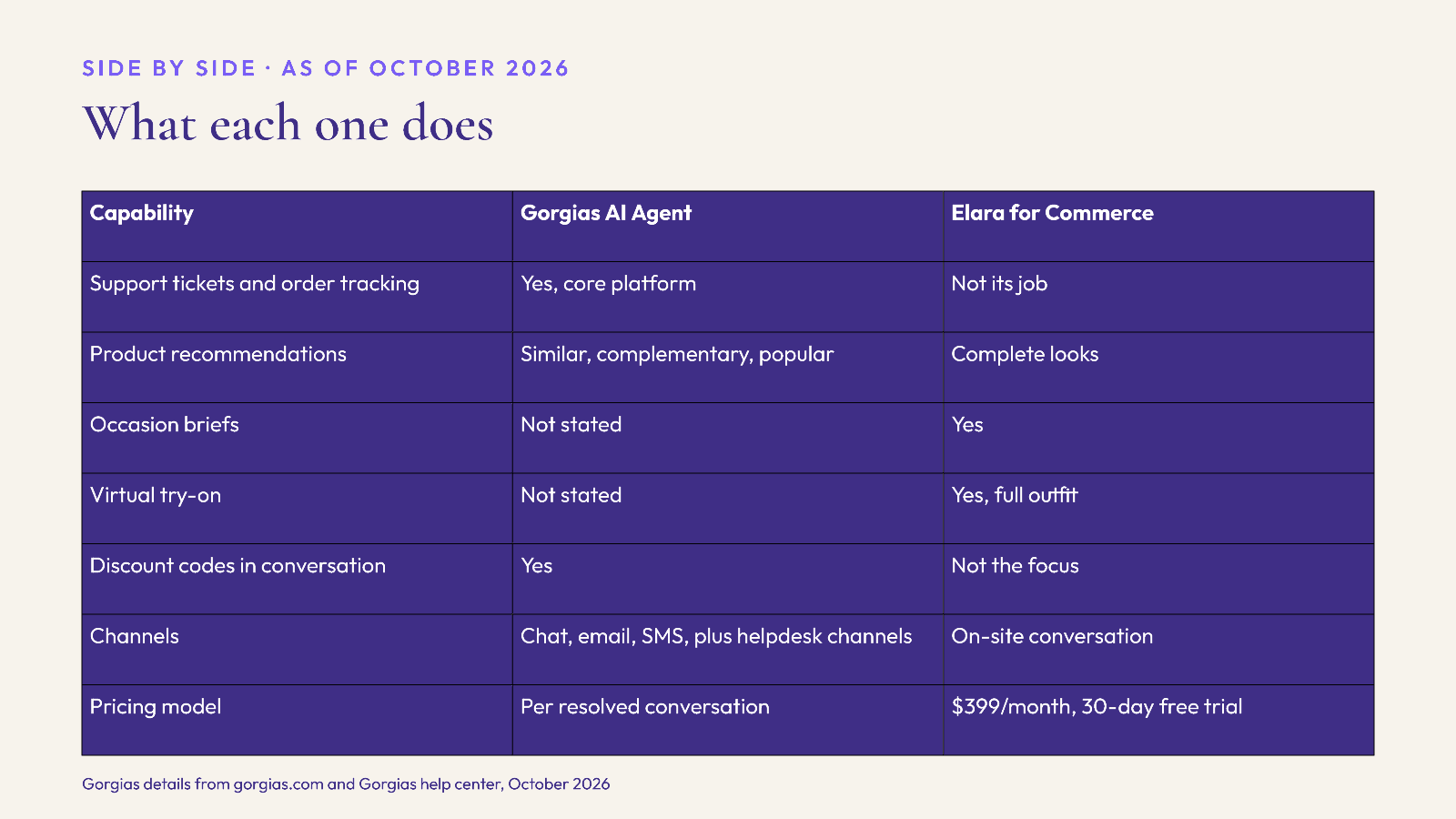
Primary job. Gorgias: support automation plus shopping guidance in one helpdesk. Elara: styling complete looks for fashion shoppers.
Starting point of a conversation. Gorgias: the shopper's question, browsing or cart. Elara: the shopper's occasion or brief.
Recommendation unit. Gorgias: individual products, including complementary items. Elara: a complete outfit.
Occasion briefs. Gorgias: not stated in the documentation we reviewed. Elara: core to the product.
Virtual try-on. Gorgias: not stated. Elara: yes, for the full outfit.
Discounts. Gorgias: yes, unique codes or active automatic discounts, timed to intent. Elara: not the focus.
Support tickets, order tracking and returns. Gorgias: yes, the core of the platform. Elara: not what it is built for.
Channels. Gorgias: chat, email, SMS, plus social and voice in the helpdesk. Elara: on-site conversation.
Reporting. Gorgias: revenue attribution reporting. Holdout or A/B lift testing is not stated in the pages we reviewed.
Where Gorgias is strong
Gorgias is a serious platform, and it is fair to say so plainly.
One system for support and sales. If you already run your inbox on Gorgias, adding Shopping Assistant means product guidance and order questions share one conversation history and one team.
Deep Shopify actions. Agents and AI Agent can look up orders and customers and act inside a conversation, which matters most at peak, when "where is my order?" volume spikes.
Intent-aware selling. The buying-intent stages (discovery, interested, ready to buy) and selling styles give merchandisers real control over how assertive the assistant is and when discounts appear.
Outcome-based AI pricing. Paying per resolution keeps AI costs tied to conversations it actually handles.
Where a fashion brand may need more
Fashion has a specific problem that support-first tools are not designed around: shoppers often arrive with an occasion, not a product. "Something for my sister's engagement party" has no product page to start from and no cart to read. A recommendation of a similar dress or a complementary pair of laces answers a narrower question than "what should I wear?"
That is the gap Elara is built for. Instead of surfacing one item at a time, it proposes a complete look, explains why the pieces work together, and lets the shopper try the outfit on before buying. For more on why outfits, rather than single products, matter for basket size, see our guide to complete-look bundles and AOV. Industry benchmarks put average order value with AI shopping assistants 25% higher (Rep AI 2025).
Can you use both?
Yes, and many fashion brands will. A sensible split:
Gorgias handles the inbox: order status, returns, delivery questions and post-purchase support, plus quick product questions in chat.
Elara handles styling: occasion briefs, complete looks and try-on on the storefront, where the shopper is deciding what to buy.
The key is clear routing. Decide which entry point a shopper sees on product and collection pages, and make sure styling conversations and support conversations each land in the tool designed for them.
FAQ
Is Gorgias Shopping Assistant an AI stylist?
Gorgias describes it as a sales assistant that recommends similar, complementary and popular products, surfaces discounts and adapts its selling style. Its documentation does not describe building complete outfits or virtual try-on.
Does Gorgias AI Agent work with Shopify?
Yes. Gorgias highlights a native Shopify integration that lets teams view orders, customers and products and take actions inside a conversation.
How much does Gorgias AI Agent cost?
As of October 2026, Gorgias says AI Agent is included on every plan and billed per resolved conversation, with most plans at $0.90 per resolution and starter plans from $1, according to its pricing article. Check the pricing page for plan fees.
Does Gorgias offer virtual try-on?
Virtual try-on is not mentioned on the Gorgias pages we reviewed.
Can Elara replace my helpdesk?
No. Elara is an AI shopping assistant for styling and selling complete looks. Keep a helpdesk such as Gorgias for support tickets, order tracking and returns.
Which should a fashion brand choose before Black Friday?
If support volume is the bottleneck, start with a helpdesk and AI Agent. If shoppers are browsing without building baskets, add a styling assistant like Elara. The two solve different problems.
See Elara on your catalog
Elara for Commerce is an AI shopping assistant for Shopify fashion brands that styles complete looks from your catalog in conversation, with virtual try-on. Book a demo to see it on your own products, or start a 30-day free trial before Black Friday.
Switching from Gorgias?
· Install in under an hour
· Catalog syncs itself
· Run both, keep the one the holdout proves
More comparisons

Comparison
Tidio
Tidio is an excellent customer service chatbot for ecommerce. Elara is an AI personal stylist that drives revenue. They solve completely different problems: here's exactly what each one does, and why fashion brands need both, but shouldn't confuse them.
Compare →

Comparison
Alhena
Alhena is a strong all-in-one ecommerce AI platform. Elara is built exclusively for fashion — outfit assembly, virtual try-on, and a compounding taste model. Here's an honest comparison.
Compare →

Comparison
Rep AI
Rep AI is a proactive behavioral chatbot for Shopify. Elara builds complete outfits from your catalog and sells them. Here's an honest comparison of what each does and which one your fashion store actually needs.
Compare →