New research guide: The Confidence Economy, how AI is changing fashion commerce.
Playbooks
·
September 5, 2026
Complete-Look Bundles: +25% AOV for Fashion
Fashion stores using complete-the-look logic report 15-25% AOV increases. Here's why shop-the-look is a measurable revenue lever, where to place it for maximum return, and how to prove the lift with holdout data.
Mehul Agarwal, Founder & CEO

Key Takeaways
Fashion stores using complete-the-look logic report 15–25% AOV increases — making "shop the look" a revenue mechanism, not a UX feature (easyappsecom.com).
AI taste modeling trained on real human styling decisions outperforms product metadata carousels that surface "more blue dresses to people who bought blue dresses."
79% of Shopify traffic is mobile (Shopify, 2026) — complete-look blocks must be swipeable and thumb-friendly to convert.
Highest-ROI placements: product page, cart, homepage — each serving a distinct conversion role.
Elara provides holdout-tested data showing your actual lift, giving store owners rigorous numbers for internal budget reviews.
Introduction: The $957 Billion Opportunity Fashion Stores Are Leaving on the Table
Fashion ecommerce is projected to reach $957.31 billion in 2026, according to the Shopify Enterprise Blog — and most Shopify stores are positioned to capture almost none of the upside their traffic represents. The paradox is structural: shoppers arrive thinking in outfits, occasions, and complete looks, but the average fashion store greets them with a product grid and a search bar. High abandonment rates persist despite record ad spend.
The fix isn't another retargeting campaign. It's resolving the mismatch between how shoppers think and how stores present products. "Shop the look" recommendations are the mechanism — but not as a discovery or content feature. In 2026, when AI-driven taste modeling is available to any Shopify merchant, "shop the look" is a measurable AOV and revenue lever with documented lift data behind it.
This article covers four things: why "shop the look" drives AOV structurally, where to place shop the look recommendations in Shopify for maximum return, how AI taste modeling differs from the generic carousels most stores already have, and how to measure real lift — the kind of data that survives a budget review.
Why 'Shop the Look' Is an AOV Lever, Not a Discovery Feature
Fashion-focused upsell tools that use complete-the-look logic report an estimated 15–25% AOV increase for fashion stores, according to easyappsecom.com — and the mechanism is straightforward. When a shopper buys an outfit instead of a single item, average order value rises structurally. No discounting required. No loyalty program overhead. The unit economics improve because the basket size grows.
That 15–25% figure sits within a broader range of what well-implemented recommendation systems can achieve. According to data from Boost Commerce, product recommendations can increase revenue by up to 300%, improve conversions by 150%, and raise AOV by 50% for stores that deploy them effectively. The ceiling is high. The gap between stores that hit it and stores that don't comes down to implementation quality — specifically, whether the recommendation logic reflects how people actually style outfits or just how a product catalog is tagged.
The behavioral root cause matters here. Shoppers rarely arrive on a fashion site knowing exactly which SKU they want. They arrive with an occasion: a wedding, a job interview, a weekend trip. Traditional product grids force those shoppers to become their own stylists — to browse, self-select, and mentally assemble an outfit from disconnected product pages. Most don't. They leave. "Shop the look" resolves this structural mismatch by doing the styling work for them, presenting a complete look anchored to the product they're already considering.
This isn't a niche tactic. Shopify's 2026 fashion outlook explicitly identifies personalized customer journeys and AI-driven discovery as top-tier investment priorities for fashion merchants — not experimental features to pilot cautiously, but core infrastructure for stores that intend to compete. Stores that treat shop the look recommendations in Shopify as a conversion tool — with placement strategy, measurement rigor, and real styling intelligence behind it — are the ones generating measurable lift. Stores that treat it as a content widget are leaving the AOV gain on the table.
The Gap Competitors Miss: Taste Modeling vs. Product Metadata
That distinction between treating shop the look recommendations in Shopify as a conversion tool versus a content widget comes down to what's running underneath the module. Most carousels on Shopify stores today are powered by product metadata — category tags, color attributes, co-purchase frequency — and that creates a fundamental failure mode: they show more blue dresses to people who bought blue dresses. That's not styling. That's filtering with extra steps.
According to easyappsecom.com's 2026 Shopify AI statistics, 56% of Shopify AI adopters are already using product recommendations. Adoption is not the problem. Quality is. Shopify's own guidance on AI marketing warns that full workflow integration remains limited, and that the strongest near-term wins come from well-targeted, practical recommendation systems — not broad, generic AI features. In other words, most stores are running something, but most of what they're running isn't actually intelligent.
Taste modeling works differently. Instead of asking "what else is in this category?" it asks "what would a stylist pair with this, and for what occasion?" That requires training on real human styling decisions — how experienced stylists build outfits, which complementary pieces signal formality or casualness, what works across occasions — not on catalog attributes scraped from a product database.
This is what Elara's Style Graph is built on: a taste model trained on real human styling behavior, not product metadata. Elara is not a chatbot. It's not a generic recommendation carousel. It's not a keyword co-occurrence engine that surfaces "frequently bought together" items dressed up in editorial language. The intelligence is behavioral and taste-driven — which is why the recommendations feel like they came from a stylist who knows the shopper, rather than an algorithm that knows the catalog.
Where to Place 'Shop the Look' Blocks on Your Shopify Store
Placement determines performance. A well-designed "shop the look" module in the wrong location generates noise; the same module in the right location generates revenue. Each surface on a Shopify store serves a distinct conversion role, and the placement strategy should reflect that.
Product Page. This is the primary placement — and the highest-intent surface in the store. A shopper on a product page has already expressed interest in a specific item. A complete-look module positioned below the fold, showing 3–4 complementary items styled as a cohesive outfit, meets them at exactly the right moment. According to easyappsecom.com's 2026 Shopify AI data, AI product recommendations drive 31% of ecommerce revenue for stores that implement them. The product page is where that attribution is highest, because purchase intent is already present. Shop the look recommendations in Shopify work best here because the shopper is primed to think about their next purchase.
Cart Page / Drawer. The cart is the last-mile upsell moment. A shopper who has added an item has already committed to buying — which means "complete your look" logic here captures incremental AOV at the lowest possible friction point. This is the highest-ROI secondary placement because you're not convincing anyone to buy; you're showing them what else belongs in the same outfit.
Homepage. Homepage visitors are browsing, not buying — which means the goal here is different. Editorial-style styled looks signal brand aesthetic, communicate a point of view, and pull shoppers deeper into the catalog. Shopify's 2026 fashion outlook explicitly identifies unified shopping experiences as a top priority, and a homepage that presents complete looks rather than a product grid delivers exactly that: a coherent brand world, not a warehouse.
Mobile-First Design. 79% of traffic to Shopify stores arrives on mobile devices, according to Shopify's own data. A "shop the look" module that works on desktop but hasn't been rebuilt for mobile will fail the majority of visitors. A mobile-optimized complete-look block is swipeable rather than scrollable, thumb-friendly in its tap targets, and fast-loading — ideally lazy-loading images below the fold. A desktop layout ported directly to mobile typically renders as a cramped grid that shoppers abandon before engaging.
As an extension of this placement strategy, shoppable "look" content on Instagram and TikTok that links back to on-site shop the look recommendations in Shopify is gaining traction as a 2026 social commerce pattern — closing the loop between discovery on social and conversion on-site.
How to Measure 'Shop the Look' Lift
The internal justification problem is real. Anecdotal conversion bumps don't survive budget scrutiny. What does survive is holdout-tested data with a clean methodology — and setting that up before launch is the difference between a defensible investment and an expensive experiment with ambiguous results.
Primary metric: AOV for sessions that interact with the "shop the look" module versus sessions that don't. The critical word is segment. Averaging AOV across all sessions — including those that never saw or engaged with the module — dilutes the signal and produces a misleading number. Segment by interaction, then compare.
Holdout methodology: Split visitors 50/50. Half see the "shop the look" module; half don't. Compare AOV and conversion rate between the two groups. This isolates the module's true incremental contribution rather than inflating results with selection bias from high-intent shoppers who would have converted anyway. Without a holdout group, you're measuring who clicked the module, not what the module caused.
Secondary metrics to track alongside AOV:
Conversion rate (exposed vs. control)
Revenue per visitor (exposed vs. control)
Items per order (a direct signal of outfit-completion behavior)
The recommendation engine market is projected to reach $15.13 billion by 2026, according to blog.boostcommerce.net — and at that scale, rigorous measurement infrastructure is becoming standard practice, not a differentiator. Stores that can't produce holdout-tested lift data are increasingly at a disadvantage when justifying AI spend to leadership.
Elara structures your measurement around this exact methodology, giving you holdout-tested AOV data — not a screenshot of a good week.
'Shop the Look' as Retention Infrastructure, Not Just a Conversion Tool
That lift data is the beginning of the value, not the end of it. The more consequential payoff from shop the look recommendations in Shopify happens over months, not days — and it's almost entirely absent from competitor analyses.
Every interaction a shopper has with a shop the look module generates a taste signal. A click on the suede loafer instead of the white sneaker. A skip on the oversized blazer. A save on the midi skirt. A purchase of the full look. Individually, these are micro-events. Compounded across sessions, they build a persistent taste profile that makes every return visit measurably more relevant than the last — and fundamentally different from the generic grid experience every other store is serving.
This is where the 2026 trend toward unified and personalized shopping experiences, identified in Shopify's Enterprise Blog data, becomes commercially concrete. A persistent taste profile is the mechanism that transforms shop the look from a one-session AOV boost into a retention flywheel. Shoppers who feel recognized — who land on a store and immediately see looks that reflect their aesthetic, not the brand's average customer — come back. Shoppers who don't, don't.
The occasion-based dimension compounds this further. A returning shopper isn't in the same context as they were three weeks ago. Showing them looks built around their next occasion — not a replay of their last purchase — drives higher conversion and deeper brand loyalty than any re-engagement email.
According to Shopify's AI adoption data, 56% of Shopify AI adopters are already using product recommendations, but Shopify's own guidance cautions that full workflow integration remains limited and the strongest near-term wins come from well-targeted, practical systems rather than broad generic features. That gap between adoption and integration is exactly where retention breaks down. If you're building a lifecycle strategy, shop the look is the taste data collection layer that makes every subsequent campaign — email, SMS, retargeting — smarter. Elara is the infrastructure that makes shop the look recommendations in Shopify persistent, structured, and actionable.
FAQ: Shop the Look & AI Styling on Shopify
Q: How quickly will I see lift from adding shop the look recommendations in Shopify?
A: Most stores see measurable AOV changes within the first 2–4 weeks of launch. The exact timeline depends on traffic volume and engagement rates. Elara's holdout testing methodology lets you see clear before-and-after data rather than waiting months to declare a winner.
Q: Do I need to hire engineers to set up shop the look recommendations in Shopify?
A: No. Elara is delivered as an SDK that integrates directly into your Shopify store without requiring a data science team or months of infrastructure work. Installation is designed for store owners and merchandisers, not engineers.
Q: Will shop the look recommendations in Shopify work for my brand if I have a small catalog?
A: Yes. Taste modeling works by understanding styling patterns and occasion logic, not by requiring a massive inventory. Stores with 500 SKUs see the same AOV lift as stores with 5,000 because the recommendation engine is taste-driven, not metadata-driven.
Q: How does shop the look differ from "frequently bought together" carousels I might already have?
A: "Frequently bought together" shows products that customers happened to buy at the same time — which often reflects price point or category, not styling logic. Shop the look is built on real human styling decisions and occasion context, so recommendations feel intentional and personalized rather than algorithmic.
Q: Can I track which shop the look recommendations in Shopify drive the most revenue?
A: Yes. Elara's measurement infrastructure lets you see AOV lift by placement (product page, cart, homepage), by look, and by shopper segment. This data is holdout-tested, so you know exactly what the recommendations contributed.
Conclusion: Implement, Measure, Compound
Fashion ecommerce is approaching $957.31 billion in 2026, according to the Shopify Enterprise Blog. At that scale, the stores that win won't be the ones with the largest catalogs — they'll be the ones that guide shoppers to the right look, for the right occasion, at the right moment. Displaying products is table stakes. Styling shoppers is the differentiator.
Shop the look recommendations are a proven AOV lever, a taste-building engine, and a retention multiplier — but only when powered by real styling intelligence. Fashion-focused tools using complete-the-look logic report 15–25% AOV increases. That lift is real, but it's also just the opening number. The compounding value — the persistent taste profile, the smarter lifecycle campaigns, the returning shopper who feels known — is what separates a conversion tool from a growth infrastructure.
The next step is straightforward: install Elara on your Shopify store at joinelara.shop and get holdout-tested data showing your actual lift — the kind of numbers that survive internal budget reviews.
Not ready to install yet? Request a demo to see the Style Graph in action before committing. Either way, the measurement starts the moment you do.
Keep reading

Peak Season, Cross-Border, Shopify
Holiday 2026 Cross-Border Orders: US De Minimis, the EU €3 Parcel Duty and a DDP Checklist for Shopify Fashion Brands
US de minimis is gone and the EU now charges €3 per item type on small parcels. What changed, DDP vs DAP for gifts, and a Shopify duties checklist before Black Friday.

Peak Season, Payments, Compliance
UK Buy Now Pay Later Is Now Regulated: A Black Friday 2026 Audit for Shopify Fashion Brands
The FCA began regulating BNPL on 15 July 2026, so this Black Friday is the first peak under the new rules. What to change in your BNPL wording, checkout and returns.
Peak Season, Merchandising, Marketing
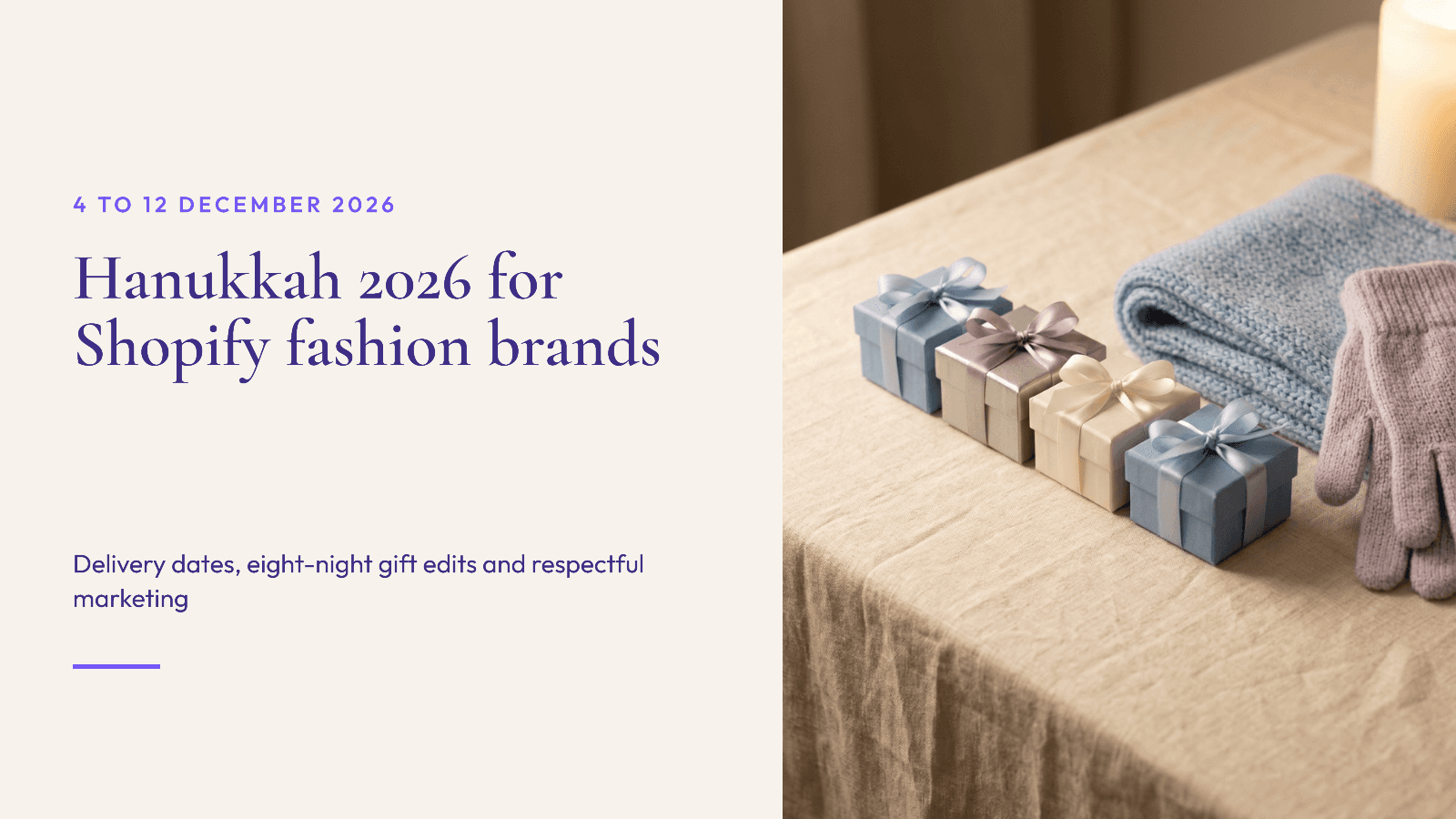
Hanukkah 2026 for Shopify Fashion Brands: Delivery Dates, Eight-Night Gift Edits and Respectful Marketing
Hanukkah 2026 runs 4 to 12 December, three weeks before Christmas. When first-night gifts must arrive, how to merchandise for eight nights, and how to market it with care.