New research guide: The Confidence Economy, how AI is changing fashion commerce.
Peak Season, Payments, Compliance
·
UK Buy Now Pay Later Is Now Regulated: A Black Friday 2026 Audit for Shopify Fashion Brands
The FCA began regulating BNPL on 15 July 2026, so this Black Friday is the first peak under the new rules. What to change in your BNPL wording, checkout and returns.
Mehul Agarwal, Founder & CEO

Last updated: October 2026
Quick answer: Since 15 July 2026, buy now pay later (BNPL) offered by a third-party lender in the UK has been regulated by the Financial Conduct Authority (FCA) as Deferred Payment Credit. The lender carries the regulation, not your Shopify store, but Black Friday is the first peak season under the new rules, so three things change for fashion brands: your BNPL marketing must use the lender's approved materials and drop any "unregulated" wording, your checkout may have extra credit information and checks, and BNPL withdrawals now sit alongside your returns policy. Audit all three before Black Friday on 27 November.
For UK fashion shoppers, BNPL has been one of the most visible ways to spread the cost of a festive outfit or gift. For years it sat outside consumer credit regulation. That changed this summer, and many brands have not looked at their BNPL banners, product-page messages or returns flows since.
This guide explains what the new regime covers, according to the FCA, what lenders are now telling merchants, and a practical pre-peak audit for UK-facing Shopify fashion stores. It is an overview, not legal advice. Your BNPL provider's merchant terms are the place to confirm specifics.
What changed on 15 July 2026
The FCA's consumer page puts it simply: "We started regulating Deferred Payment Credit, often known as Buy Now Pay Later, on 15 July 2026." The FCA defines Deferred Payment Credit (DPC) as "an interest-free form of credit, repayable in 12 or fewer instalments, over 12 months or less."
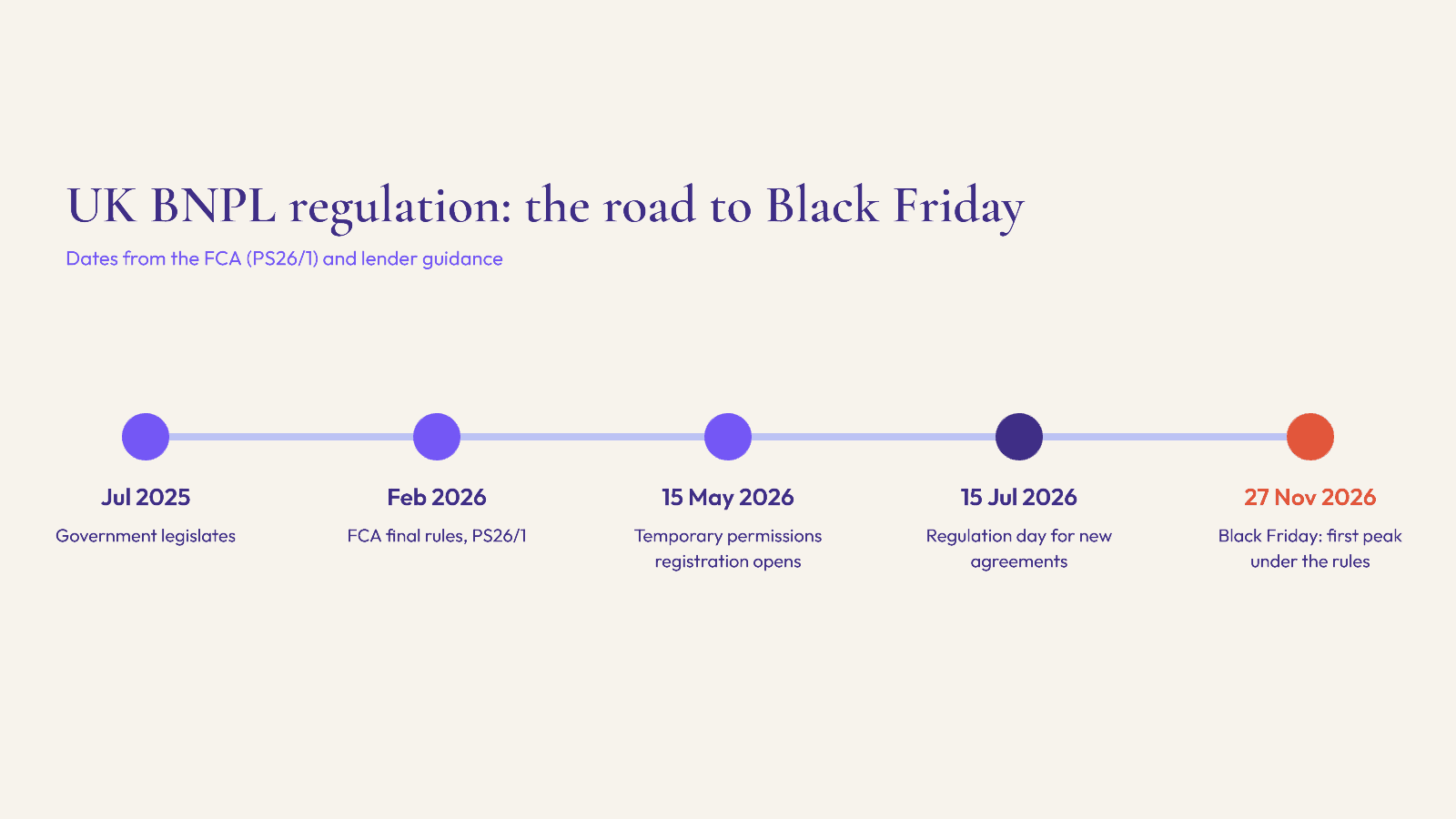
The key dates, from the FCA's policy statement PS26/1 and lender guidance:
July 2025: the government legislated to bring DPC into regulation.
February 2026: the FCA published its final rules in PS26/1.
From 15 May 2026: firms doing DPC activity without the necessary permissions had to register for the FCA's temporary permissions regime.
15 July 2026: regulation day. New third-party DPC agreements are regulated from this date.
Two scope points matter for fashion brands. First, the FCA says lenders offering DPC to finance purchases from a merchant are regulated, but "merchants that offer their own DPC agreements directly will not" be. Second, agreements taken out before 15 July 2026 remain unregulated.
Who carries the regulation: your lender, not your store
If you offer BNPL through a third-party provider, the provider is the regulated lender. The FCA says lenders "need to be authorised by us or be part of our temporary permissions regime to continue offering DPC," and its consumer page lists lenders with temporary permission, including Clearpay.
Zopa's merchant FAQ, written for retailers that offer its DPC product, is explicit that its merchants do not need FCA authorisation in any capacity, and that "the regulation sits with us as the lender." Other providers' terms may differ, so read yours. The first practical task is simply to confirm your provider is authorised or holds temporary permission; the FCA explains how to check on its Firm Checker.
What the lender now has to do for your shoppers, according to the FCA:
Affordability checks: lenders "need to check whether you can afford to repay before you take out an agreement."
Clear information first: the amount borrowed, when repayments are due, late fees and the shopper's rights.
Missed-payment contact and support for customers in difficulty.
Complaints: customers complain to the lender first, then can go to the Financial Ombudsman Service. The FCA also says Section 75 of the Consumer Credit Act is available, "the same protection you'd have if you used a credit card."
Your BNPL marketing: use approved wording only

This is where most fashion brands need to act before Black Friday. Holiday banners, gift-guide copy and emails often mention payment options, and some were written when BNPL was unregulated.
Remove "unregulated" claims. Zopa tells merchants to remove references to "unregulated" credit and any wording suggesting the product sits outside FCA regulation or Ombudsman protection. Retail analysis site 365 Retail reports that PayPal also instructed merchants using their own Pay in 3 material to remove references describing it as unregulated credit.
Use the lender's materials, not your own. Zopa says merchants "cannot create their own marketing materials or financial promotions for the product" and should use the assets and terminology it provides. 365 Retail advises marketing teams to avoid new claims about convenience, approval or affordability without lender-approved material.
"Interest-free" is still allowed, where accurate. Zopa tells merchants they can still describe its product as interest-free, and encourages it, which matches the FCA's own definition of DPC.
Check every surface. 365 Retail suggests making sure the latest approved messaging is used across product pages, checkout screens and apps. For a Shopify brand that means theme banners, product-page snippets, cart drawers, email templates, SMS and paid social.
A quick way to find old copy: search your theme's text, your email template library and your active ads for "pay later", "instalments", "Pay in 3", "Pay in 4" and "unregulated".
Checkout: expect more steps, and test them
Regulated lenders must show pre-contract information and run affordability checks. Zopa lists what customers now see before agreeing: total credit, the interest rate, the repayment schedule, the consequences of missed payments, a 14-day right to withdraw and Section 75 information. 365 Retail reports Clearpay saying customers may undergo soft credit checks or be asked to confirm income and expenditure.
For most stores using a provider's standard app or payment method, the provider builds these screens. Zopa says custom integrations may need minor updates. Either way, the shopper journey is longer than it was last Black Friday. Before peak:
Run a full test purchase with BNPL on mobile, from product page to confirmation.
Time it, and note where extra steps appear. 365 Retail warns that additional eligibility steps can change the point at which shoppers leave the site.
Watch checkout completion by payment method during Black Friday week, so you can tell a BNPL drop-off from a site problem.
Keep other payment options visible for shoppers who do not want a credit check.
Returns: the withdrawal right is separate from your returns policy
Regulated DPC brings a 14-day right for the customer to withdraw from the credit agreement. Zopa's merchant guidance makes the key point clearly: "The withdrawal right and your returns policy are separate."
If the item is returnable: the customer withdraws from the credit, returns the item, and it is processed as a standard return.
If the item is not returnable (for example a final-sale or personalised piece): the credit is cancelled, but the customer still owes you for the product.
Two practical steps for the holiday returns season. First, make sure your returns data and the lender's payment records line up; 365 Retail warns that delayed refunds or mismatched transaction information can create problems now that customers can escalate to the Ombudsman. Second, brief your customer service team: questions about repayments, affordability or financial difficulty go to the lender, while you still handle the sale, delivery and return. Our guide to holiday returns and January exchanges covers the rest of returns season.
A pre-Black Friday BNPL audit for UK fashion stores
Confirm your BNPL provider is FCA-authorised or holds temporary permission.
Read the updated merchant terms your provider sent for regulation day.
Replace any self-written BNPL copy with the provider's approved assets.
Search themes, emails, SMS and ads for "unregulated" and remove it.
Test the BNPL checkout on mobile and note any new steps.
Align refunds with the provider's records and brief customer service on who handles what.
Track checkout completion by payment method through Cyber Week.
If you are also tidying up discount claims for the same campaigns, see our guide to showing was prices and countdown timers legally.
Helping shoppers decide before they reach the payment step
Payment friction matters most when the shopper is unsure about the product. An AI shopping assistant that helps them find the right size, see a complete look and try it on virtually can settle that uncertainty earlier, so fewer shoppers abandon at a longer checkout. Industry benchmarks associate AI shopping assistants with 4x conversion rates (Neuwark 2026) and 25% higher average order value (Rep AI 2025); these are industry benchmarks, not Elara results.
Elara for Commerce is an AI shopping assistant built for fashion brands on Shopify. It engages shoppers proactively, styles complete looks from your catalog, offers virtual try-on and attributes revenue to each styling conversation.
FAQ
When did buy now pay later become regulated in the UK?
The FCA started regulating Deferred Payment Credit, commonly called buy now pay later, on 15 July 2026. Agreements taken out before that date remain unregulated.
Does my Shopify store need FCA authorisation to offer BNPL?
Not if you offer BNPL through a third-party lender, according to lender guidance such as Zopa's, because the lender is the regulated firm. The FCA also says merchants offering their own DPC directly are outside this regime. Check your provider's terms.
Can I still say "interest-free" in BNPL marketing?
Lender guidance such as Zopa's says yes, where accurate, but merchants should use the lender's approved materials rather than writing their own promotions.
What is the 14-day withdrawal right for BNPL?
Regulated DPC gives customers 14 days to withdraw from the credit agreement. Zopa notes this is separate from your returns policy: for non-returnable items, the credit is cancelled but the customer still owes you for the product.
Who handles BNPL complaints?
The lender. The FCA says customers should complain to the lender first and can then take it to the Financial Ombudsman Service.
Book a demo before peak season
To see how Elara can help UK shoppers find the right look before they reach checkout, book a demo or start the 30-day free trial of Elara for Commerce.
Keep reading

Peak Season, Cross-Border, Shopify
Holiday 2026 Cross-Border Orders: US De Minimis, the EU €3 Parcel Duty and a DDP Checklist for Shopify Fashion Brands
US de minimis is gone and the EU now charges €3 per item type on small parcels. What changed, DDP vs DAP for gifts, and a Shopify duties checklist before Black Friday.

Peak Season, Merchandising, Marketing
Hanukkah 2026 for Shopify Fashion Brands: Delivery Dates, Eight-Night Gift Edits and Respectful Marketing
Hanukkah 2026 runs 4 to 12 December, three weeks before Christmas. When first-night gifts must arrive, how to merchandise for eight nights, and how to market it with care.

Peak Season, Promotions, Shopify
BFCM 2026 Discount Stacking on Shopify: How Discount Combinations Actually Calculate
Which Shopify discounts can combine, the order they apply in, the limits that bite during Cyber Week, and a test routine to run before 27 November.