New research guide: The Confidence Economy, how AI is changing fashion commerce.
Peak Season, AI Compliance, Shopify
·
AI Shopping Assistants This Holiday: EU AI Act Chatbot Disclosure and California's Bot Law for Shopify Fashion Brands
Since 2 August 2026, EU shoppers must be told they are chatting with an AI. What Article 50 and California's bot law mean for your holiday AI assistant.
Mehul Agarwal, Founder & CEO

Last updated: October 2026
Quick answer: If shoppers in the EU can chat with an AI assistant on your store this holiday season, the EU AI Act's transparency rules already apply: since 2 August 2026, people must be told they are talking to an AI, clearly and at the latest at their first interaction. AI-generated or manipulated images that look real, such as synthetic model photos, bring their own marking and disclosure duties. In the US, California's bot disclosure law has required a clear and conspicuous disclosure since 2019 when a bot is used to encourage a sale. The practical fix is small: an honest opening line, a persistent AI label, and clear captions on synthetic imagery. Do it before Black Friday on 27 November, not after a complaint.
This is a practical summary of public legal texts and official guidance, not legal advice. Check your specific setup with a lawyer.
Peak season is when fashion brands lean hardest on automation: AI shopping assistants that greet visitors, answer sizing questions and build looks, and AI-generated imagery that fills out a holiday catalogue fast. That is exactly the territory the new transparency rules cover. The good news is that compliance here is mostly about wording and placement, which you can fix in an afternoon.
What changed on 2 August 2026
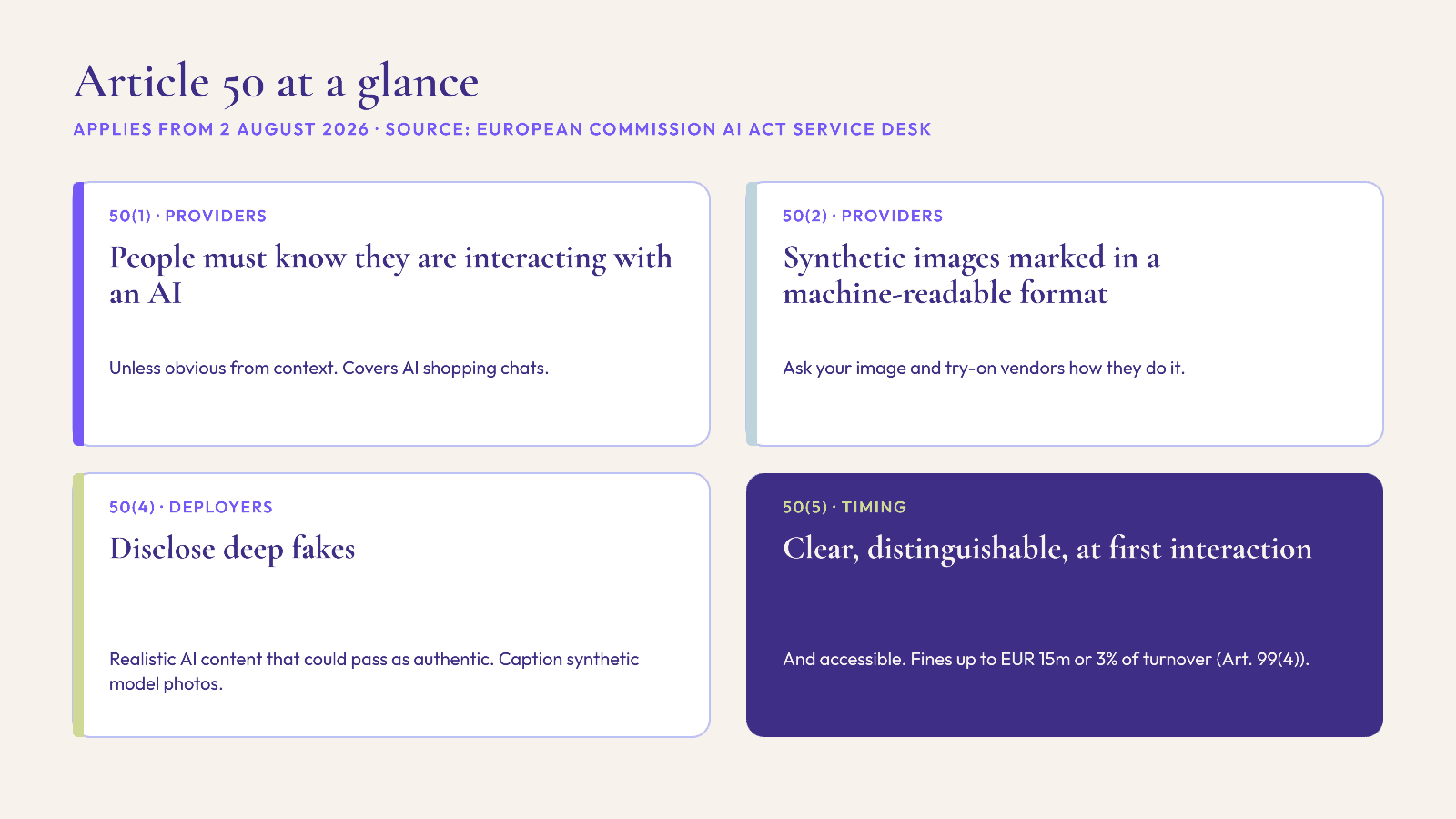
The European Commission's page for its Article 50 guidelines, published on 20 July 2026, states plainly: "These transparency obligations apply from 2 August 2026." The AI Omnibus, which the Commission says entered into force on 27 July 2026, pushed back the high-risk rules (to 2 December 2027 for Annex III systems and 2 August 2028 for AI embedded in regulated products), but the Commission's guidance still gives 2 August 2026 for transparency.
Article 50 of the AI Act, as published on the Commission's AI Act Service Desk, contains four duties relevant to fashion ecommerce:
Article 50(1), AI interaction: providers must design AI systems that interact directly with people so that those people are informed they are dealing with an AI, unless that is obvious from the context.
Article 50(2), synthetic content: providers of systems that generate synthetic images, video, audio or text must ensure outputs are marked in a machine-readable format and detectable as artificially generated or manipulated.
Article 50(4), deep fakes: deployers who generate or manipulate image, audio or video content that is a deep fake must disclose that it is artificially generated or manipulated.
Article 50(5), timing: the information must be given "in a clear and distinguishable manner at the latest at the time of the first interaction or exposure," and meet accessibility requirements.
Does it apply to your brand?
Two definitions in Article 3 decide your role:
Provider: whoever develops an AI system, or has one developed and places it on the market or puts it into service under its own name or trademark.
Deployer: whoever uses an AI system under its authority, outside purely personal use.
For most Shopify fashion brands using an AI shopping assistant from a vendor, the vendor is the provider and the brand is the deployer. But note the "under its own name or trademark" wording. If you have an assistant built for you and launch it as your own branded product, check with counsel whether that makes you a provider too.
Location is less of an escape hatch than many brands assume. Article 2(1) applies the Act to deployers in the EU, and also to providers and deployers in third countries "where the output produced by the AI system is used in the Union." A US or UK brand whose assistant chats with shoppers in France should plan as if the rules apply.
Penalties are real. Under Article 99(4), breaching the Article 50 transparency obligations can bring fines of up to EUR 15 million or 3% of worldwide annual turnover, whichever is higher. For SMEs and start-ups, Article 99(6) applies whichever is lower.
The chatbot disclosure: what good looks like
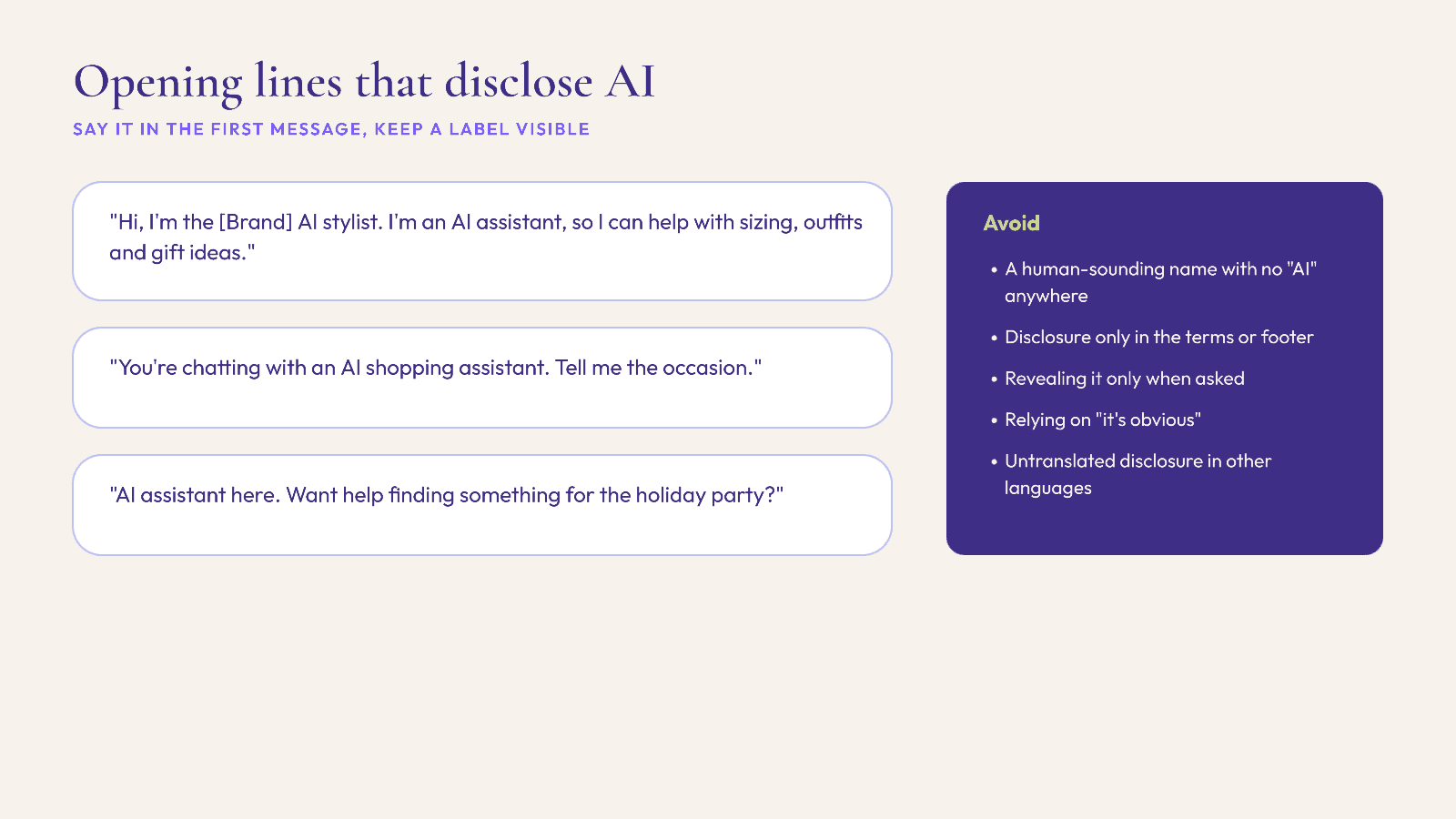
Article 50(1) is a design obligation on the provider, but as the brand putting the assistant in front of your customers, you control the experience they see. Three principles follow from the text:
First interaction, not the footer. Article 50(5) says "at the latest at the time of the first interaction." A disclosure buried in your terms, or revealed only if someone asks, does not meet that test. The opening message is the natural place.
Clear and distinguishable. Use plain words ("AI", "AI assistant") rather than a cute persona name that hides what it is. A friendly name is fine, as long as the AI part is explicit.
Do not lean on "obvious from context". The exception exists, but a polished assistant that writes like a human stylist is precisely the case where it may not be obvious. Disclose anyway.
Example opening lines that do the job:
"Hi, I'm the [Brand] AI stylist. I'm an AI assistant, so I can help with sizing, outfits and gift ideas, and connect you to our team for anything else."
"You're chatting with an AI shopping assistant. Tell me the occasion and I'll pull together a few looks."
"AI assistant here. Want help finding something for the holiday party?"
Then keep a small "AI assistant" label visible in the chat header for the whole conversation, and make sure it is readable by screen readers, since Article 50(5) also requires the information to meet applicable accessibility requirements. If you hand conversations to human agents during peak, say so when it happens, so the shopper knows who they are talking to.
AI imagery: try-on, synthetic models and holiday campaigns
Many brands now use AI to generate model shots, swap colours, or show garments on different bodies. Two duties may apply:
Machine-readable marking (Article 50(2)) sits with the provider of the generating system. Ask your image or try-on vendor how outputs are marked, and do not strip that metadata in your workflow. Google's Merchant Center image rules separately ask merchants to preserve embedded metadata such as the IPTC DigitalSourceType tag on AI-generated images, so keeping it helps on both fronts.
Deep fake disclosure (Article 50(4)) sits with the deployer. Article 3(60) defines a deep fake as AI-generated or manipulated image, audio or video content that resembles existing persons, objects or places and would falsely appear to a person to be authentic or truthful. A photorealistic AI model wearing your real dress could fall into that definition. A short caption such as "AI-generated image" on synthetic model photos is a low-cost way to stay on the right side of it.
Virtual try-on images that a shopper generates of themselves are a different situation from campaign imagery you publish, so ask your vendor how their product handles marking and labelling, and read the Commission's Article 50 guidelines for the detail.
The US angle: California's bot disclosure law
California's Business and Professions Code section 17941 makes it unlawful to use a bot to communicate with a person in California online with the intent to mislead them about its artificial identity in order to incentivize a purchase or sale of goods or services. A person using a bot is not liable if they disclose that it is a bot, and the disclosure must be "clear, conspicuous, and reasonably designed" to inform the people the bot talks to. The same opening line and persistent label that satisfy the EU rule work here too, which is a good reason to build one disclosure pattern for every market.
A pre-Black Friday checklist
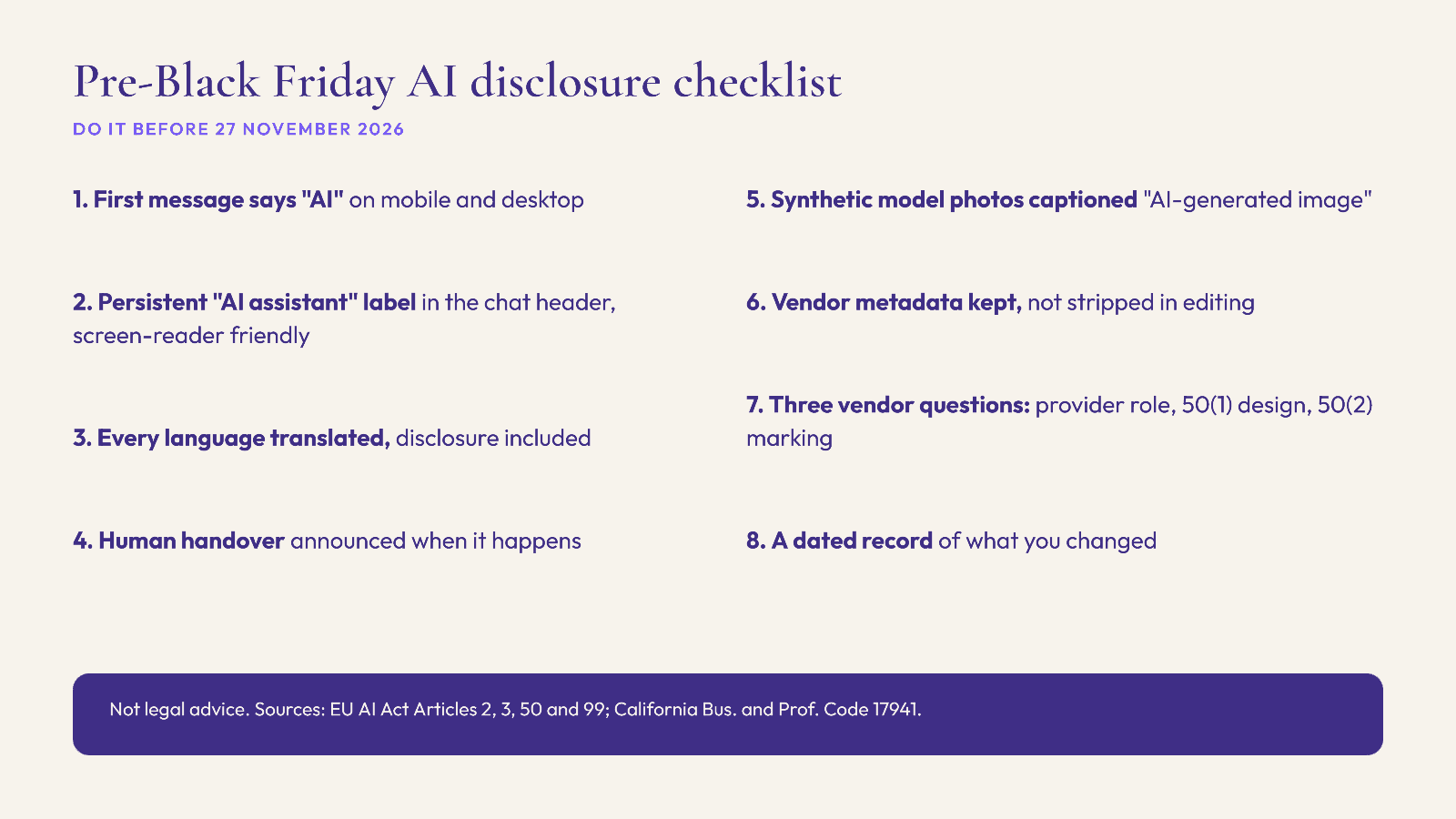
Read your assistant's opening message on mobile and desktop. Does it say "AI" in the first message?
Add a persistent label in the chat header, and check it with a screen reader.
Check every language your assistant speaks, so the disclosure is translated too.
Review human handover wording for peak staffing.
Audit AI-generated imagery in your holiday campaign, product pages and ads. Caption photorealistic synthetic models, and keep the vendor's metadata intact.
Ask your vendors three questions: do you treat yourselves as the provider under the AI Act, how do you meet Article 50(1), and how are generated images marked under Article 50(2)?
Record what you did and when, in case a regulator or marketplace asks.
If your AI images also end up in Google Shopping, our guide to getting your clothes ready for Google's virtual try-on covers the image rules on that side.
Where Elara fits
Elara for Commerce is a conversational AI shopping assistant for fashion brands on Shopify. It can start the conversation proactively, ask about the occasion, build complete looks from your catalog and offer virtual try-on. Whichever assistant you use, the disclosure rules above apply to how it greets your shoppers, so ask any vendor, including us, to show you exactly what the first message says and how generated images are handled. For a broader view of what to ask before you buy, see our guide to evaluating AI vendors.
FAQ
When did the EU AI Act chatbot disclosure rule start?
The European Commission's guidelines page states that the Article 50 transparency obligations apply from 2 August 2026.
Does the EU AI Act apply to a US or UK Shopify brand?
It can. Article 2(1) covers providers and deployers in third countries where the output of the AI system is used in the EU, so a chatbot talking to shoppers in the EU is likely in scope.
What exactly has to be disclosed in an AI shopping chat?
That the shopper is interacting with an AI system. Article 50(5) says this must be clear and distinguishable and given at the latest at the first interaction.
Do AI-generated model photos need a label?
Possibly. Providers of image generators must mark outputs in a machine-readable way, and deployers must disclose deep fakes, which the AI Act defines as AI-generated or manipulated content that resembles real persons, objects or places and would falsely appear authentic. A visible "AI-generated image" caption is a sensible default.
What are the fines for breaching Article 50?
Article 99(4) sets fines of up to EUR 15 million or 3% of worldwide annual turnover, whichever is higher. For SMEs and start-ups, the lower of the two applies.
Does California require chatbots to disclose they are bots?
California's Business and Professions Code section 17941 makes it unlawful to use a bot to mislead someone about its artificial identity to encourage a sale, and provides that a clear and conspicuous disclosure avoids liability.
See it in action
If you are choosing an AI shopping assistant for the holidays, look at the first message before anything else. Book a demo of Elara for Commerce to see how a styling conversation starts, or begin the 30-day free trial and review the experience on your own store.
Keep reading

Peak Season, Google Shopping, Virtual Try-On
Google Virtual Try-On Before Holiday 2026: The Product Image Checklist for Shopify Fashion Brands
Google now shows your clothes on models and on shoppers' own photos. Image rules, Shopify feed fixes and a five-week plan to be try-on ready by Black Friday.

Peak Season, Shipping, Operations
Canada and Australia Christmas 2026 Shipping Cut-offs: Canada Post and Australia Post Dates for Shopify Fashion Brands
Canada Post and Australia Post Christmas 2026 shipping dates for Shopify fashion brands, plus how to turn carrier cut-offs into an honest order-by date.

Peak Season, Cross-Border, Shopify
Holiday 2026 Cross-Border Orders: US De Minimis, the EU €3 Parcel Duty and a DDP Checklist for Shopify Fashion Brands
US de minimis is gone and the EU now charges €3 per item type on small parcels. What changed, DDP vs DAP for gifts, and a Shopify duties checklist before Black Friday.