New research guide: The Confidence Economy, how AI is changing fashion commerce.
AI & Technology
·
September 6, 2026
Shopify Store AI Visibility: The 90-Day Audit & Roadmap
Only 11% of domains appear in both ChatGPT and Perplexity. Here's the sequenced 90-day roadmap, structured data, third-party credibility, crawlability, buyer-intent copy, that gets a Shopify store recommended by AI.
Mehul Agarwal, Founder & CEO

Key Takeaways
Only 11% of domains appear in both ChatGPT and Perplexity, a dual-track strategy is essential. (Ivinco Blog)
One authoritative editorial review increases ChatGPT recommendation rate by 4.2x, the single highest-ROI action available. (Metricus App Blog)
Top Shopify stores capture 5%+ of orders from AI discovery; the average store gets 0.06%. (Evolve AMZ)
Shopify stores already dominate AI shopping results when optimized: 4 of 6 ChatGPT pajama results and 6 of 9 Perplexity results were Shopify stores. (Charle Agency)
Four levers in priority order: structured data → third-party reinforcement → crawlability → buyer-intent copy.
Introduction: The AI Recommendation Gap Most Shopify Stores Are Leaving Open
Most Shopify stores receive roughly 0.06% of their traffic from ChatGPT, but a small cohort of optimized stores already attributes 5% or more of orders to AI discovery, according to data from Evolve AMZ. That gap is not a matter of luck or store age. It is a matter of legibility: whether an AI recommendation engine can find, parse, and trust a store enough to name it to a shopper.
The proof that Shopify stores can win here is already in the results. In a query test conducted by Charle Agency, ChatGPT returned six products for a pajama search and four of those six were Shopify stores; Perplexity returned nine brands and six of nine were Shopify. The platform is not the obstacle. The optimization is.
This article introduces a framework called AI-readable commerce hygiene, the combination of structured product data, third-party credibility signals, and buyer-intent content that makes a Shopify store visible to AI recommendation engines like ChatGPT and Perplexity. Think of it as the technical and editorial groundwork that transforms a store from invisible to recommendable.
Three sections follow: a platform-differentiation lens showing why ChatGPT and Perplexity require distinct strategies, the ROI math behind editorial and review signals, and a sequenced 90-day audit roadmap. Readers who already know AI visibility matters will leave with a concrete plan to pursue it.
ChatGPT vs. Perplexity: Why Shopify Stores Need Two Distinct Strategies
The most expensive assumption a Shopify store owner can make is that optimizing for one AI platform automatically improves visibility on the other. According to data from Ivinco Blog, only 11% of domains are cited by both ChatGPT and Perplexity. That means nearly nine out of ten domains appearing in one platform's recommendations are absent from the other's, the two audiences are almost entirely separate, and a single optimization strategy will underperform on at least one of them.
The reason comes down to how each system works. ChatGPT relies on training data indexed before its knowledge cutoff, with stronger emphasis on established, well-linked publications. Perplexity retrieves from the live web at query time, pulling from current indexes, community platforms, and recent mentions. The same store can be invisible to one engine while ranking prominently in the other, depending entirely on where its credibility signals live.
This structural difference maps directly to which tactics belong in which track:
For ChatGPT: editorial placements in authoritative publications (gift guides, category roundups, lifestyle press), high-quality review coverage on indexed platforms, and structured product data in sources that inform training models carry disproportionate weight.
For Perplexity: Bing indexing status, fresh third-party mentions, active community presence, and real-time review signals on platforms Perplexity retrieves from (Trustpilot, Google Reviews) are the primary levers.
The Charle Agency pajama query test illustrates this split in practice. Shopify stores dominated results on both platforms, but the specific stores appearing in ChatGPT's six results were not necessarily the same stores appearing in Perplexity's nine. The winning stores had built credibility in the channels each engine actually reads. A store with deep editorial coverage but weak Bing indexing will surface in ChatGPT and disappear in Perplexity. The inverse is equally true.
The practical implication is straightforward: before building any optimization roadmap, Shopify store owners should run separate visibility audits, searching their primary product categories in both ChatGPT and Perplexity, noting which stores appear, and identifying whether their own store surfaces in either. The audit results will almost always point to different gaps on each platform, which is exactly why a dual-track strategy is the starting point, not an advanced tactic.
The ROI Math: Why Third-Party Credibility Outperforms On-Site Technical Fixes
Running separate ChatGPT and Perplexity audits will almost always surface the same uncomfortable finding: the stores dominating AI recommendations aren't winning because they have cleaner schema markup. They're winning because they've built external credibility that AI systems can independently verify.
The math here is striking. According to the Metricus App Blog, brands appearing in at least one authoritative editorial review, a "best silk pajamas" roundup on a credible lifestyle site, a gift guide mention on a major publisher, are recommended by ChatGPT at 4.2x the rate of brands with zero editorial coverage. A single well-placed editorial mention is, by that measure, the highest-leverage single action available to a Shopify store owner trying to break into AI recommendations.
Layer in the review-volume effect and the numbers compound further. Stores with 300+ reviews across indexed platforms appear in ChatGPT recommendations at roughly 3x the rate of stores with fewer than 100 reviews, again according to Metricus App Blog data. These two multipliers don't add, they multiply. A store with one authoritative editorial placement and a 300+ review profile is looking at a combined lift scenario of approximately 12.6x (4.2 × 3) compared to a store with neither.
A store with zero editorial coverage and under 100 reviews vs. a store with one editorial mention and 300+ indexed reviews: the latter is roughly 12x more likely to surface in ChatGPT recommendations.
This is the context that makes the 0.06% vs. 5%+ traffic gap from Evolve AMZ legible. Technical fixes, schema markup, robots.txt configuration, JavaScript rendering audits, are the necessary foundation. They make a store legible to AI crawlers. But they don't explain why one crawlable store gets recommended and another doesn't. Third-party credibility is the ceiling, and it's what separates average stores from the cohort already capturing 5%+ of orders from AI discovery.
Elara's AI Stylist operates at a different point in this funnel. Once AI discovery delivers a shopper to a fashion store, Elara's taste-driven personalization converts that visit into a purchase. But the prerequisite, getting recommended in the first place, depends entirely on building the external credibility stack described here.
The 90-Day AI Visibility Audit: Four Levers, Sequenced by Impact
Most AI visibility advice hands Shopify store owners a feature list without a sequence. The sequence is the strategy. Each lever in this roadmap builds on the one before it, which is why compressing or reordering them produces worse results.
Before starting: run the 5-question diagnostic. Answer these now to identify your single biggest gap:
Does your store have complete Product schema (title, brand, price, availability, reviews, FAQ) validated in Google's Rich Results Test?
Has your store been mentioned by name in any editorial content on a domain with meaningful authority in the past 12 months?
Do you have 300+ reviews distributed across indexed third-party platforms (Trustpilot, Google Reviews, Reddit threads)?
Is your store indexed in Bing, and have you verified this, not assumed it?
Do your top product pages include occasion-based or use-case copy ("best linen pajamas for hot sleepers") rather than feature-only descriptions?
The first "No" answer is where you start. Don't skip to a later lever because it feels more actionable.
Lever 1 — Structured Product Data (Days 1–21). Schema completeness is the prerequisite. Without it, editorial mentions and review volume can't attach to a machine-readable product identity. Audit every top product page against Google's Rich Results Test, fill metafield gaps using Shopify's native JSON-LD output, and add FAQ schema to pages targeting question-format queries. This work takes 2–3 weeks done properly and makes every subsequent lever more effective.
Lever 2 — Third-Party Reinforcement (Days 22–45). This is where the ROI math from the previous section becomes operational. Target one to two authoritative editorial placements, pitch gift guide editors, category roundup writers, and lifestyle journalists covering your product niche. A single successful placement unlocks the 4.2x ChatGPT recommendation multiplier identified by Metricus App Blog. Simultaneously, launch a structured review aggregation campaign to cross the 300-review threshold on indexed platforms; Metricus App Blog data shows this alone triples ChatGPT recommendation rate. Prioritize platforms Perplexity actively retrieves from: Google Reviews, Trustpilot, and relevant Reddit communities.
Lever 3 — Crawlability & Indexing (Days 46–60). With credibility signals in place, confirm AI crawlers can actually access them. Configure llms.txt to explicitly permit AI crawler access. Verify Bing indexing, this is critical for Perplexity, which relies on Bing's index for real-time retrieval. Audit JavaScript rendering issues that may block crawlers from reading dynamically loaded product content. Submit updated sitemaps.
Lever 4 — Buyer-Intent Copy (Days 61–90). Rewrite product page copy to answer the specific questions shoppers type into AI tools, occasion-based, problem-specific, comparison-oriented. "Best linen pajamas for hot sleepers" outperforms "lightweight linen pajamas" because it mirrors actual AI query patterns. Add FAQ sections to top product pages using structured markup.
Measuring progress from Day 1: In GA4, add ChatGPT.com and Perplexity.ai as tracked referral sources before anything else. Baseline your current AI referral traffic on Day 1 so every subsequent lever has a visible before/after signal. Without this, the roadmap is unaccountable.
What High-Visibility Shopify Stores Are Doing Differently: A Reverse-Engineering Framework
The 0.06% average AI-driven Shopify traffic figure from Evolve AMZ is useful precisely because it implies its opposite: a distinct cohort of stores is already well above it, some capturing 5% or more of orders from AI discovery. That cohort is observable. Their characteristics are auditable. And they can be reverse-engineered.
The pajama query test documented by Charle Agency makes this concrete: ChatGPT returned 6 products for a pajama search and 4 of 6 were Shopify stores; Perplexity returned 9 brand recommendations and 6 of 9 were Shopify stores. Those winning stores didn't get there by accident. They share five observable characteristics:
Complete, attribute-rich product pages, not just a hero image and three-sentence description, but material details, sizing context, care instructions, and use-case framing that gives AI systems substantive content to extract.
Multiple external mentions across editorial, review, and community sources, not a single press hit, but a distributed footprint across publication types that AI systems treat as independent corroboration.
Clean, crawlable URL structures, consistent URL patterns, no excessive parameter strings, fast load times that don't penalize AI crawler patience.
Occasion- and use-case-oriented product copy, written to match how shoppers actually prompt AI tools, not how merchandisers describe inventory.
Active review profiles on indexed third-party platforms, reviews that exist where AI systems look, not only in on-site widgets that crawlers may not parse.
The competitive audit exercise: Search your primary product category in both ChatGPT and Perplexity right now. Note which stores appear. Pull those stores up and audit them against these five characteristics. The gap between their profile and yours is your specific optimization priority, not a generic checklist, but a competitor-calibrated action list.
Once AI discovery starts delivering shoppers to your store, the on-site experience becomes the conversion variable. For Shopify fashion stores, that's where Elara's AI Stylist operates, converting AI-referred browsers into buyers through taste-driven personalization that mirrors the guidance of a real stylist. Getting recommended is the first problem; converting the visit is the second. Both are solvable, and the roadmap above addresses them in the right order.
FAQ
Q: How long does it take to see results from AI visibility optimization?
A: The 90-day roadmap is structured to show measurable progress at each stage. Lever 1 (structured data) takes 2–3 weeks and immediately improves crawlability. Lever 2 (editorial and review signals) typically shows initial ChatGPT recommendation lift within 30–45 days, though editorial placements may take longer to secure. Perplexity visibility often appears faster once Bing indexing is confirmed. Track GA4 referral sources from Day 1 to measure incrementally.
Q: Do I need to choose between optimizing for ChatGPT or Perplexity, or is a dual strategy really necessary?
A: A dual strategy is necessary. Only 11% of domains appear in both platforms (Ivinco Blog), so optimizing for one platform leaves roughly 90% of the AI recommendation opportunity untouched. The good news: the two strategies share the same foundation (structured data and third-party credibility) but diverge in execution. ChatGPT benefits more from editorial placements and indexed review depth; Perplexity benefits more from Bing indexing and real-time community mentions. Run separate audits for each platform to identify your specific gaps.
Q: Which is the highest-ROI action I can take this month?
A: Securing one authoritative editorial placement, a mention in a gift guide, category roundup, or lifestyle publication with domain authority, increases ChatGPT recommendation rate by 4.2x (Metricus App Blog). This is the single highest-leverage action available. Simultaneously, start a structured review aggregation campaign to cross the 300-review threshold on indexed platforms (Google Reviews, Trustpilot); this alone triples ChatGPT recommendation rate. Both actions compound: a store with one editorial placement and 300+ reviews is roughly 12x more likely to surface in ChatGPT recommendations than a store with neither.
Q: What role does Elara play in AI visibility strategy?
A: Elara operates downstream of AI visibility. The roadmap above solves the first problem: getting recommended by ChatGPT and Perplexity. Elara's AI Stylist solves the second problem: converting that AI-referred traffic into purchases. Once a shopper arrives from an AI recommendation, Elara's taste-driven personalization, trained on real human styling decisions, not product metadata, guides them to complete outfits and increases conversion. Both problems must be solved: visibility without conversion is wasted traffic; conversion without visibility has no traffic to convert.
Conclusion: From Invisible to Recommended — Your Next 30 Days
The roadmap above rests on three arguments that reinforce each other. First, ChatGPT and Perplexity are genuinely different surfaces, with only 11% domain overlap according to Ivinco, optimizing for one without the other leaves half the opportunity untouched. Second, third-party credibility is the highest-ROI lever available: the 4.2x editorial multiplier and 3x review-volume effect documented by Metricus App Blog compound into a potential 12x+ visibility advantage over unoptimized competitors. Third, the gap between the 0.06% average and the 5%+ leaders that Evolve AMZ identifies is not a function of store size, it's a function of sequenced execution, and the Shopify stores already winning in AI results, like those dominating the pajama queries Charle Agency tested, share observable, replicable characteristics.
Your next step is concrete: run the 5-question audit diagnostic from the 90-day framework this week and identify your single biggest gap. Fix that one lever before moving to the next.
For Shopify fashion stores, there's a second problem that follows immediately from solving the first. Once AI discovery starts delivering shoppers to your store, conversion becomes the variable that determines whether that visibility translates to revenue. That's the gap Elara's AI Stylist is built to close, turning AI-referred browsers into buyers through taste-driven personalization trained on real human styling decisions, not product metadata. Start a free trial or book a demo at joinelara.shop.
AI recommendation visibility compounds. Stores that build the credibility infrastructure now will not simply catch up to the leaders, they'll widen their own lead as AI shopping behavior accelerates through the rest of 2026. The window to act before this becomes table stakes is measurable in months, not years.
Keep reading

Peak Season, Cross-Border, Shopify
Holiday 2026 Cross-Border Orders: US De Minimis, the EU €3 Parcel Duty and a DDP Checklist for Shopify Fashion Brands
US de minimis is gone and the EU now charges €3 per item type on small parcels. What changed, DDP vs DAP for gifts, and a Shopify duties checklist before Black Friday.

Peak Season, Payments, Compliance
UK Buy Now Pay Later Is Now Regulated: A Black Friday 2026 Audit for Shopify Fashion Brands
The FCA began regulating BNPL on 15 July 2026, so this Black Friday is the first peak under the new rules. What to change in your BNPL wording, checkout and returns.
Peak Season, Merchandising, Marketing
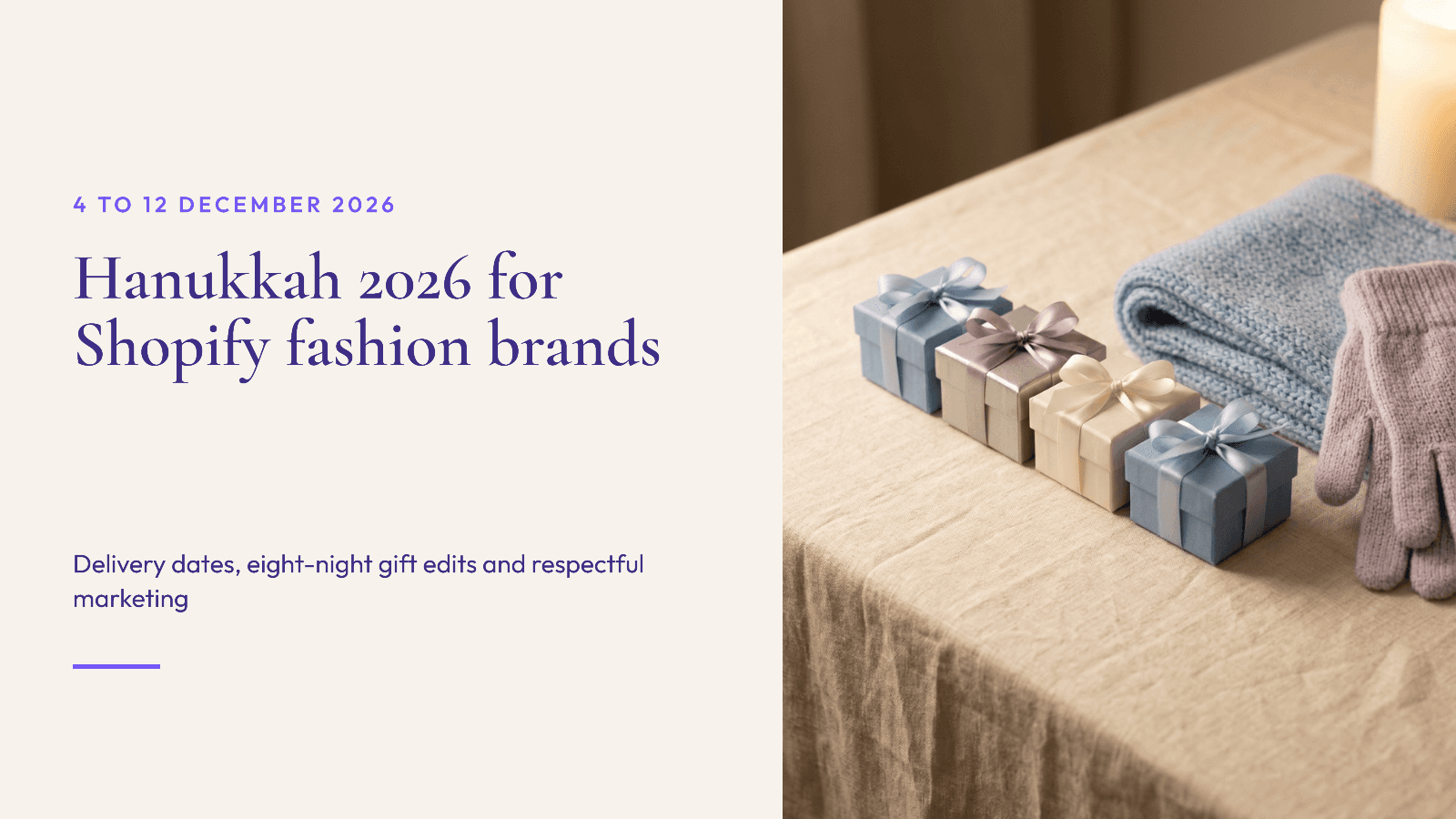
Hanukkah 2026 for Shopify Fashion Brands: Delivery Dates, Eight-Night Gift Edits and Respectful Marketing
Hanukkah 2026 runs 4 to 12 December, three weeks before Christmas. When first-night gifts must arrive, how to merchandise for eight nights, and how to market it with care.