New research guide: The Confidence Economy, how AI is changing fashion commerce.
SEO & Content
·
September 6, 2026
How to Set Up Shopify SEO: Intent-Based Collection & Blog Strategy
Commercial keywords belong on collection pages, informational keywords belong on the blog. Here's the intent-mapping framework, content hub architecture, and seasonal strategy that turns search visibility into revenue.
Mehul Agarwal, Founder & CEO
Key Takeaways
Map commercial intent ("best leather crossbody bags" → collection pages) and informational intent ("how to style a midi skirt" → blog posts), never mix the two.
Collection pages need 150–250 words of unique copy to rank as content hubs, not thin product grids (1 Digital Agency).
Keep seasonal URLs live when they have ranking history; refresh annually, never rebuild (Plugin Useful).
Elara's AI stylist closes the conversion gap that SEO alone cannot bridge.
Introduction: Why Most Shopify Fashion SEO Guides Leave Money on the Table
Fashion stores pour budget into SEO, and then watch most visitors leave without buying. That gap between search visibility and actual revenue is where most Shopify SEO guides go silent. They cover keyword research and meta tags, then stop, leaving store owners with a well-optimized page that still doesn't convert.
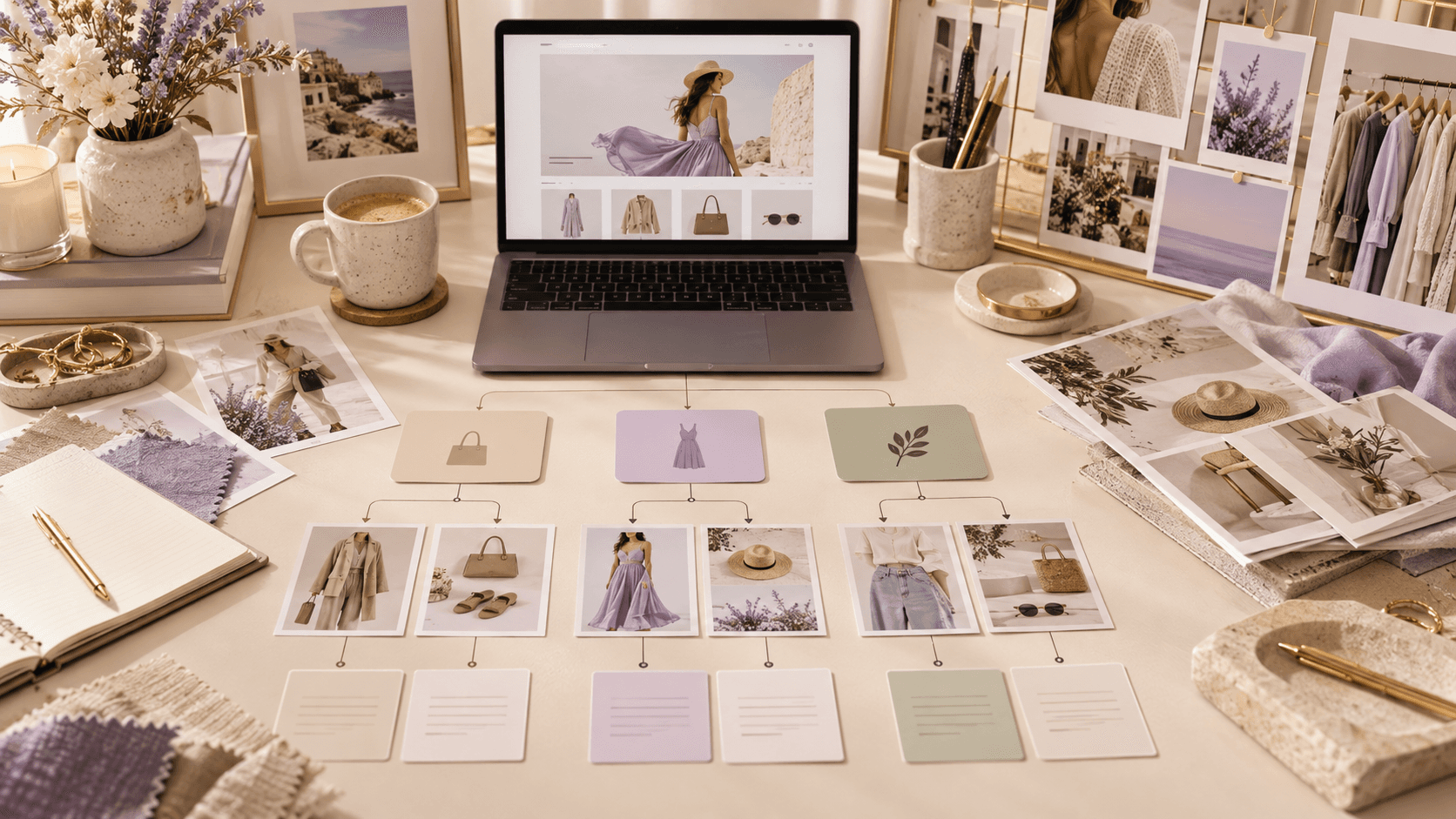
This guide goes further. Shopify's core SEO workflow, keyword research, search intent analysis, title and meta optimization, and link building, is the foundation, but it's only the foundation. Built on top of it are four pillars that determine whether fashion SEO actually drives revenue: intent mapping (assigning each keyword to the right content type), collection page architecture (building pages that rank and convert), blog and buying guide strategy (creating demand and funneling it), and seasonal SEO (capturing cyclical fashion demand without losing accumulated ranking equity). Elara, an AI stylist that integrates directly into Shopify stores, serves as the personalization layer that converts SEO-driven traffic into completed purchases, the bridge this guide builds toward.
The Intent-Mapping Framework: Collection Pages vs. Blog Posts
The single most consequential decision in fashion SEO is also the most frequently botched: assigning each keyword to the correct content type. According to Plugin Useful, the rule is explicit, commercial searches belong on collection pages; informational searches belong on blog posts. Getting this wrong doesn't just waste content effort; it actively damages rankings through keyword cannibalization.
For collection pages, the target keywords carry transactional or category-browsing intent. A shopper typing "women's linen summer dresses," "best leather crossbody bags," or "men's formal wedding suits" is ready to browse and buy. These queries belong on collection pages because Google treats them as commercial, it wants to return a page where the user can complete a purchase, not read an article.
Blog posts serve the opposite function. Queries like "how to style a midi skirt," "what to wear to a winter wedding," or "how to care for suede shoes" signal that the searcher wants guidance, not a product grid. Assigning these to a blog post, and linking that post to the relevant collection, captures the informational intent while creating a natural funnel into commercial pages.
Keyword cannibalization happens when a blog post and a collection page both target the same commercial keyword. Google cannot determine which page to rank, so it oscillates between them, often ranking neither well. A fashion store that publishes a blog post titled "Best Leather Crossbody Bags for 2026" while also running a collection page at /collections/leather-crossbody-bags is splitting its own authority.
The fix is a two-column mapping exercise. List your top 20 target keywords. Classify each as commercial (transactional, category-level, product-specific) or informational (how-to, what-to-wear, care guides, trend explainers). Then assign every keyword to exactly one content type, collection page or blog post, and audit existing content to eliminate any overlap. Shopify's core SEO workflow, which emphasizes search intent analysis as a foundational step, makes this classification exercise the logical first task before any page is built or optimized.
Building Collection Pages That Rank: The Content Hub Approach
With commercial and informational keywords assigned to their correct content types, the next challenge is execution, and for fashion stores, collection pages are where the highest-leverage SEO work happens. These pages sit directly in the path of category-level purchase intent. Done well, they rank for dozens of commercial queries simultaneously. Done poorly, as thin product grids with no copy, they're invisible to search engines and useless to shoppers who arrive without a specific product in mind.
According to 1 Digital Agency, collection pages should carry 150–250 words of unique copy. Fashion-specific guidance from Plugin Useful narrows this further: 100–200 words of introductory copy, positioned above or below the product grid, is the practical target for fashion collections. Those words aren't filler, every sentence should earn its place by including the primary keyword, style context (the aesthetic or aesthetic range the collection covers), material and occasion signals ("breathable linen for summer events," "structured suiting for black-tie occasions"), and internal links to related subcollections.
Sutton Commerce identifies three non-negotiable elements that separate a ranking content hub from a thin grid:
Unique keyword-rich copy, never duplicated from product descriptions
Internal links to related collections and top-performing products within the category
Schema markup, specifically CollectionPage or ItemList structured data, which makes pages eligible for rich results in Google Search
At the product level, The Spearpoint recommends a minimum of 300 words per product description, with long-tail keyword variants woven naturally into the copy. On the image side, Sutton Commerce sets a clear ceiling: keep every product image under 200KB, and write descriptive alt text that incorporates style and occasion keywords rather than generic filenames like "IMG_4521.jpg."
Shopify admin implementation note: Add collection description copy directly in the Shopify admin under Products → Collections → [Collection Name] → Description. Most themes render this copy above the product grid by default. If your theme supports it, or with a minor theme edit, move this block below the grid using a custom section. Shoppers browsing products aren't reading category copy first; search engines are. Placing copy below the grid preserves UX while keeping the SEO signal intact.
Blog & Buying Guide Strategy: Creating Demand and Funneling It
Collection pages capture existing demand. The blog creates it, and when structured correctly, it funnels that demand directly into the collections that close the sale. According to 1 Digital Agency, every blog post should function as a three-stage pipeline: answer the informational intent, embed contextual CTAs to relevant collections, and include product spotlights that capture long-tail purchase queries. Most Shopify fashion blogs stop at stage one and wonder why their content doesn't convert.
First Pier's guidance establishes two distinct content tiers with specific word count targets:
Simple informational posts (style tips, trend roundups, seasonal outfit ideas): 500–800 words
Comprehensive buying guides (occasion dressing, capsule wardrobes, category deep-dives): 1,500–3,000 words
The distinction matters because search engines reward depth proportional to query complexity. A post titled "How to Style White Sneakers" can rank at 600 words. "The Complete Guide to Building a Capsule Wardrobe for Work" needs 2,000+ words to compete with established lifestyle publishers.
1 Digital Agency sets the minimum publishing cadence at two blog posts per month as the baseline for maintaining search momentum. Below that threshold, crawl frequency drops and topical authority builds too slowly to compound.
Three content templates that consistently perform for fashion stores, along with their natural collection link targets:
"What to Wear to [Occasion]": answers a high-volume informational query and links directly to an occasion-specific collection ("Shop wedding guest dresses →")
"The [Season] Capsule Wardrobe": targets seasonal browsing intent and links to the live seasonal collection URL
"[Category] Buying Guide: How to Choose the Right [Item]": captures pre-purchase research behavior and links to the corresponding category collection
Each of these templates follows the same funnel logic: hook the reader with a genuine answer, then create a natural bridge to the product. A post on "what to wear to a rooftop dinner" that doesn't link to a "date night dresses" collection is leaving conversion on the table.
Seasonal & Occasion-Based SEO: The Strategy Competitors Miss
Most Shopify SEO guides treat keyword mapping as a one-time exercise. Fashion doesn't work that way. Search demand in fashion moves in predictable cycles, wedding season, summer, holiday gifting, New Year's, and stores that build their SEO architecture around those cycles accumulate ranking equity that compounds year over year.
The foundational rule, confirmed by Plugin Useful, is URL preservation: when a seasonal collection like /collections/summer-dresses has accumulated ranking history, keep it live year-round. Refresh the copy and swap in current products each season rather than deleting the URL and starting over. A rebuilt URL starts from zero authority. A preserved URL carries forward every backlink and ranking signal it earned in previous seasons.
Three occasion-based keyword clusters worth building dedicated collection and blog infrastructure around:
Wedding season: "wedding guest outfit," "mother of the bride dresses," "men's wedding suit"
Holiday/gifting: "Christmas gift ideas for her," "New Year's Eve outfit," "holiday party dress"
Date night/social: "winter date night outfit," "rooftop dinner outfit ideas," "cocktail attire women"
The timing layer is equally important. Publish blog content targeting each occasion cluster weeks before peak search volume, not the week of. For wedding season, that means February content for May searches. For holiday gifting, October content for December searches. Each blog post should link directly to the live seasonal collection URL, channeling topical authority from the informational content into the commercial page.
Underpinning all of this is technical hygiene. According to Seology.ai, a 90+ mobile PageSpeed score is the 2026 target for Shopify SEO. Canonical tags on paginated and filtered collection variants prevent duplicate content from diluting ranking signals, Shopify auto-generates canonicals but filtered URLs (e.g., ?sort_by=price-ascending) require manual review. Sitemap submission to Google Search Console ensures seasonal pages are crawled promptly when refreshed, not weeks after the demand peak has passed.
From Search Visibility to Sale: Why Personalization Is the Missing Layer
Getting the technical hygiene right, canonical tags, PageSpeed scores, sitemap submissions, creates the conditions for search visibility. But visibility is not revenue. The structural problem is a mismatch between intent and experience. A shopper who finds your store by searching "rooftop dinner outfit ideas" arrives with a clear occasion in mind. Your blog post answers the informational question. But the moment they click through to a collection page, they face a static product grid, no occasion context, no styling guidance, no acknowledgment of what they actually came to solve. The intent signal that SEO captured evaporates the moment the shopper hits the store.
This is exactly the gap Elara is built to close. Elara's Conversational Brief Intake lets shoppers describe their need in natural language, "something for a rooftop dinner Saturday," and translates that brief into curated, complete-look recommendations drawn directly from the catalog. The Complete Look Building feature surfaces complementary items rather than isolated products, raising average order value while removing the self-styling burden that causes browse-and-leave behavior.
What separates Elara from a generic recommendation carousel is the Elara Style Graph, a taste model trained on real human styling decisions, not product metadata or keyword co-occurrence patterns. Most personalization tools show slightly more blue dresses to shoppers who bought blue dresses. The Style Graph understands taste at a behavioral level.
The coherence this creates is the real SEO multiplier. Blog content capturing occasion intent ("rooftop dinner outfit") feeds the same signals Elara's conversational intake uses. The journey becomes: search → blog → AI stylist → checkout, each step reinforcing the last rather than dropping the shopper into an impersonal grid.
Technical SEO Checklist for Shopify Fashion Stores
Technical SEO is the foundation that makes every content decision above rankable. Without it, even the best collection copy and buying guides fail to earn the visibility they deserve. These five items are non-negotiable:
Sitemap submission: Submit your Shopify auto-generated sitemap (/sitemap.xml) to Google Search Console. Resubmit whenever seasonal collection pages are refreshed so Google crawls updated content before the demand peak passes.
Canonical tags on paginated and filtered URLs: Shopify auto-generates canonical tags, but filter URLs (e.g., ?sort_by=price-ascending, ?color=black) may not be handled correctly. Review these manually or use a Shopify SEO app to prevent duplicate content from diluting collection page ranking signals.
Core Web Vitals / PageSpeed: Target a 90+ mobile PageSpeed score, per 2026 guidance from Seology.ai. Compress all product images to under 200KB (Sutton Commerce), uncompressed imagery is the single most common cause of mobile PageSpeed failures on Shopify fashion stores.
Structured data: Implement CollectionPage, Product, and Article schema on the relevant page types. According to Sutton Commerce, treating collection pages as content hubs with schema, not thin product grids, is a direct ranking lever. Use a Shopify SEO app or manual theme edits for implementation; Shopify does not add schema automatically.
Internal linking discipline: Every blog post must link to at least one collection. Every collection must link to related collections and top-performing products. According to 1 Digital Agency, this internal linking structure is what turns blog content into a genuine conversion funnel rather than a traffic dead-end.
Technical SEO creates the conditions for content to rank, it is not the strategy itself. Treat this checklist as table stakes, then invest the majority of your effort in the intent mapping and content architecture above.
FAQ: Shopify Fashion SEO Questions Answered
Q: How long does it take to see SEO results from this approach?
A: Blog posts typically start ranking for informational queries within 4–8 weeks. Collection pages, especially those with backlinks and internal linking from blog posts, can rank for commercial keywords within 8–12 weeks. Seasonal collections benefit from the URL preservation strategy, if a URL has ranked before, refresh timing accelerates to 2–4 weeks because the page retains prior authority.
Q: Should I create separate collections for seasonal keywords, or add seasonal filters to existing collections?
A: Create separate collection URLs. Seasonal URLs like /collections/summer-dresses or /collections/holiday-gifts accumulate their own ranking history and backlinks. Filters on a single collection don't create separate ranking opportunities in Google's index. Preserve these seasonal URLs year-round and refresh the copy and products annually, don't delete and rebuild.
Q: How do I measure whether my SEO strategy is actually driving revenue, not just traffic?
A: Use Google Analytics 4 to track conversion rate and revenue per session by landing page. Compare SEO-driven traffic (Organic channel) to other channels. Set up a UTM parameter on internal links from blog posts to collections, this shows exactly how much blog traffic converts on collection pages. In Shopify, use the Sales by Traffic Source report to attribute revenue to organic search specifically.
Q: Can I use the same blog post to target both informational and commercial keywords?
A: No, this causes keyword cannibalization. A single post should target one primary keyword (informational) and 3–5 related long-tail informational queries. Commercial keywords belong on collection pages. If a blog post naturally drives clicks to a collection, that's the funnel working correctly, the blog and collection are separate ranking entities serving different intents.
Q: What's the minimum number of products a collection needs to rank?
A: No minimum, but 10–15 products is practical for a collection to feel substantial to shoppers and search engines. Micro-collections with 3–5 products can rank if they have unique, keyword-rich copy and internal links, but they're less likely to accumulate long-tail ranking signals from product-level pages.
TL;DR: How to Set Up Shopify SEO for a Fashion Store in 2026
Map intent first. Commercial keywords → collection pages. Informational keywords → blog posts. No overlap.
Build collection pages as content hubs. 150–250 words of unique, keyword-rich copy, internal links, and schema markup. Thin grids don't rank.
Publish blog posts on a cadence. Two posts per month minimum. Use "What to Wear to [Occasion]" and "[Category] Buying Guide" templates. Link every post to at least one collection.
Own seasonal demand. Preserve seasonal collection URLs year-round. Refresh copy and products annually. Publish blog content 4–8 weeks before peak search volume.
Execute technical SEO. 90+ PageSpeed score, canonical tags on filters, sitemap submission, schema markup, internal linking discipline.
Close the sale with Elara. SEO gets shoppers to your store. Elara's AI stylist converts them.
Conclusion: SEO Gets Them There — Elara Closes the Sale
The framework this guide covers runs in sequence: map search intent to the right content type, build collection pages as content hubs rather than thin product grids, publish blog content that creates demand and funnels it, and execute a seasonal keyword strategy that builds ranking equity before peak demand arrives. Each pillar depends on the one before it.
The core thesis holds throughout: fashion SEO is not a generic checklist. It requires aligning content type to intent, building seasonal keyword equity months in advance, and treating the blog as a structured conversion funnel, not a publishing afterthought.
But every SEO investment is only as valuable as the experience that greets the shopper when they arrive. A personal stylist closes the sale. A product grid does not.
See how Elara's AI stylist turns your SEO traffic into sales at joinelara.shop.
Keep reading

Peak Season, Cross-Border, Shopify
Holiday 2026 Cross-Border Orders: US De Minimis, the EU €3 Parcel Duty and a DDP Checklist for Shopify Fashion Brands
US de minimis is gone and the EU now charges €3 per item type on small parcels. What changed, DDP vs DAP for gifts, and a Shopify duties checklist before Black Friday.

Peak Season, Payments, Compliance
UK Buy Now Pay Later Is Now Regulated: A Black Friday 2026 Audit for Shopify Fashion Brands
The FCA began regulating BNPL on 15 July 2026, so this Black Friday is the first peak under the new rules. What to change in your BNPL wording, checkout and returns.
Peak Season, Merchandising, Marketing
Hanukkah 2026 for Shopify Fashion Brands: Delivery Dates, Eight-Night Gift Edits and Respectful Marketing
Hanukkah 2026 runs 4 to 12 December, three weeks before Christmas. When first-night gifts must arrive, how to merchandise for eight nights, and how to market it with care.