In 2025, 47 million people used AI-powered fashion apps to plan their outfits. Shopping-related queries on generative AI platforms grew 4,700% between 2024 and 2025. The behavior of using AI to figure out what to wear is mainstream.
Most of that behavior is happening in consumer apps and AI assistants — on the shopper's phone, in ChatGPT, in Gemini. Not on the brand's store.
The brands closing that gap — the ones that put an AI outfit generator directly on their Shopify store — are the ones capturing the conversion from shoppers who would otherwise have figured out the outfit somewhere else and come back (if they came back at all) just to buy.
This is what an AI outfit generator is, how it works, what it does to a brand's numbers, and how it differs from what most brands already have.
What an AI outfit generator actually does
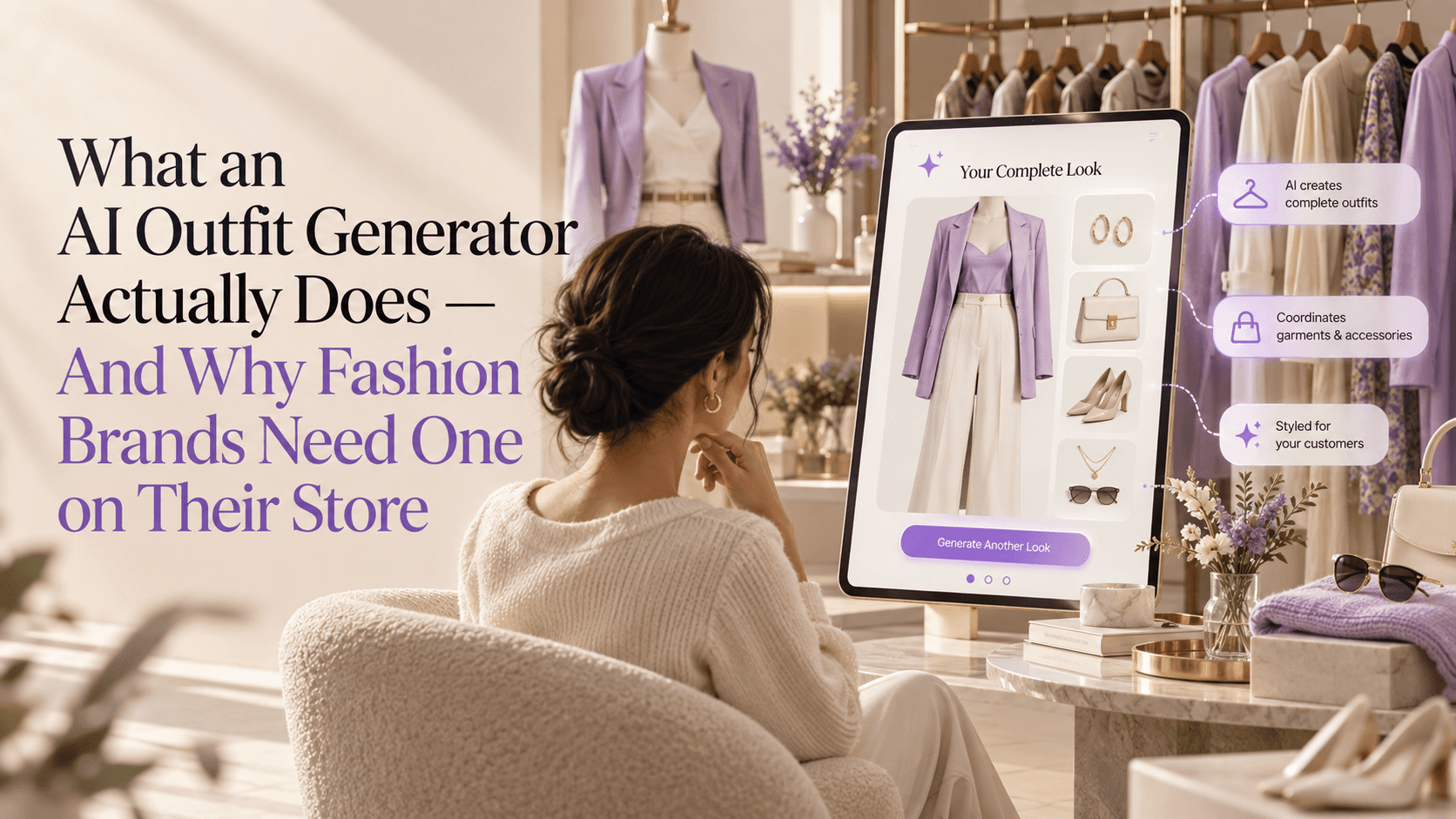
An AI outfit generator takes a natural language input — a brief, a question, a context — and returns a complete outfit assembled from a specific catalog.
"Something for a Diwali party, not too heavy." The generator takes this brief, understands what a Diwali party implies (festive but not necessarily formal, culturally specific aesthetic expectations, occasion appropriate without being overdressed), and selects pieces from the brand's live catalog that form a coherent look for that occasion. Top, bottom, dupatta, footwear, jewelry. Each piece in the shopper's size. Each piece with a rationale.
The output is not a list of products matching keywords. It is a styled decision — a complete look assembled specifically for that shopper's brief, from that brand's catalog.
This is what makes an AI outfit generator different from every other tool in the Shopify ecosystem.
The difference between an AI outfit generator and a recommendation widget
Every Shopify fashion store has some form of product recommendation. "You might also like." "Frequently bought together." "Customers who bought this also bought."
These tools surface products. They do not build outfits.
The distinction matters commercially. A shopper who arrives with an occasion brief ("I need something for my best friend's mehendi") has a decision to make that goes far beyond "which kurta should I buy." They need to know what occasion-appropriate looks like for that event, which pieces from this store work together, whether the complete look fits their budget, and what the whole thing looks like on them.
A recommendation widget answers none of these questions. It surfaces kurtas that other shoppers have bought after looking at this kurta. The shopper is still responsible for the assembly, the judgment, and the styling coherence.
An AI outfit generator answers all of them. It does the assembly. It applies the styling judgment. It presents the complete decision.
This is why outfit-engaged sessions consistently produce 2–3x more items per session than recommendation-widget-engaged sessions. The shopper is not evaluating individual products and deciding whether to add each one. They are evaluating a complete outfit and deciding whether to buy it.
How an AI outfit generator works
There are three layers to a well-built AI outfit generator.
Layer 1: Brief interpretation
The shopper's natural language input is parsed for occasion context (what kind of event, what formality level, what cultural context), aesthetic constraints (if any are stated), practical constraints (budget, comfort, fabric), and personal context (what they already own, what they want to avoid).
A brief like "something elegant for a winter wedding reception, I'm not wearing a sari, budget around ₹15,000" contains four distinct dimensions of information that a well-built system extracts and uses. A keyword search would match "elegant" and "wedding" and return everything tagged that way. An AI outfit generator reasons about what "elegant winter wedding reception, non-saree, ₹15,000" actually requires and builds to it.
Layer 2: Catalog reasoning
The generator cross-references the interpreted brief against the brand's live catalog — filtering for the shopper's size, eliminating out-of-stock items, applying occasion metadata and style attributes to identify candidate pieces, and selecting combinations that work together aesthetically.
This step is where catalog richness matters most. A catalog with detailed occasion tags, style attributes, material and fit data, and complete-look metadata produces significantly better outfit recommendations than a bare catalog with titles and categories. The AI can only reason over what exists in the data.
Layer 3: Taste model application
For returning shoppers, the outfit generator applies the shopper's Style Graph — the accumulated record of what they've liked, skipped, and bought across previous sessions. A shopper who has consistently chosen minimal silhouettes receives outfit recommendations filtered for minimalism. A shopper who always shops in a specific price band sees recommendations calibrated to that band without needing to re-specify it.
The taste model is what makes the outfit generator compound over time. Session four produces better recommendations than session one because the system has four sessions of taste data to work with. This is the mechanism behind the LTV improvement that AI-assisted stores see in their repeat purchase data.
What happens to the numbers
The commercial impact of an AI outfit generator on a Shopify fashion store comes through three levers.
Conversion rate. Shoppers who complete an outfit interaction — who receive a complete look and engage with it — convert at 3–4x the rate of shoppers who browse unassisted. The reason is decision quality. A shopper who received a complete, personalized outfit recommendation has resolved the styling uncertainty that causes most fashion bounces. The decision is made. The add-to-cart follows.
Average order value. Outfit-engaged sessions produce 2.4x more items per session than individual product browsing. A shopper building a complete look for an occasion is buying 3–5 pieces, not one. The basket value on a complete outfit purchase is structurally higher than the basket value on a product page add-to-cart.
Return rate. Shoppers who purchased a complete outfit assembled by an AI — styled specifically for their occasion, their taste, and shown via virtual try-on on their body — are buying with more confidence and better decision-making. Returns are lower because the purchase was better informed. Industry benchmarks show 20–30% fewer returns for outfit-level VTO-assisted purchases versus standard PDP purchases.
What distinguishes a good AI outfit generator from a mediocre one
The category is growing fast and the quality variance is large. Three distinctions that separate tools that move conversion from tools that are impressive in a demo.
Fashion-specific occasion reasoning vs. generic query matching. A generic AI tool can take a query and return products matching keywords. A fashion-specific AI outfit generator understands what different occasions require — the formality gradations of Indian wedding events, the aesthetic spectrum from traditional to contemporary fusion, the cultural specificity of festival dressing. This knowledge is not learned from product metadata alone. It requires fashion domain training.
Outfit assembly vs. product surfacing. The output of an AI outfit generator should be a complete look, not a list of products. Every piece should be selected for how it works with the other pieces, not independently. A system that surfaces five individual products that could each work for the occasion has not built an outfit. A system that returns top, bottom, accessory, and footwear as a coherent styled look has.
Holdout-based measurement vs. attributed sessions. Any vendor can show you a "conversion rate on AI-engaged sessions." This number is almost always overstated because shoppers who choose to use an AI tool are not a random sample — they are higher-intent than average. The only honest measurement is a holdout test: comparing conversion between shoppers who had access to the AI and a control group who didn't. Ask every vendor for this number from a live deployment comparable to your store.
Who benefits most
Every Shopify fashion brand benefits from AI outfit generation, but the impact is largest for brands where:
The catalog is occasion-driven. Indian ethnic and fusion wear, occasion dressing, festive collections, workwear — anywhere the shopper arrives with a specific moment in mind and needs help translating it into a purchase. Occasion-intent traffic converts 3–4x better through AI outfit generation because the tool is solving exactly the problem the shopper has.
The catalog is large enough to require assembly. A 50-SKU catalog can be browsed. A 500-SKU catalog cannot. As catalog size grows, the gap between "shopper finds the right outfit" and "shopper leaves" widens — and AI outfit generation closes it.
The return rate is a margin problem. Every fashion brand has returns. Brands where returns are eroding margin significantly benefit most from the return rate reduction that comes with outfit-level VTO and better-informed purchase decisions.
The repeat purchase rate is below 30%. The taste model compounds. Brands with low repeat rates have the most to gain from a system that improves with every session and gives returning shoppers a materially better experience than first-time visitors.
The consumer behavior is already there
Shoppers are already using AI to figure out what to wear. The question is whether they are doing it on your store or somewhere else.
A shopper who opens ChatGPT, describes their occasion, gets an outfit suggestion, and then navigates to a brand store to buy the pieces is completing a purchase journey that started in AI. The brands that capture this journey are the ones whose stores can continue the conversation — can take the brief the shopper already articulated, build the outfit from their live catalog, and close the sale.
The brands whose stores reset to a product grid when an AI-referred shopper arrives lose the shopper at the moment they were most ready to buy.
The AI outfit generator on your store is not competing with ChatGPT. It is continuing the conversation ChatGPT started.
Related reading
AI Shopping Assistant vs. Product Recommendation Widget · Virtual Try-On for Shopify · The Complete Guide to Outfit Recommendation Engines