New research guide: The Confidence Economy, how AI is changing fashion commerce.
Fashion Commerce
·
September 6, 2026
What Shopify's Best-Selling Fashion Stores Do Differently on Product Pages
Best-selling fashion stores architect product pages as guided decisions, not static displays. Here are the five specific behaviors, from imagery sequencing to complete-look architecture, that make the difference.
Mehul Agarwal, Founder & CEO
Key Takeaways
Top-performing Shopify fashion stores treat product pages as guided decision experiences, not static product displays.
Imagery sequencing, social proof placement, and on-page brief intake are the three most differentiating architectural behaviors separating best-sellers from average stores.
Complete-look architecture, showing the full outfit, not just the item, drives measurable AOV lift by capturing outfit-level purchase intent.
Elara's Style Graph automates all five of these behaviors at scale, without manual merchandising effort.
Introduction: Why Your Product Page Feels Different From Theirs
Store owners and e-commerce directors who study competitor pages often describe the same experience: a rival's product page just feels more confident, more helpful, more like talking to someone who knows what they're doing. The frustration is that the difference is hard to name. It's not obviously the price, the brand, or even the product quality. Something architectural is happening, and it's working.
The thesis here is straightforward: best-selling fashion stores don't simply display products. They architect product pages to guide taste-based decision-making, systematically reducing the friction that causes most fashion e-commerce visitors to leave without buying. That abandonment gap is the defining performance problem in fashion e-commerce, and the product page is where it's won or lost.
This article breaks down five specific, observable behaviors that separate top-performing Shopify fashion stores from the rest. Elara's Style Graph is built to systematize exactly these behaviors, but understanding them mechanically is the starting point.
The Decision Paralysis Problem Fashion Product Pages Must Solve
Fashion shoppers don't arrive at a product page thinking in SKUs. They arrive thinking in situations: something for a rooftop dinner on Saturday, a look that works for back-to-back client meetings, an outfit I can wear to my friend's engagement party without overthinking it. But the product page they land on is organized around item taxonomy, category, colorway, size, material. The mismatch is structural, and it's the root cause of decision paralysis in fashion e-commerce.
Decision paralysis in this context isn't about too many products existing in the world. It's about the absence of a "this is right for you" signal at the moment a high-intent shopper is standing at the decision point. Without taste-based guidance, shoppers default to the safest cognitive move: leaving. This dynamic drives high abandonment rates that define fashion e-commerce performance, every unresolved doubt is a potential exit, and most product pages generate several doubts per visit.
The filter-and-search paradigm that underlies traditional product pages was built for shoppers who know exactly what they want. Most fashion shoppers don't. They have a feeling, an occasion, a vague aesthetic direction, and they need a page that meets them there. Best-selling Shopify fashion stores have recognized this mismatch and solved it at the architecture level, not by writing better bullet points. The five behaviors that follow are how they do it.
Behavior #1: Imagery Sequencing That Mirrors the Styling Decision Process
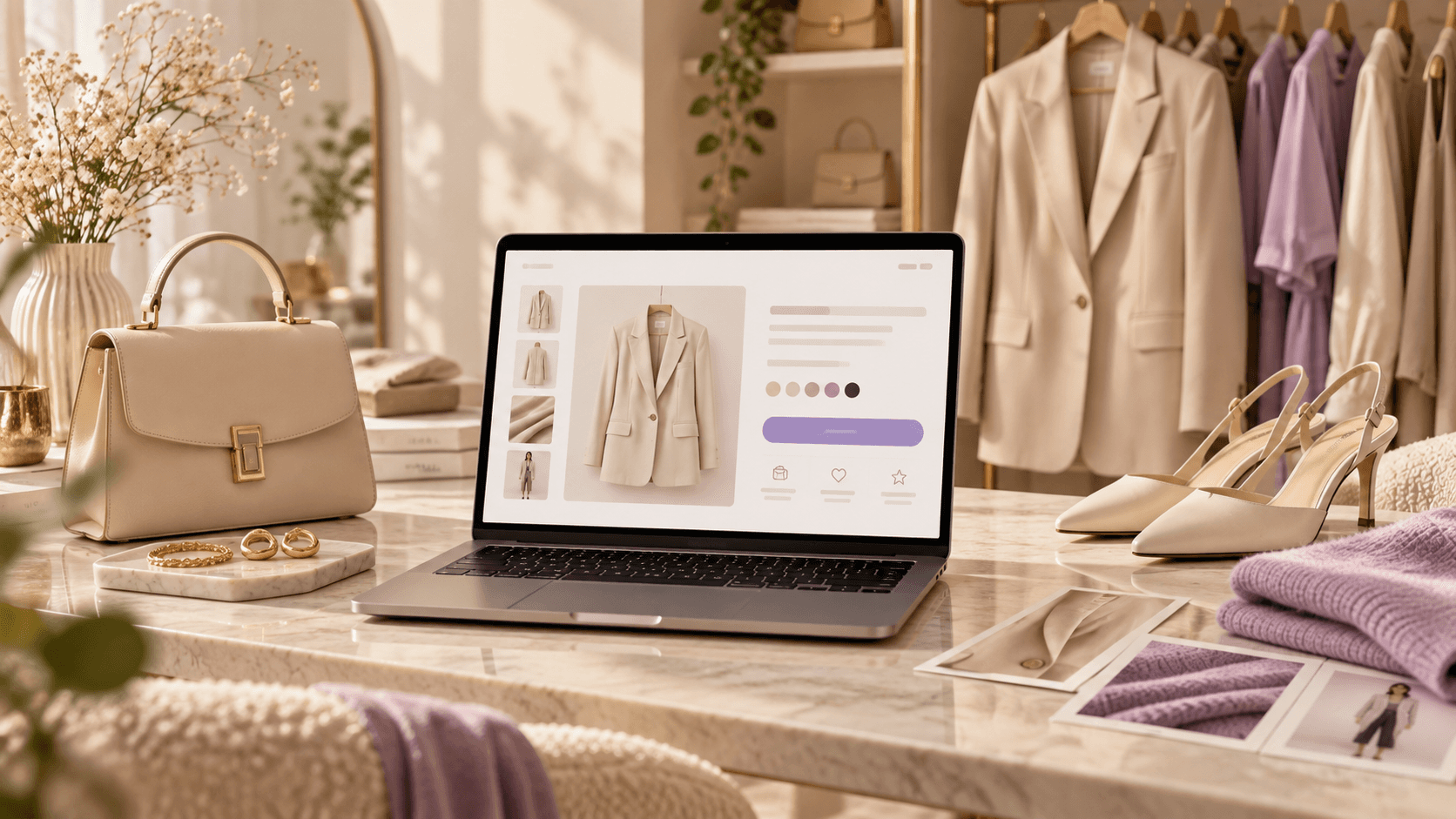
The first thing that separates a best-selling fashion product page from an average one is often invisible to the untrained eye: the order of images. Top-performing Shopify fashion stores sequence product photography the way a skilled stylist would present an item in person, context first, construction second, complete look third.
The sequence works in three stages. The first image is an editorial or lifestyle shot that establishes occasion context, it answers "where would I wear this?" before the shopper has read a single word of copy. The second and third images shift to detail shots: fabric texture, drape on a body, a close-up of a collar or hem. These answer "will this actually work for me?" Finally, complete-look images close the sequence, showing the item styled as part of a full outfit. This last stage isn't just aspirational photography, it's the earliest seed of an upsell.
Contrast this with stores that lead with flat-lay or white-background shots. Those images are technically clean and photograph well in isolation, but they're contextually empty for a shopper who arrived with an occasion in mind, not a product category. A white-background image answers no styling question. It simply confirms the item exists.
Product pages that lead with lifestyle imagery tend to outperform those leading with studio shots on engagement metrics, shoppers spend longer on page and interact with more image frames. The sequencing isn't a photography preference. It's editorial architecture, silent styling guidance that shapes the shopper's decision frame before any copy is processed.
Behavior #2: Social Proof Placed at the Moment of Maximum Doubt
Most Shopify fashion stores include reviews. Best-sellers place them strategically. The distinction sounds subtle, but review placement relative to decision points affects conversion, reviews that appear after the primary decision window has closed function as confirmation rather than persuasion.
The placement logic follows the shopper's doubt sequence. Size and fit reviews belong immediately below the size selector, not at the bottom of the page. A shopper hovering over "Size 8" or "Medium" is experiencing maximum uncertainty at that exact moment. A review that reads "I'm usually between sizes and the 8 fit perfectly through the hips" intercepts that doubt before it becomes a reason to abandon. Occasion-specific reviews ("wore this to a gallery opening, got three compliments") placed near the product description validate the shopper's own use case in real time. User-generated content and styled photos placed near the complete-look section show real people wearing the item in context, not a studio model, but someone who made the same decision the shopper is now making.
The generic star-rating block dumped at the bottom of the page is the most common mistake. It's technically present, but by the time a shopper scrolls there, they've already formed their intent, to buy or to leave. Reviews at the bottom serve the already-convinced; they do nothing for the undecided.
Social proof in fashion functions as a taste-validation signal, not just a trust signal. A shopper isn't only asking "is this brand legitimate?", they're asking "is this right for someone like me?" Reviews placed at friction points answer both questions simultaneously.
Behavior #3: Brief Intake and Styling Context Built Into the Page — Not Behind a Modal
The most underimplemented behavior among average Shopify fashion stores, and the most consistently present among best-sellers, is on-page styling context collection. Rather than routing shoppers to a separate quiz flow or triggering a chatbot modal, high-performing stores embed lightweight context prompts directly into the product page experience.
In practice, this looks like a simple occasion prompt placed near the product description: "What's the occasion?" with two or three selectable contexts that dynamically adjust the styling recommendations shown below. Or it looks like inline styling notes, "Pair with tailored trousers for client meetings; swap for white sneakers and a linen shirt for a weekend edit," that function as micro-brief responses without requiring any user input at all. Some stores use progressive disclosure: a default recommendation set is shown, but a single tap lets the shopper signal their context and receive a tailored view.
The reason this must stay on the page is intent timing. A shopper who has navigated to a specific product page has already filtered, browsed, and committed enough attention to land there. Interrupting that flow with a modal breaks the intent signal at the worst possible moment. That shopper is at peak receptivity, keeping them on-page means the styling guidance lands when it matters most.
This is the behavior that Elara's Conversational Brief Intake feature systematizes. Rather than requiring each store to engineer its own on-page prompt logic, Elara delivers it as an SDK embedded directly into the product page, capturing occasion context inline, feeding it to the Style Graph, and surfacing recommendations without ever pulling the shopper out of their decision moment. The architecture replicates what the best-selling stores are building manually, at scale, without the merchandising overhead.
Behavior #4: Complete-Look Architecture vs. Single-Item Display
That brief intake logic, capturing occasion context and surfacing relevant recommendations inline, is only one piece of the architecture. The other is what happens to the product page itself once you know what the shopper is trying to build.
Most Shopify fashion stores operate on a single-item display philosophy: show the product, perhaps append a "you might also like" carousel at the bottom, and let the shopper do the rest. Best-selling stores reject this model entirely. Their product pages are built around the outfit, not the item, a distinction that sounds subtle but produces measurably different outcomes.
Complete-look architecture has three defining hallmarks. First, the hero section shows the item as part of a styled outfit, with every other piece shoppable from the same page, no hunting, no new tabs. Second, a "Shop the Look" CTA appears above the fold or within the first scroll, not buried after six paragraphs of copy. Third, and most critically, complementary items are selected by styling logic, occasion match, color harmony, formality register, not by purchase co-occurrence data. "Customers also bought" surfaces what people happened to buy together; complete-look architecture surfaces what a stylist would actually pair.
The AOV implication is direct: shoppers who engage with complete-look sections are buying with outfit intent, not item intent. This shift in purchase framing drives higher basket values because the shopper's mental accounting changes, they're building a look, not evaluating a single product.
Replicating this at scale is the hard part. Curating styled looks across a catalog of hundreds of SKUs requires either a dedicated merchandising team or a taste-model-driven system. That's precisely the gap Elara's Complete Look Building feature is designed to close, applying the Style Graph's styling logic automatically, across every product page, without manual curation overhead.
Behavior #5: Decision-Support Copy That Speaks to Occasion, Not Just Product
Feature-list copy and decision-support copy can describe the exact same product and produce radically different conversion outcomes. "100% merino wool, machine washable, relaxed fit" is accurate. "Built for all-day meetings that end at dinner" is useful. The first answers questions no one was asking; the second answers the question every fashion shopper carries onto the page: Is this right for my situation?
Best-selling stores write copy that functions as a decision brief, not a catalog entry. Three tactics define the approach. The occasion-lead sentence comes first, it establishes the context before any material specification, immediately signaling to the shopper whether this product belongs in their life. Explicit styling direction follows: "Wear with tailored trousers for the office; swap for denim on weekends" reduces the shopper's self-styling burden at the exact moment they need it most. Finally, formality and occasion language mirrors how shoppers actually think about their wardrobes, "smart casual," "event-ready," "elevated weekend," rather than defaulting to retailer taxonomy like "midi length" or "relaxed silhouette."
This copy style functions as a text-based brief intake. It anticipates the shopper's occasion context and answers it proactively, without requiring any user input. Shoppers who receive occasion-relevant guidance at the point of decision are more likely to convert, because the cognitive work of self-styling has already been done for them.
The limitation is scale. Writing occasion-first, styling-direction-rich copy for every SKU in a growing catalog is a resource-intensive editorial commitment. Elara's Style Graph operationalizes the same outcome differently: by generating occasion-aware, taste-matched recommendations dynamically, it delivers the decision support that well-written copy provides, without requiring every product description to be manually rearchitected.
How These Behaviors Work Together: The Product Page as a Guided Experience
No single behavior produces the conversion advantage that best-selling fashion stores hold. The gap is structural, it comes from architecting the entire product page as a sequential, guided styling journey rather than a collection of independent modules.
The sequence runs like this: imagery establishes occasion context before a word of copy is read. Decision-support copy validates the shopper's specific use case and reduces self-styling burden. Brief intake captures occasion intent inline and adjusts recommendations in real time. Social proof appears at the exact friction points, beside the size selector, near the product description, where doubt peaks rather than after the shopper has already decided to leave. Complete-look architecture closes the journey by converting item intent into outfit intent, lifting basket value in the process.
Contrast this with the typical Shopify fashion product page: a white-background hero image, a feature-list description written for SEO, a star-rating block at the bottom, and a co-purchase carousel that surfaces whatever happened to be bought together last month. Each element exists, but none of them connect. The shopper arrives with occasion-based intent and leaves with no clearer sense of whether this product belongs in their life.
The competitive implication is straightforward: stores building this architecture manually hold a conversion advantage that requires either a large, specialized merchandising team or an automated system to replicate. Elara for Commerce is the SDK that closes that gap, delivering complete-look building, brief intake, occasion-aware recommendations, and taste-matched social proof sequencing through a single integration, powered by the Style Graph trained on real human styling decisions rather than product metadata or purchase co-occurrence data.
Frequently Asked Questions
Q: How long does it take to see lift from these product page changes?
A: Most Shopify stores implementing complete-look architecture and on-page brief intake report observable engagement changes within the first week, longer time on page, more image interactions, higher click-through to styled looks. Conversion lift typically appears within 14 days, once enough shopper volume has moved through the new experience. Stores using Elara's Style Graph can track this through Elara's analytics dashboard.
Q: Do these behaviors work for all product categories, or just fashion?
A: These behaviors are specifically built for fashion and apparel because they address the occasion-based decision-making that defines fashion shopping. Accessories, footwear, and occasion wear see the strongest lift. Ready-to-wear and basics also benefit significantly. Jewelry and swimwear stores report similar patterns. The core principle, occasion context before item taxonomy, applies anywhere shoppers are buying for a specific situation rather than a generic need.
Q: What if our store doesn't have lifestyle imagery? Can we still implement these behaviors?
A: Yes. Lifestyle imagery accelerates the effect, but it's not required. Stores can start by sequencing existing product photography differently, putting the most contextually useful shot first, placing detail shots second, grouping styled looks last. Decision-support copy and on-page brief intake work with any photography. If you're building a new photography shoot, prioritize lifestyle and styled looks. If you're working with existing assets, resequencing is an immediate, zero-cost starting point.
Q: How do these behaviors relate to Elara's Style Graph?
A: These five behaviors represent what the best-selling fashion stores do manually. Elara's Style Graph automates all of them: it sequences recommendations by occasion context (brief intake), builds complete looks using taste-matched styling logic, places social proof signals at decision points, and generates occasion-aware copy variants dynamically. Rather than requiring a merchandising team to implement each behavior for every SKU, Elara delivers them as a coordinated system through a single SDK integration.
TL;DR: What to Implement First
If you're starting today, prioritize in this order:
Resequence your product imagery: move your most contextual, lifestyle-forward shot to first position. This single change often produces immediate engagement lift with zero technical work.
Add occasion-aware copy to top-performing SKUs: write 2–3 product descriptions using the occasion-first format ("Built for X situation") rather than feature-first. Test against your current copy. Roll out the winning approach to your full catalog.
Place size and fit reviews near the size selector: move your most relevant fit feedback to the point where shoppers are making the size decision, not to the bottom of the page.
Add a styled-look section to your product page: show the item as part of a complete outfit. Make every piece in that look shoppable from the same page. Test "Shop the Look" CTAs above the fold.
Implement on-page occasion intake: add a simple "What's the occasion?" toggle or dropdown near your product description. Use it to dynamically adjust which styled looks and recommendations are shown.
Stores that implement all five behaviors report measurable engagement and conversion improvements. Elara's Style Graph automates this entire sequence, delivering all five behaviors across every product page without manual merchandising overhead.
Conclusion: The Gap Between Noticing and Closing
What separates best-selling Shopify fashion stores from the rest isn't any single tactic, it's intentional page architecture. Imagery sequencing, occasion-aware copy, on-page brief intake, complete-look building, and strategically placed social proof aren't independent features; they're a coordinated system designed to move a shopper from uncertainty to conviction before doubt triggers abandonment.
The honest problem is that most Shopify stores can't replicate this system manually at scale. Maintaining styling logic across hundreds of SKUs, sequencing social proof by friction point, and building complete looks from taste-matched pairs requires either a full merchandising team or automated intelligence, and most stores have neither.
That's the gap Elara for Commerce closes. Delivered as a single SDK integration, powered by the Style Graph trained on real human styling decisions, Elara brings complete-look building, conversational brief intake, and occasion-aware recommendations to any Shopify product page, no data science team, no manual merchandising overhead.
Keep reading

Peak Season, Promotions, Shopify
BFCM 2026 Discount Stacking on Shopify: How Discount Combinations Actually Calculate
Which Shopify discounts can combine, the order they apply in, the limits that bite during Cyber Week, and a test routine to run before 27 November.

Peak Season, Operations, Shopify
BFCM 2026 Shopify Flow Automations: 7 Workflows Fashion Brands Should Set Up Before Black Friday
The Shopify Flow workflows that take routine Cyber Week jobs off your team: low-stock alerts, size-aware sold-out rules, risk holds, VIP tags and a scheduled end-of-sale clean-up.

Peak Season, Marketing, Compliance
GivingTuesday 2026 Charity Promotions: What Shopify Fashion Brands Must Disclose in the US and UK
Planning a give-back capsule for 1 December? How to state the donation clearly, what US and UK rules expect, product-page copy you can adapt, and a launch checklist.