New research guide: The Confidence Economy, how AI is changing fashion commerce.
Peak Season, Marketing, Compliance
·
GivingTuesday 2026 Charity Promotions: What Shopify Fashion Brands Must Disclose in the US and UK
Planning a give-back capsule for 1 December? How to state the donation clearly, what US and UK rules expect, product-page copy you can adapt, and a launch checklist.
Mehul Agarwal, Founder & CEO

Last updated: October 2026
Quick answer: GivingTuesday falls on Tuesday 1 December 2026, the Tuesday after US Thanksgiving. If your Shopify fashion brand promises that a purchase will benefit a charity, say exactly how much goes to which charity, for which products, between which dates, and whether there is a cap. "A portion of proceeds" is not enough under the guidance from the BBB Wise Giving Alliance and the New York Attorney General, and in the UK the Charities Act 1992 requires a statement customers can use to work out the amount. Have a written agreement with the charity before launch, check whether US states require registration, and publish the total raised afterwards.
Charity tie-ins are a natural fit for the end of Cyber Week: shoppers have spent four days hearing about discounts, and a "we give back" day can feel like a better message. For fashion brands, the common formats are a fixed donation per item from a capsule collection, a percentage of sales on one day, or a matched donation. All three are cause marketing, and all three come with disclosure expectations that are easy to overlook.
This guide sets out those expectations in the US and UK, then turns them into product-page copy and a Shopify setup you can use. It is general information, not legal advice; charitable sales promotions are regulated state by state in the US, so check the specifics with counsel for your campaign.
Why "a portion of proceeds" is a problem

The BBB Wise Giving Alliance, which assesses charities against its 20 Standards for Charity Accountability, says under Standard 19 that cause marketing should "specify the actual or anticipated amount of the purchase that will help the charity", giving "5 cents for every box of cereal sold" as an example. It calls terms like "proceeds" or "profits" unclear, and says promotions should also state any time limit and any minimum or maximum amount, such as a cap of "up to $200,000."
The New York Attorney General's Charities Bureau goes further in its "Five Best Practices for Transparent Cause Marketing", as summarised by law firm Proskauer:
Clearly describe the promotion: the charity's name, any donation cap, whether the shopper must do something for a donation to happen, and the start and end dates.
Let consumers easily work out the donation: a fixed dollar amount per purchase, rather than vague wording about a share of proceeds.
Be transparent about what is not apparent: for example, whether a fixed amount is donated regardless of sales, or whether a pink ribbon or colour only raises awareness rather than triggering a donation.
Be transparent on social media: show the per-action donation, the charity, the dates and any minimum or maximum in the post itself.
Tell the public how much was raised: both the company and the charity should publish the total.
For a fashion brand, the practical takeaway is simple: a shopper should be able to read your product page and know exactly what their purchase does.
The US rules: commercial co-venturers
In some US states, a business that advertises that buying its products will benefit a charity is treated as a commercial co-venturer. Cause marketing association Engage for Good notes that New York law defines it this way, and that companies running charitable sales promotions may face registration or reporting requirements in up to seven states, with online campaigns needing a more nuanced analysis of where you are selling.
Engage for Good's list of what a campaign should have:
A written contract with the charity for every campaign, covering the products, territory, donation amount and trigger, campaign period and a final accounting to the charity.
Point-of-sale disclosure of the amount per purchase, any minimum guarantee, any cap, the campaign period and any conditions.
Clarity on flat donations: if you donate a fixed sum regardless of sales, say that purchases will not trigger a donation.
No implied endorsement: do not suggest the charity endorses your products unless it does.
Because a Shopify store sells into every state, check with counsel whether your promotion needs registration in states where you have customers before you announce it.
The UK rules: commercial participators
In the UK, a business that represents that charitable contributions will come from its promotion is a commercial participator under section 58 of the Charities Act 1992, according to law firm Womble Bond Dickinson. Its summary of the requirements:
A written agreement with the charity (or its trading company) that meets the Act's requirements, in place before the promotion starts, covering how the promotion works, when funds are paid and any remuneration you keep.
A statement to customers under section 60(3) that names the charity, or each charity and its share, and states the "notifiable amount": either the amount per item or the total to be donated.
Something customers can calculate. The firm notes that "10% of net profits" would not meet the requirement, because shoppers cannot work out what that means for their purchase.
Breaching the Act is an offence that can lead to a fine, and Womble Bond Dickinson adds that the reputational damage is likely to matter more than the fine itself.
Product-page copy that meets the bar
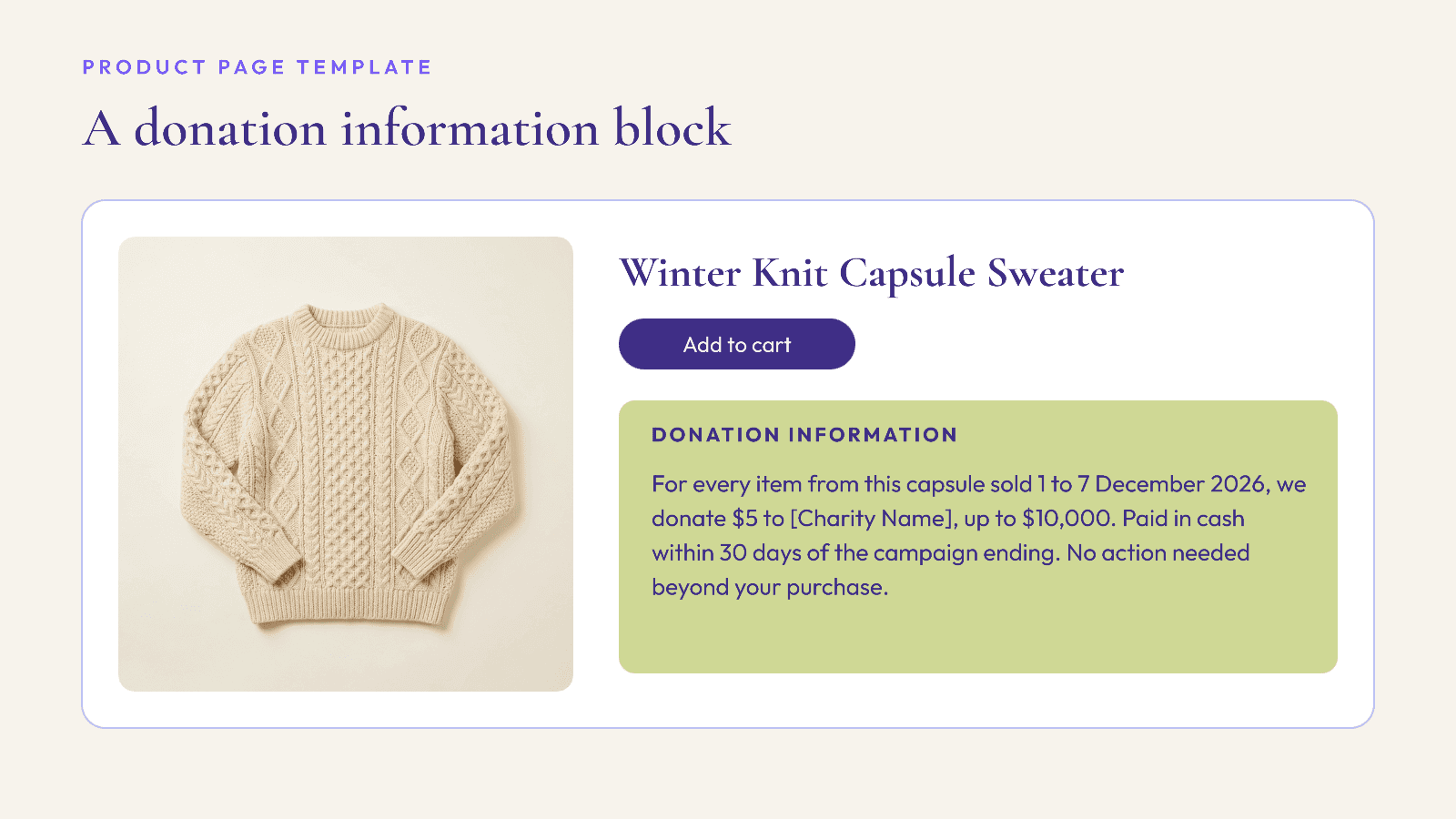
A short "donation information" block, placed next to the price and repeated in the cart, covers what both sets of guidance ask for. A worked example for a capsule collection:
For every item from the Winter Knit capsule sold between 1 and 7 December 2026, we will donate $5 to [Charity Name], up to a maximum of $10,000. Donations are made in cash within 30 days of the campaign ending. No action is needed beyond your purchase.
Adapt it for your format:
Percentage of sales: state the percentage and what it is a percentage of, for example "10% of the item price before tax and shipping", so the shopper can calculate it.
Matched or flat donation: say the donation is fixed and that purchases do not change it, as Engage for Good recommends.
UK customers: make sure the statement names the charity and gives the amount per item or the total, as section 60(3) requires.
Setting it up on Shopify
Scope the products with a collection or tag so the donation block only appears on eligible items, and the campaign dates in your copy match the dates the block is visible.
Show the block in three places: the product page, the cart and the order confirmation email, so the terms travel with the purchase.
Track eligible units automatically. A Shopify Flow workflow on Order paid can tag orders that contain campaign items, which makes the final accounting to the charity a filter rather than a spreadsheet exercise. Our Shopify Flow BFCM workflows guide explains how Flow triggers and tags work.
Stop cleanly at the cap. If you set a maximum, decide in advance how you will remove the block when you reach it, and say so in the terms.
Publish the total. After the campaign, add the amount raised to the campaign page and your announcement email, as the New York guidance recommends.
A GivingTuesday campaign checklist
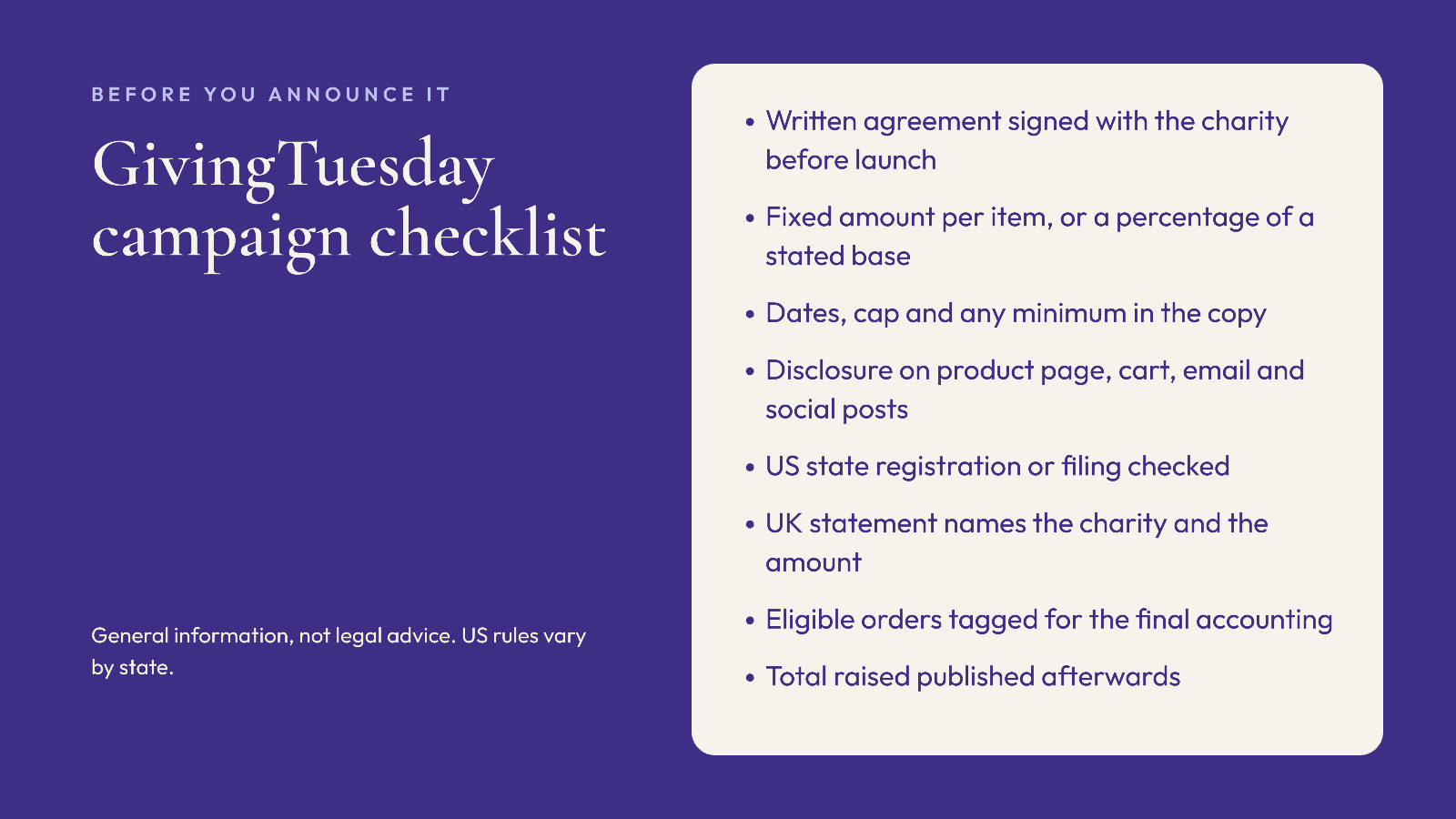
Charity chosen, registration status checked, written agreement signed before launch
Donation stated as a fixed amount per item or a percentage of a stated base
Campaign dates, cap and any minimum written into the copy
Disclosure on product page, cart, confirmation email and every social post
Registration or filing needs checked for US states where you sell
UK statement names the charity and the amount per item or total
Eligible orders tagged for the final accounting
Total raised published after the campaign
Where Elara fits
A cause-led capsule only works if shoppers find it and understand it. Elara for Commerce is an AI shopping assistant for Shopify fashion brands that styles shoppers in conversation, builds complete looks from your synced catalog and offers virtual try-on, so a shopper looking for a gift can be shown the campaign pieces in a full outfit. Industry benchmarks report 4x conversion with AI shopping assistants (Neuwark 2026) and 25% higher average order value (Rep AI 2025); these are industry figures, not Elara results. Book a demo or start the 30-day free trial. For the rest of your peak-season preparation, see the BFCM 2026 site readiness checklist.
FAQ
When is GivingTuesday 2026?
Tuesday 1 December 2026. GivingTuesday is held on the Tuesday after US Thanksgiving, which falls on 26 November in 2026.
Can I say "a portion of proceeds goes to charity"?
It is not recommended. The BBB Wise Giving Alliance calls terms like "proceeds" unclear, the New York Attorney General's guidance asks for a fixed amount per purchase, and UK law requires a statement customers can use to work out the amount.
Do I need a contract with the charity for a one-day promotion?
Engage for Good recommends a written contract for every cause marketing campaign, and in the UK a written agreement is a legal requirement for commercial participators before the promotion starts.
Do I have to register a charitable sales promotion in the US?
Possibly. Some states require commercial co-venturers to register or file reports, and online sales can bring several states into scope. Check with counsel before launch.
Should I publish how much we raised?
Yes. The New York Attorney General's best practices recommend that both the company and the charity publish the total raised.
Keep reading

Peak Season, Promotions, Shopify
BFCM 2026 Discount Stacking on Shopify: How Discount Combinations Actually Calculate
Which Shopify discounts can combine, the order they apply in, the limits that bite during Cyber Week, and a test routine to run before 27 November.

Peak Season, Operations, Shopify
BFCM 2026 Shopify Flow Automations: 7 Workflows Fashion Brands Should Set Up Before Black Friday
The Shopify Flow workflows that take routine Cyber Week jobs off your team: low-stock alerts, size-aware sold-out rules, risk holds, VIP tags and a scheduled end-of-sale clean-up.

Peak Season, Compliance, Shopify
Selling to the EU This Christmas? The GPSR Checklist for Shopify Fashion Brands (2026)
What the EU General Product Safety Regulation means for Shopify fashion brands shipping Christmas orders to the EU: product page information, the EU responsible person, labels, accidents and recalls.