New research guide: The Confidence Economy, how AI is changing fashion commerce.
Returns, Shopify, Strategy
·
October 24, 2026
Size Bracketing Returns: How Shopify Fashion Brands Spot and Cut Them
How to measure size and style bracketing in your Shopify order data, fix size doubt and style doubt at the moment of choice, and set return rules that steer shoppers to exchanges.
Mehul Agarwal, Founder & CEO

Quick answer: Size bracketing is when a shopper orders the same item in two or more sizes, planning to send back the ones that do not fit. You can measure it from your Shopify order export by flagging orders that contain the same product in more than one size, then checking how many of those come back. The fixes that work go at the moment of size choice: garment measurements and fit notes on the product page, help for shoppers who are unsure about style as well as size, and return rules that steer people towards exchanges without punishing your best customers.
Bracketing is one of the few return drivers you can see coming. The order arrives with two sizes of the same dress in the cart, and you already know one of them is coming back. This guide covers how to measure it in your own data, why it happens, the product-page and policy fixes that address it, and where an AI stylist fits.
What size bracketing is, and why fashion brands should care
True Fit, which sells fit technology to apparel retailers, defines size bracketing as "when a shopper orders the same item in multiple sizes" intending to return the ones that do not fit. It also describes sequential bracketing: the shopper returns one size and reorders another, so the bracket happens across two orders instead of one.
There is a third version that size tools miss: style bracketing. The shopper buys the same knit in two colours, or two different dresses for the same wedding, because they cannot decide which looks right. The return is just as certain, but the cause is style doubt, not fit doubt.
How common is it? In its 2025 returns report with the National Retail Federation, Happy Returns found that 51% of Gen Z shoppers bracket their purchases, compared with 24% of Baby Boomers. The same NRF data projected $849.9 billion of US retail returns in 2025, a return rate of 15.8% (reported by Digital Commerce 360). For a fashion brand whose growth customers are younger, bracketing is not an edge case. It is how a large share of your future customers already shop.
Step 1: Measure bracketing in your own Shopify data

You cannot fix what you have not sized. True Fit notes that most retailers undercount bracketing, because bracketed returns are usually logged as "too big" or "too small" rather than as a separate category. Here is a practical way to measure it without new software:
Export orders with line items from Shopify admin (Orders, then Export, as a CSV of all orders in a recent 90-day window).
Group line items by order and product. Any order with the same product title appearing with two or more different size variants is a same-order bracket.
Check sequential brackets. For returned items, look for the same customer reordering the same product in a different size within a few weeks.
Join to your returns. Calculate what share of all returned units came from bracketed orders, and the return rate on bracketed orders compared with the rest.
Read your return reasons. True Fit suggests filtering return reason codes for size and fit (wrong size, too large, too small) and checking customer service or chat logs for sizing questions.
True Fit's rule of thumb is that if 10% or more of your returns follow the bracketing pattern, "you have a measurable bracketing problem". To put a cost on it, run your numbers through the Elara fashion return-rate calculator, then compare bracketed and non-bracketed orders.
Step 2: Find out which products drive it
Bracketing often concentrates in part of a catalogue. When you have the export, rank products by bracket rate. Likely candidates to check first:
Fitted categories where a size up or down changes the garment: tailored trousers, jeans, structured blazers, bodycon dresses.
New or inconsistent fits, where a product runs differently from the rest of your range.
Occasion pieces (wedding-guest dresses, party wear), where the stakes are high and shoppers hedge on both size and style.
Products with thin size information: a generic size chart, no model measurements, no fit notes.
That ranked list tells you where to spend effort first. Fixing the ten most-bracketed products can matter more than a sitewide change.
Step 3: Fix size doubt at the moment of choice

True Fit's argument is that the intervention has to happen at "the moment of size selection", on the product page, before add to cart. Bracketing is a rational response to uncertainty; remove the uncertainty and the reason to bracket goes with it.
Publish garment measurements, not just body measurements. A body chart tells shoppers what size they are; a garment chart (chest, waist, rise, inseam, length, measured flat) tells them how this piece will actually fit compared with something they already own.
Add a plain-language fit note to every bracketed product. "Runs small in the hips, size up if between sizes" does more than any chart, and your returns data already tells you which products need it.
Show model size and height on every product image set, including at least one model outside the sample size if you can.
Flag multi-size carts gently. True Fit describes prompting shoppers who add the same item in two sizes to get a size recommendation instead. A short, helpful message ("Not sure between an 8 and a 10? Here is how this one fits") is better than a warning.
Use size tools where fit is the real issue. Dedicated fit tools exist for exactly this. True Fit reports that Moosejaw's bracketing rate fell 24% over a year after it added size recommendations at the point of choice; that is the vendor's own published claim, so treat it as a direction rather than a benchmark.
Step 4: Treat style bracketing as a separate problem
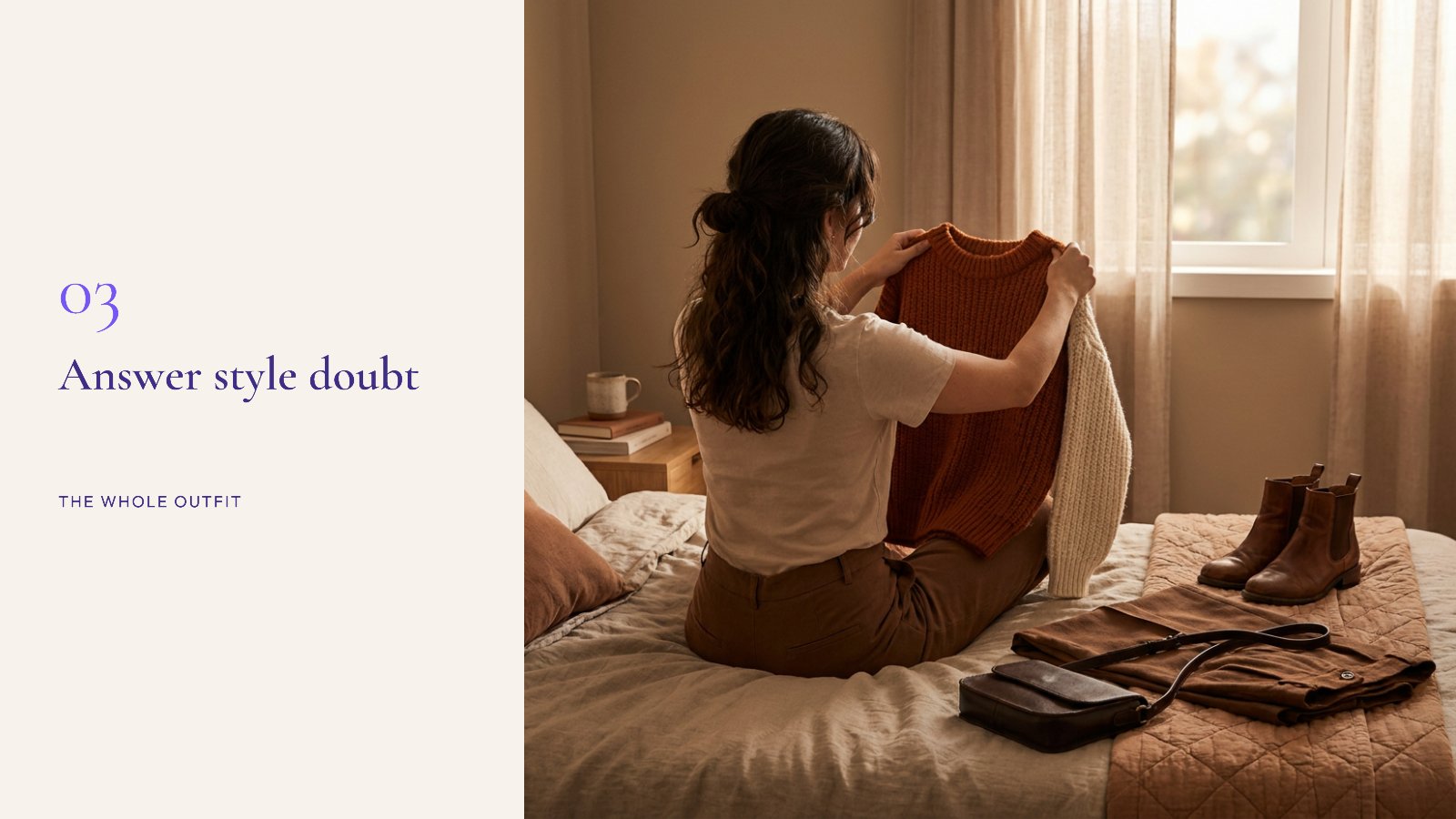
Size tools answer "which size?". They do not answer "which one?", and that is the question behind style bracketing: two colourways of the same knit, three dresses for one wedding, a jacket ordered "to see how it looks with my trousers".
Style doubt is reduced by showing the shopper the whole outfit, not the single product:
Complete-the-look on the product page, so the shopper sees what the piece is worn with, from your own catalogue.
Occasion guidance. "What should I wear to a winter wedding?" is a styling question; a product grid cannot answer it, a stylist can.
Full-outfit try-on. Seeing the complete look on themselves, rather than one garment on a model, is what settles "which colour suits me?".
This is where an AI stylist earns its place. Elara for Commerce takes the shopper's brief (occasion, budget, style), builds complete looks from your catalogue and lets shoppers try the full outfit on virtually before they buy, so the decision between two colourways happens before checkout rather than after delivery. For a deeper look at how try-on placement affects returns, see our guide to what virtual try-on actually reduces.
Step 5: Set return rules that steer behaviour without punishing it

Shopify's return rules give you several levers. According to Shopify's help centre you can:
Set a return window (14, 30 or 90 days, unlimited or custom), and override it for specific collections, products or variants.
Offer free return shipping, a flat-rate fee per return, or customer-paid labels.
Charge a restocking fee as a percentage (Shopify notes it is not deducted automatically; you deduct it when you create the refund).
Mark collections or products as final sale.
Use them carefully. Free returns are part of why people buy: in a Digital Commerce 360 and Bizrate Insights survey, 54.2% of shoppers said they consider free return shipping when buying. A blanket fee aimed at bracketers also lands on every honest customer. Better patterns:
Make exchanges free and refunds cost something. A bracketing shopper who exchanges an 8 for a 10 keeps the revenue with you.
Target only the products that bracket most, for example with a return window override on that collection rather than a sitewide change.
Check the law in each market. In the UK and EU, online shoppers have a statutory cancellation right that final-sale settings do not remove; our worn partywear returns guide covers the detail.
Say it plainly on the product page, next to the size selector, not only in the policy.
What not to do
Do not block multi-size carts. You will lose the sale, not the bracket.
Do not judge success on return rate alone. If returns fall but conversion falls further, you have moved the problem. Track net revenue per order and kept units.
Do not treat all bracketers the same. A Gen Z customer who brackets and keeps one item every month may be one of your most valuable customers.
FAQ
What is bracketing in ecommerce?
Bracketing is ordering several versions of the same item, usually in different sizes, with the plan to return the ones that do not fit. Shoppers also bracket on style, ordering two colours or two styles and keeping one.
How common is size bracketing?
Happy Returns' 2025 report with the NRF found 51% of Gen Z shoppers and 24% of Baby Boomers bracket their purchases.
How do I find bracketing in my Shopify store?
Export orders with line items and flag orders that contain the same product in more than one size. Then compare the return rate on those orders with the rest, and check for customers who return and reorder the same item in a different size.
Should I charge a restocking fee to stop bracketing?
Use it selectively. Shopify's return rules let you set a percentage restocking fee and edit it on individual returns, but many shoppers weigh free returns when deciding to buy, so free exchanges with a fee on refunds is often a gentler lever.
Does virtual try-on reduce bracketing?
It helps most with style bracketing, where the doubt is how a piece looks, especially when shoppers see the complete outfit on themselves. For pure size doubt, garment measurements, fit notes and size recommendation tools do more.
What is sequential bracketing?
True Fit uses the term for a shopper who returns one size and reorders another, so the bracket is spread across two orders.
See where bracketing is costing you
Run your numbers through the fashion return-rate calculator first. If style doubt is part of the picture, Elara for Commerce helps shoppers settle on the right look before checkout with complete outfits and full-outfit try-on. Book a demo or start the 30-day free trial.
Keep reading

Peak Season, Influencer Marketing, Compliance
Creator Gifting Disclosure Rules for Fashion Brands (FTC and UK)
Sending knitwear and party pieces to creators this holiday? What the FTC, ASA and CMA say about gifted products, which labels work, and a brief to send with every parcel.
October 23, 2026

Peak Season, Operations, Shopify
Christmas Gift Orders on Shopify: Wrap, Messages and Gift Receipts
How to set up gift wrap as a product, capture gift messages, print packing slips without prices and give gift recipients an easy exchange this Christmas.
October 23, 2026

Returns, Peak Season, Policy
Worn Partywear Returns: UK and EU Rules for Shopify Fashion Brands
What UK and EU law lets you deduct when party outfits come back worn, a return policy that holds up, and how to set it in Shopify's return rules before January.
October 23, 2026