New research guide: The Confidence Economy, how AI is changing fashion commerce.
Peak Season, Influencer Marketing, Compliance
·
October 23, 2026
Creator Gifting Disclosure Rules for Fashion Brands (FTC and UK)
Sending knitwear and party pieces to creators this holiday? What the FTC, ASA and CMA say about gifted products, which labels work, and a brief to send with every parcel.
Mehul Agarwal, Founder & CEO

Quick answer: If you send a creator a free product this holiday season, treat the post as one that needs disclosure, even if you asked for nothing in return. In the US, the FTC says free products still need disclosing and that "Gifted by [Brand]" is generally enough when a free product is all the creator received. In the UK, the CMA treats a gift as payment, and the ASA's guidance lists "gifted" as a riskier label, recommending "Ad" whenever you had any control over the content. Labels go at the start of the post or video, not buried in hashtags, and your brand shares responsibility for getting it right.
November and December are peak gifting months for fashion brands: party edits, knitwear drops and gift guides all go out to creators in the hope of a haul video or an outfit post before Black Friday on November 27 and the Christmas shipping cut-offs. That is also when disclosure mistakes are most likely, because seeding moves fast, involves dozens of creators, and often has no written brief at all.
The stakes have risen in the UK. Since April 6, 2025, the Digital Markets, Competition and Consumers Act has let the Competition and Markets Authority enforce consumer law directly, with fines of up to £300,000 or 10% of annual global turnover, whichever is higher, according to the UK law firm Stephens Scown, which notes that brands, agencies and influencers carry equal responsibility. This guide sets out what the US and UK rules actually say about gifted products, and turns them into a seeding brief you can send with every parcel.
Rule 1: a free product counts

The most common misunderstanding in fashion seeding is that a gift with no strings attached is not advertising. Both regulators disagree.
United States. The FTC's own FAQ on its Endorsement Guides says free products still require disclosure, and that it "doesn't matter" that a creator is not required to review everything they receive. The test is whether knowing about the gift could affect how the audience weighs the recommendation. For a free product alone, the FTC says "Gifted" on its own is ambiguous, but "Gifted by XYZ" is generally sufficient.
United Kingdom. The joint ASA and CMA influencer guidance says that under consumer law, payment includes "a free product/service (whether requested or received out of the blue)." The ASA only steps in where the brand also had some control over the content, such as specifying words, hashtags, images or approval rights. The CMA's rules apply regardless of control. So an unconditional gift still needs a clear label for UK audiences, and once you add any brief or approval, it needs an "Ad" label.
In practice: if you ship to creators in both countries, write your brief to the stricter UK standard.
Rule 2: where the label goes matters as much as the word
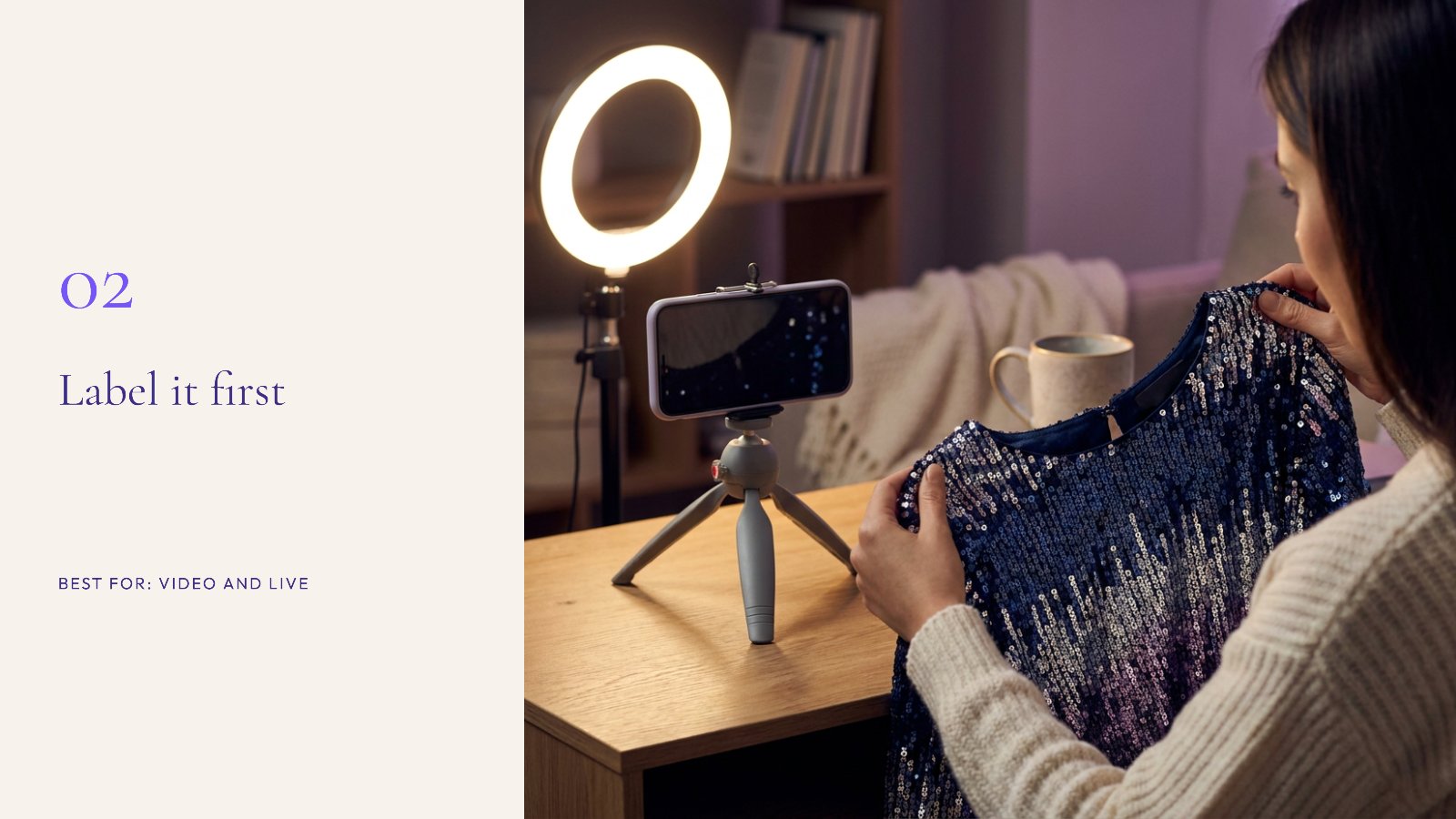
Both regulators care about whether a viewer will actually see the disclosure before they engage.
At the start. The FTC says disclosures should come at the beginning, close to the endorsement, and that ones in the middle or at the end are "easier to miss." The ASA guidance says the label must appear before anyone clicks "see more," for example in the first line, title, thumbnail or image.
In the video, not only the caption. For video, the FTC says to disclose in the video itself, ideally both on screen and out loud. A TikTok or YouTube description alone is not enough.
Repeated on live streams. Viewers join at any time, so the FTC recommends continuous or periodic disclosure during a live shopping session.
Not hidden in a hashtag pile. Both bodies say a label buried among other hashtags, in a comment, or behind a click does not count.
Platform tools are not a shield. The FTC says built-in branded content tools are not automatically sufficient, and that responsibility "rests with the influencer and the brand." It recommends adding your own disclosure as well.
Rule 3: the words that work, and the ones that do not
The two countries accept slightly different wording, which is why a single global brief should spell it out.
Acceptable in the US, per the FTC: "Ad," "#ad" or "Ad:" at the start; "Sponsored by [Brand]"; "Paid post by [Brand]"; "[Brand] paid me to tell you about it"; and "Gifted by [Brand]" when the only connection is a free product.
Not adequate in the US: "#ambassador," "partner," "thank you," "#comped," "#hosted," "#client" and similar terms on their own. Tagging a brand is also not a disclosure; the FTC says it is an endorsement, not a statement of a connection.
Acceptable in the UK, per the ASA: "Ad," "Advert," "Advertising," "Advertisement" or "Advertisement feature," with or without a hashtag.
Labels the ASA lists as risky or inadequate: "Gifted," "Sponsored," "Supported by," "In association with," "Thanks to [brand]," "#sp," "#spon," "Affiliate" and "aff."
Affiliate links need their own disclosure. The FTC gives "I get commissions for purchases made through links in this post" as an example and says "affiliate link" alone is not enough.
Rule 4: your brand is responsible too

Neither regulator lets a brand hand the problem to the creator. The FTC expects advertisers to have "reasonable programs in place to train and monitor members of their network," including telling creators how to disclose, checking posts periodically, and acting when something is wrong. It specifically says creators who received only free products still need disclosure instructions, and that using an agency does not remove the brand's responsibility. It also recommends pre-approving paid posts because short-lived Stories are hard to monitor afterwards.
The ASA and CMA guidance says responsibility is shared between the creator, the brand and any agency, and that the CMA expects everyone in the chain to have robust compliance processes.
For fashion brands that seed at volume, that means a written process, not good intentions:
One brief template, sent with every gift.
A named person who checks posts within 48 hours of going live and asks for fixes.
A simple log of who received what, when, and whether the post was labelled.
A holiday seeding brief that keeps everyone compliant
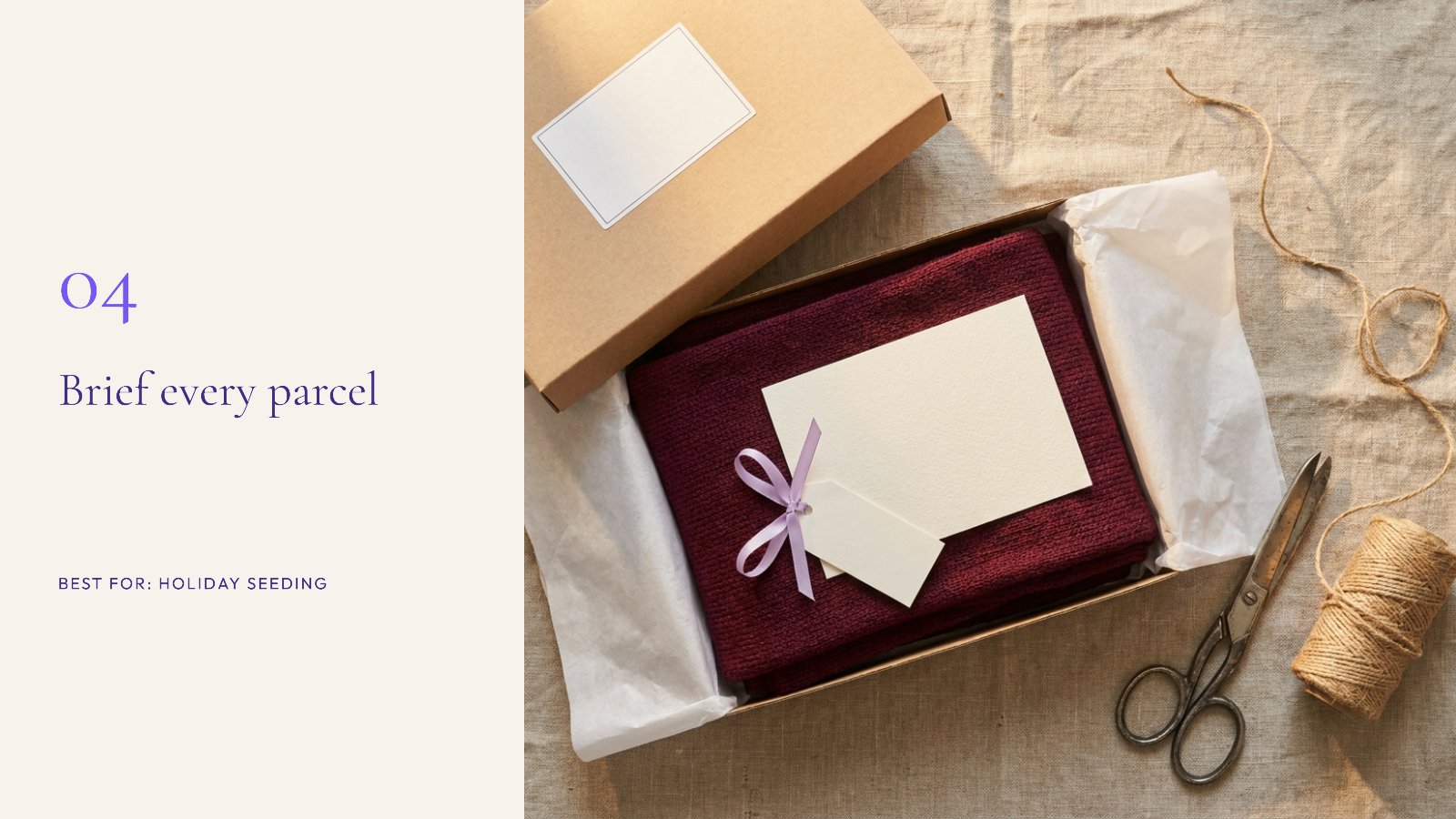
Put this in the parcel as a printed card and in the email that confirms shipping. Keep it short enough that a creator will actually read it.
What this is. "This [product] is a gift from [Brand]. You are not obliged to post, but if you do, please label it."
The label to use. For US audiences: "Gifted by [Brand]" at the start of the caption, or "Ad" if we have agreed anything about the content. For UK audiences: "Ad" at the start of the caption, or on screen in the first seconds of a video.
Where to put it. First line of the caption, on screen in video and said out loud, and repeated during any live stream.
Affiliate or discount codes. If we have given you a code or a commission link, say so next to the link, for example "I earn a commission if you buy through this link."
Claims. Describe the product in your own words. Do not repeat claims about fabric or sustainability unless they are on our product page.
Contact. Who to email if they are unsure.
If you manage creators through Shopify Collabs, Shopify's help center says it lets merchants send gifts and discount codes, track affiliate sales and pay creators, and connect Shopify Flow for automation on eligible plans. Collabs is not available on the Starter and Retail plans. Use the same brief there: the tool handles logistics, not disclosure.
Gifting also brings new traffic at the busiest time of year. Our playbook on holiday party occasion edits covers how to turn that traffic into complete-look purchases, and our guide to BFCM review requests and fake review rules covers the related rules on reviews.
FAQ
Do creators have to disclose a gifted product if we did not ask them to post?
In the US, the FTC says free products still need disclosing when the gift could affect how the audience weighs the post, and recommends always disclosing to be safe. In the UK, the CMA treats a free product as payment whether or not you asked for anything.
Is "#gifted" enough?
In the US, the FTC says "Gifted" alone is ambiguous but "Gifted by [Brand]" is generally sufficient for a free product. In the UK, the ASA lists "gifted" as a riskier label and recommends "Ad" where the brand had any control over the content.
Does Instagram's or TikTok's paid partnership tag count as disclosure?
Not automatically. The FTC says platform tools are not necessarily sufficient and recommends adding your own clear disclosure as well.
Who gets fined if a creator does not label a post?
Responsibility is shared. The FTC expects brands to train and monitor creators, and the ASA and CMA guidance says the creator, brand and any agency are all responsible. In the UK, the CMA can now fine traders directly, up to £300,000 or 10% of global turnover.
How should affiliate links be disclosed?
Next to the link, in plain words. The FTC's example is "I get commissions for purchases made through links in this post," and it says "affiliate link" alone is not adequate.
This guide summarises regulator guidance as of October 2026 and is not legal advice; check the FTC, ASA and CMA pages, or a lawyer, for your specific programme.
When creator posts send new shoppers to your store, Elara for Commerce greets them with an AI shopping assistant that turns "I saw this on a creator's feed" into a complete outfit they can try on and buy. Book a demo or start the 30-day free trial.
Keep reading

Peak Season, Operations, Shopify
Christmas Gift Orders on Shopify: Wrap, Messages and Gift Receipts
How to set up gift wrap as a product, capture gift messages, print packing slips without prices and give gift recipients an easy exchange this Christmas.
October 23, 2026

Returns, Peak Season, Policy
Worn Partywear Returns: UK and EU Rules for Shopify Fashion Brands
What UK and EU law lets you deduct when party outfits come back worn, a return policy that holds up, and how to set it in Shopify's return rules before January.
October 23, 2026

Peak Season, Google Shopping, Virtual Try-On
Google Virtual Try-On: Product Image Checklist for Fashion Brands
Google now shows your clothes on models and on shoppers' own photos. Image rules, Shopify feed fixes and a five-week plan to be try-on ready by Black Friday.
October 22, 2026