New research guide: The Confidence Economy, how AI is changing fashion commerce.
Returns, Peak Season, Policy
·
October 23, 2026
Worn Partywear Returns: UK and EU Rules for Shopify Fashion Brands
What UK and EU law lets you deduct when party outfits come back worn, a return policy that holds up, and how to set it in Shopify's return rules before January.
Mehul Agarwal, Founder & CEO

Quick answer: You can protect holiday partywear from "wear once and return" without breaking the law, but how you do it depends on where you sell. In the UK and EU, online shoppers keep a 14-day right to cancel, so you cannot simply make party dresses final sale; what the law allows is a deduction from the refund when an item has been handled beyond what a shopper could do in a shop, provided you told them about their cancellation rights. In the US, your published policy does most of the work. On Shopify, set a shorter window or final sale (where lawful) for partywear with return rule overrides, show any restocking fee upfront, and inspect every returned item before you refund it.
December is party season, and January is when the party clothes come back. Sequinned dresses, velvet suits and satin slips are exactly the items most exposed to "wardrobing," which the chargeback firm Chargebacks911 defines as a type of return fraud committed by legitimate shoppers who buy an item intending to return it after using it, such as an outfit worn once. It is hard to prove, awkward to challenge, and easy to handle badly, either by refunding everything or by refusing returns in ways the law does not allow.
This guide sets out what UK and EU law actually permits, how to write a partywear return policy that holds up, and how to configure it in Shopify's return rules before the holiday party rush. For the wider January returns plan, see our holiday returns and January exchanges playbook.
What the law lets you do in the UK and EU

United Kingdom. Under regulation 34 of the Consumer Contracts Regulations 2013, published on legislation.gov.uk, a trader can recover the amount by which goods have lost value because of handling "beyond what is necessary to establish the nature, characteristics and functioning of the goods," up to the contract price. The regulations define that test by comparison with a shop: handling goes too far if it exceeds what might reasonably be allowed in a shop. The deduction can come off the refund.
Two conditions matter:
You must have told the customer about their right to cancel. Regulation 34(11) says the deduction right does not apply if the trader failed to provide that information.
You must refund on time. Where you have not offered to collect the goods, the refund is due within 14 days of receiving them back, or of the customer providing evidence of sending them, if that is earlier.
European Union. Article 14(2) of the Consumer Rights Directive sets the same principle: the consumer is liable only for diminished value resulting from handling beyond what is needed to establish the nature, characteristics and functioning of the goods, and not at all if the trader failed to give the required withdrawal information.
What this means in practice: trying a dress on at home, as you would in a fitting room, is normal handling. A dress that comes back with make-up on the neckline, a smell of perfume and smoke, or stretched seams has been worn, and you may deduct for the loss of value. You generally cannot refuse the cancellation outright, and the deduction should reflect the actual loss, up to the price paid.
United States. The FTC's Cooling-Off Rule, which lets buyers cancel some sales within three business days, does not cover sales "made entirely online, by mail, or telephone," according to the FTC's consumer guidance. So for change-of-mind returns your published policy is what customers and card networks will look at. Make it clear, visible before purchase, and consistent with what your team actually does. State rules on how return policies must be disclosed vary, so check those for the states you sell to most.
This is a summary, not legal advice; check the regulations or a lawyer for your situation.
Write a partywear policy that holds up
A good policy tells the honest customer exactly what to do and gives your team a fair basis for decisions. For occasionwear, include:
The condition you expect. For example, "unworn, unwashed, with all tags attached." Chargebacks911 recommends stating expected condition and that every return is inspected before a refund.
A clear window. Chargebacks911 suggests 14 to 30 days for wearable items. For UK and EU customers, your window cannot be shorter than the 14-day statutory cancellation period plus 14 days to send items back.
How deductions work for UK and EU customers: that items handled beyond trying on may receive a reduced refund reflecting the loss in value, and that you will explain any deduction.
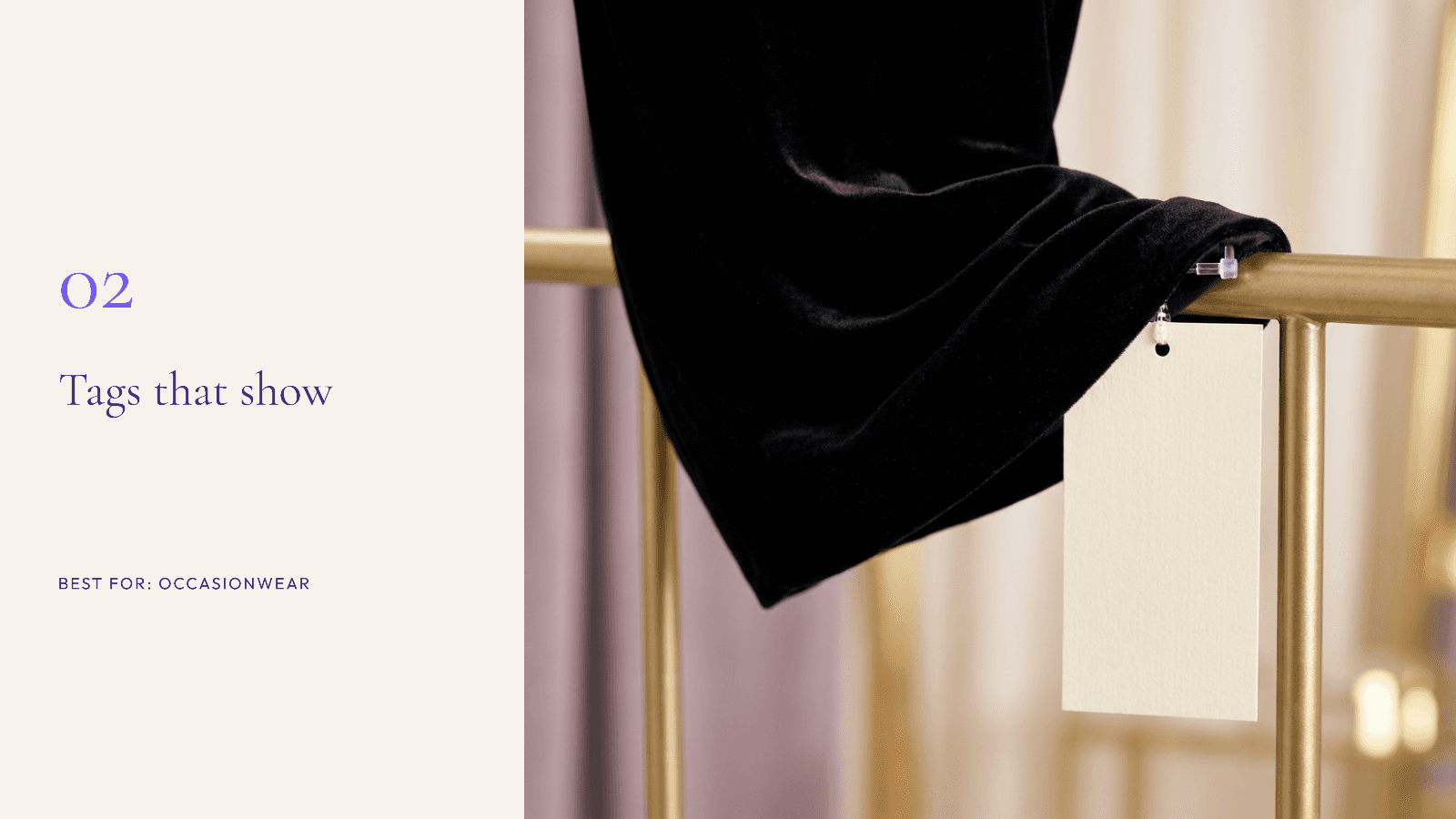
Visible tags. A large swing tag or a tamper-evident tag attached somewhere visible when worn, such as the outside of the hem, makes it hard to wear the item to an event without removing it. Chargebacks911 suggests tag placements that are hard to hide or reattach.
Where it lives. On the product page for partywear, in the cart, in the order confirmation email, and on the packing slip.
Set it up in Shopify's return rules
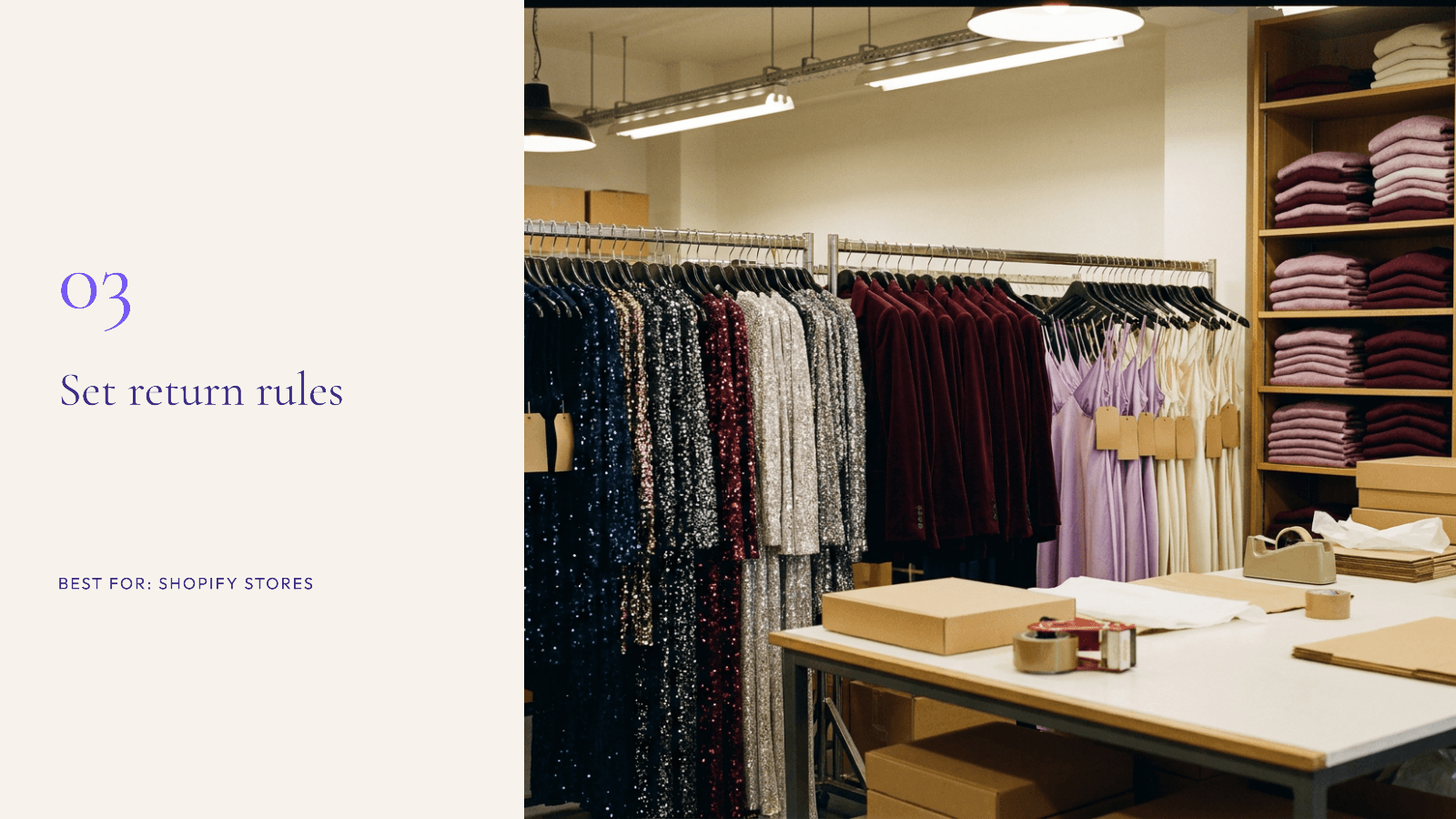
Shopify's help center describes return rules that let you match the policy to the product:
Default window and overrides. Choose 14, 30 or 90 days, unlimited, or a custom number of days, and set overrides for specific collections, products or variants. If an item falls under several overrides, the shortest applies. A "Party edit" collection can therefore carry its own window.
Final sale. You can mark specific collections or products as final sale, and customers cannot request returns or cancellations for them. Use this carefully: for UK and EU distance sales, final sale does not remove the statutory cancellation right, so reserve it for markets and items where it is lawful.
Restocking fees. A restocking fee is set as a percentage, is shown to customers when they request a return, can be edited per return or item, and applies only to returns from fulfilled orders. Return fees are not deducted from refunds automatically; you deduct them when you create the refund.
Return shipping. Offer free returns, a flat fee per return, or customer-bought labels. Shopify's help center notes that from October 23, 2026, US-shipped orders using Shopify Tax or Tax Platform may be charged tax on return shipping fees, where taxable, but not on restocking fees.
Exchanges. Exchanged items get their own return window from their own delivery date, which matters if a customer swaps sizes in late December.
Self-serve returns, when turned on, show customers only eligible items with fees and an estimated refund, which sets expectations before the parcel is sent.
Inspect returns properly, and document them

A fair deduction needs evidence. Chargebacks911 lists the signs inspectors should look for: deodorant or lipstick marks, the scent of perfume or cologne, dirt or debris, and stretched collars or sleeves, along with damaged or reattached tags. Its advice is to inspect thoroughly before refunding or restocking, because rushed checks miss subtle signs.
Build a simple routine for the January peak:
Photograph every partywear return on arrival, including the tag, the underarms, the neckline and the hem.
Grade it against your stated condition: resaleable as new, resaleable after steaming, or diminished.
Record the deduction and the reason on the return in Shopify, and tell the customer in plain words.
Escalate repeat cases to a manager rather than deciding at the bench.
Prevent the problem upstream
The cleanest fix is a customer who buys the right dress the first time. Some partywear comes back because the fit, length or colour was wrong for the occasion, not because of fraud. Clear measurements, honest fabric notes (sequins scratch; satin shows sweat marks), occasion guidance and complete-look suggestions all reduce returns that were never intended as wardrobing. Our playbook on holiday party occasion edits covers how to merchandise for that.
FAQ
Can I refuse a return because the customer wore the dress?
In the UK and EU you generally cannot refuse the cancellation of an online purchase, but you can deduct for diminished value caused by handling beyond what a shopper could do in a shop, if you told them about their right to cancel. In the US, your published policy usually governs change-of-mind returns.
Can I make party dresses final sale?
Shopify lets you mark collections or products as final sale. For UK and EU online customers, that does not remove the statutory 14-day cancellation right, so use final sale only where it is lawful for the market.
How do I charge a restocking fee on Shopify?
Set it as a percentage in Shopify's return rules. It is shown to customers when they request a return, applies to fulfilled orders, and you deduct it when you create the refund.
How quickly must I refund a UK customer?
Within 14 days of receiving the goods back, or of the customer providing evidence of sending them if that is earlier, when you have not offered to collect them, under regulation 34 of the Consumer Contracts Regulations 2013.
What should staff check on a returned party outfit?
Tags, make-up or deodorant marks, perfume or smoke smells, dirt, and stretched seams, according to Chargebacks911. Photograph the item and record the grade and any deduction.
Fewer wrong-fit purchases mean fewer January returns to inspect. Elara for Commerce gives shoppers an AI stylist that builds complete party looks from your catalog and lets them try outfits on virtually before they buy. Book a demo or start the 30-day free trial.
Keep reading

Peak Season, Influencer Marketing, Compliance
Creator Gifting Disclosure Rules for Fashion Brands (FTC and UK)
Sending knitwear and party pieces to creators this holiday? What the FTC, ASA and CMA say about gifted products, which labels work, and a brief to send with every parcel.
October 23, 2026

Peak Season, Operations, Shopify
Christmas Gift Orders on Shopify: Wrap, Messages and Gift Receipts
How to set up gift wrap as a product, capture gift messages, print packing slips without prices and give gift recipients an easy exchange this Christmas.
October 23, 2026

Peak Season, Google Shopping, Virtual Try-On
Google Virtual Try-On: Product Image Checklist for Fashion Brands
Google now shows your clothes on models and on shoppers' own photos. Image rules, Shopify feed fixes and a five-week plan to be try-on ready by Black Friday.
October 22, 2026