New research guide: The Confidence Economy, how AI is changing fashion commerce.
Peak Season, Payments, Operations
·
Cyber Week 2026 Fraud and Chargebacks: A Shopify Playbook for Fashion Brands
How to triage risky orders with Shopify fraud analysis, stop card testing, and build chargeback evidence that wins, including Visa's Compelling Evidence 3.0 rules.
Mehul Agarwal, Founder & CEO

Last updated: October 2026
Quick answer: Cyber Week fraud and chargebacks are mostly decided before you ship. On Shopify, wait for fraud analysis to finish on every card order, hold medium and high risk orders until you have confirmed them with the customer, and cancel orders that look like card testing rather than fulfilling them, because Shopify says fulfilling high-risk orders "can result in a higher number of chargebacks." Then set up for the disputes that do arrive: tracking with delivery confirmation on every parcel, policies shown at checkout, saved customer emails, and a calendar for response deadlines, which Shopify says are usually 7 to 21 days.
Black Friday falls on 27 November 2026 and Cyber Monday on 30 November. For fashion brands, that week can bring more first-time customers, larger baskets and gift orders shipping to addresses that differ from the billing address, which makes fraud harder to spot, and the chargebacks that follow arrive in December and January, when the team is busiest or away.
This playbook covers what Shopify's fraud tools actually tell you, how to triage risky orders during the peak, what evidence wins each type of dispute according to Shopify's own guidance, and how Visa's Compelling Evidence 3.0 rules reward brands that capture the right order data. If you are also tightening your operations for peak, our BFCM 2026 site readiness checklist covers the rest of the stack.
What Shopify's fraud analysis tells you, and what it does not
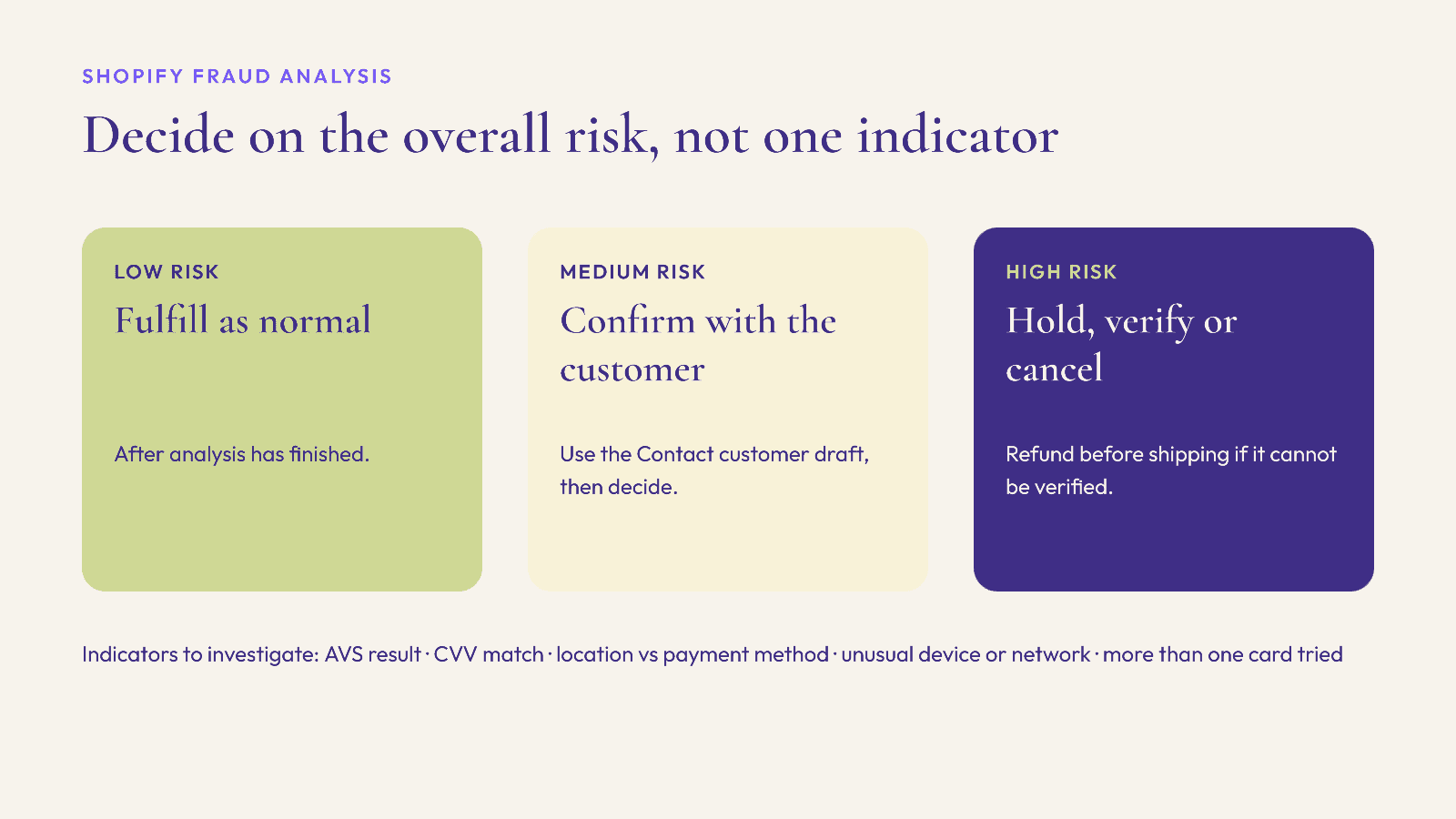
Every eligible online credit card order in Shopify gets a chargeback risk rating of low, medium or high, according to Shopify's Help Center. Medium and high risk orders are flagged with a warning symbol on the Orders page. With Shopify Payments, or on the Grow plan and above, Shopify also gives a recommendation: fulfill, confirm with the customer before fulfilling, or consider canceling.
Alongside the rating, Shopify shows individual fraud indicators, including:
Address Verification System (AVS) results
Whether the card verification value (CVV) was correct
Whether the customer's location matches the payment method
Unusual device or network activity
Whether more than one card was tried
Shopify is explicit that these indicators do not show overall risk, and warns against deciding based on one indicator or on how many there are. Use the overall recommendation as the decision, and the indicators as the reason to dig deeper.
Two facts frame everything else. First, Shopify says the decision to reverse funds is made "by the bank that issued the credit card, not by Shopify," and that Shopify "does not cover charge reversals from banks." Second, Shopify warns that a high number of chargebacks "can result in disabling payment processing and removal from Shopify Payments." In peak week, that is a business continuity risk, not just a margin one.
A peak-week triage routine for risky orders
Volume is the enemy in Cyber Week. Set the routine before the peak so nobody has to make judgment calls at midnight.
Never fulfill before analysis completes. Shopify recommends waiting for fraud analysis to finish before you decide.
Low risk: fulfill as normal.
Medium risk: confirm with the customer before fulfilling. Shopify's Contact customer option opens an email draft for you to review; it does not send anything automatically. A short, friendly message asking the customer to confirm the order details works for legitimate buyers.
High risk: hold. If the customer cannot be reached or the details do not add up, cancel and refund before fulfilling. Once a chargeback is open, Shopify says you cannot issue a refund until it is resolved.
Gift orders to a different address: common in December and not suspicious on their own. Weigh them with the overall risk level, not as a red flag by themselves.
Known customer blocked? Shopify suggests creating a draft order and sending an invoice to complete a legitimate sale.
Automate the routing. Shopify Flow can run fraud checks automatically, for example tagging medium and high risk orders for review so they never reach the pick list untouched.
Card testing: the Cyber Week pattern to watch
Card testing is when someone runs stolen card numbers through your checkout to see which work, usually with many small orders or repeated failed payments. Shopify's fraud analysis flags related signals, such as multiple cards tried and unusual device or network activity, and Shopify can temporarily block an IP address when many orders or failed payment attempts come from it in a short time. Those temporary blocks clear within 6 to 24 hours, according to Shopify.
If you see a burst of small orders from new customers in a short window, do not fulfill them. Cancel them, and review Shopify's card testing guidance for your store.
What evidence wins each type of dispute
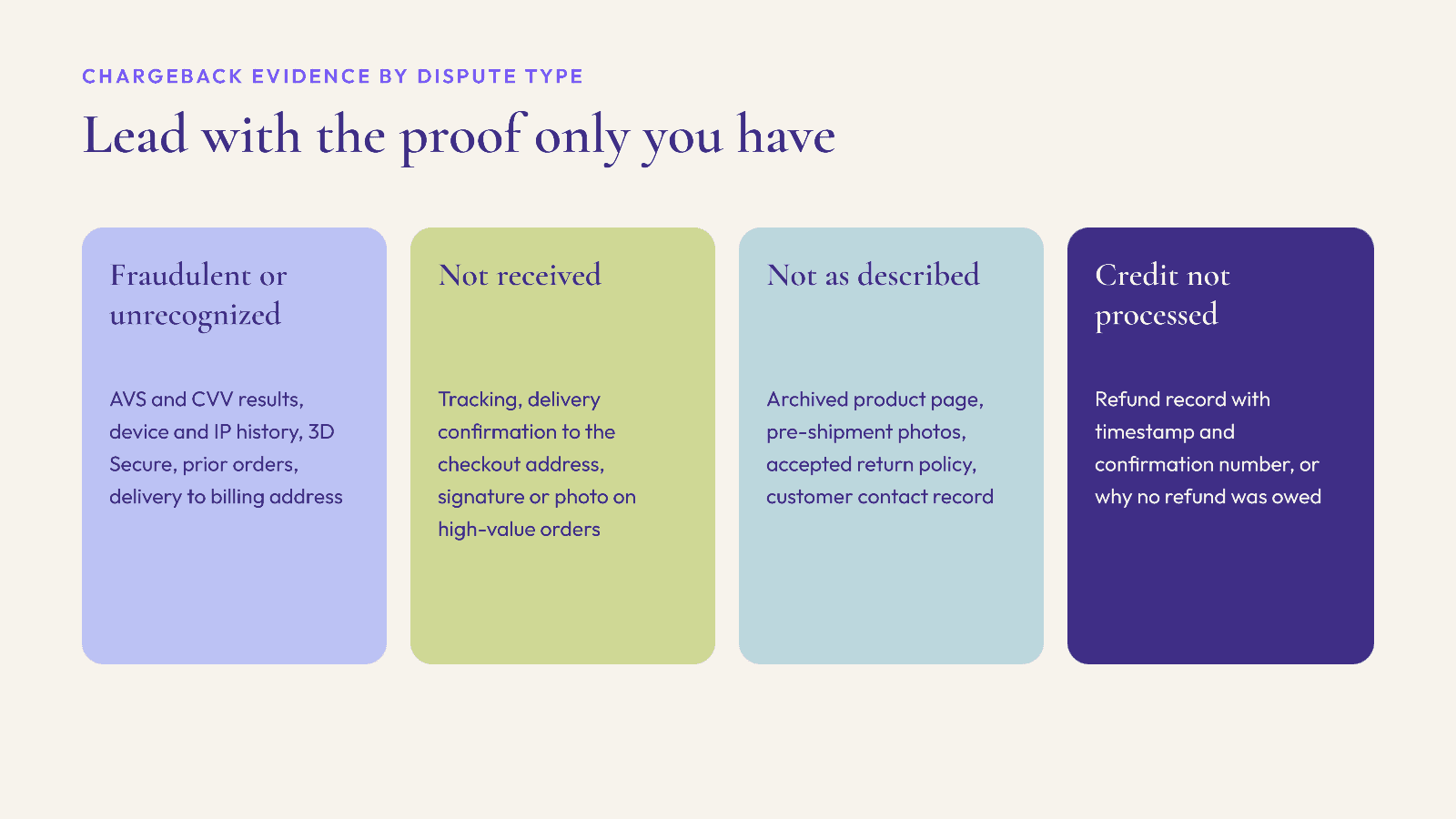
When a chargeback does arrive, Shopify Payments adds order details automatically, including product details, addresses and tracking. Shopify advises you to focus your effort on the evidence only you have, and to put your most compelling evidence first. Its guidance by dispute type:
Fraudulent or unrecognized
Show the real cardholder placed the order. Shopify lists AVS and CVV match results, device and IP data consistent with past orders, 3D Secure records and prior successful orders from the same customer. It calls delivery to the billing address one of the strongest proofs.
Shopify describes an "unrecognized" chargeback as one where the customer does not recognize the merchant name or location on their statement. Check that the name customers see on their statement matches your brand.
Product not received
Provide carrier tracking, delivery confirmation and proof the parcel went to the checkout address. Shopify suggests proof of delivery, "ideally with signature or photo," and recommends signature confirmation for high-value orders.
Product unacceptable or not as described
This is the dispute type that can follow when fit or colour disappoints. Show what the customer saw at purchase (archived product pages), what you shipped, pre-shipment photos and the return policy they accepted. Shopify notes that customers "are expected to contact you before filing a dispute," so document any contact, or the absence of it.
Credit not processed
Show the refund record with timestamps and confirmation number, or show why a refund was not owed, with your refund policy and any messages about the return.
Across all types, Shopify advises showing your policies at checkout and in confirmation emails, keeping emails and chat logs, using screenshots rather than links, and labelling each piece of evidence with a description and date. Remember that the bank's decision is final and cannot be appealed.
Visa Compelling Evidence 3.0: why order data matters now

Visa's Compelling Evidence 3.0 rules, which took effect on 15 April 2023, apply to card-absent fraud disputes (Visa dispute condition 10.4). According to Visa's merchant readiness guide, a merchant can shift liability back to the card issuer by showing two earlier, undisputed transactions with the same cardholder that are at least 120 days and no more than 365 days old.
At least two data elements must match between those earlier orders and the disputed one, from user ID, IP address, shipping address and device ID or fingerprint, and one of the two must be the IP address or the device ID. Visa adds that submission can only be attempted once.
The practical point for fashion brands with repeat customers: a loyal shopper's account, address and device history can be your strongest defence against a "friendly fraud" claim, but only if that data is captured and kept for every order. Check with your payments provider how this data is stored and submitted for your store.
Your Cyber Week chargeback calendar
Before 27 November: agree the triage routine, set up Flow tagging, confirm signature delivery thresholds and check your statement name.
During Cyber Week: review flagged orders at least twice a day, and do not let medium or high risk orders reach fulfilment unreviewed.
December and January: check the chargebacks area of your admin regularly. Shopify says the response deadline is usually 7 to 21 days, and submitting no evidence counts as accepting the chargeback.
After each dispute: note the reason code and what evidence you used, so the next response is faster.
FAQ
Does Shopify cover chargebacks?
Not by default. Shopify says the decision to reverse funds is made by the bank that issued the card and that Shopify does not cover charge reversals. Shopify Protect, where available, covers fraudulent and unrecognized chargebacks on protected Shop Pay orders, but not disputes such as item not received or not as described.
What should I do with a high-risk order on Shopify?
Do not fulfill it straight away. Shopify suggests you can verify the order, cancel it or refund it. Contact the customer to confirm details, and if they cannot be verified, cancel and refund before shipping.
How long do I have to respond to a Shopify chargeback?
Shopify says the deadline is usually 7 to 21 days after the chargeback is filed. Decisions are final and cannot be appealed, so submit your strongest evidence the first time.
What evidence wins a "product not received" chargeback?
Carrier tracking, delivery confirmation and proof the parcel went to the checkout address. Shopify recommends proof of delivery with a signature or photo, and signature confirmation for high-value orders.
What is Visa Compelling Evidence 3.0?
A Visa rule for card-absent fraud disputes, effective 15 April 2023. If you can show two earlier undisputed orders from the same cardholder, 120 to 365 days old, with at least two matching data points such as IP address, device ID, user ID or shipping address, liability can shift back to the issuer.
Fewer disputes start with shoppers buying the right thing in the first place. Elara is an AI shopping assistant for Shopify fashion brands that styles complete looks from your catalog in conversation, with virtual try-on, so shoppers can see what they are buying before they check out. Industry benchmarks from Neuwark (2026) put conversion with AI shopping assistants at 4x. Book a demo or start a 30-day free trial before Cyber Week.
Keep reading

Peak Season, Compliance, Shopify
Selling to the EU This Christmas? The GPSR Checklist for Shopify Fashion Brands (2026)
What the EU General Product Safety Regulation means for Shopify fashion brands shipping Christmas orders to the EU: product page information, the EU responsible person, labels, accidents and recalls.

Peak Season, Shopify, Omnichannel
After the Last Shipping Day: A Christmas 2026 Local Pickup and Delivery Playbook for Shopify Fashion Brands
How Shopify fashion brands can keep selling physical products after the Christmas shipping cutoff, with pickup in store, local delivery zones and Google's pickup today annotation.

Peak Season, Accessibility, Conversion
Black Friday 2026 Accessibility Check: What the European Accessibility Act Means for Shopify Fashion Stores
What the European Accessibility Act asks of online stores, and a five-week plan to fix sale prices, swatches, size charts, pop-ups and forms on a Shopify fashion store before Black Friday.