New research guide: The Confidence Economy, how AI is changing fashion commerce.
Peak Season, Accessibility, Conversion
·
Black Friday 2026 Accessibility Check: What the European Accessibility Act Means for Shopify Fashion Stores
What the European Accessibility Act asks of online stores, and a five-week plan to fix sale prices, swatches, size charts, pop-ups and forms on a Shopify fashion store before Black Friday.
Mehul Agarwal, Founder & CEO

Last updated: October 2026
Quick answer: The European Accessibility Act (EAA) has applied to e-commerce services for consumers in the EU since 28 June 2025, with an exemption for microenterprises (fewer than 10 staff and no more than 2 million euro in annual turnover or balance sheet). The harmonised standard, EN 301 549, points to the WCAG success criteria. Before Black Friday 2026, fix the parts of a fashion store that peak-season changes break most easily: sale prices, swatches, size charts, pop-ups, autoplaying banners and checkout forms.
Black Friday is on 27 November 2026, and the run-up is when fashion brands typically make their biggest storefront changes: new hero banners, countdown timers, email capture pop-ups, sale badges and bundles. Each of those changes is a chance to make the store harder to use for shoppers who rely on a screen reader, a keyboard or high contrast. If you sell to consumers in the EU, it is also a compliance question.
This guide explains what the EAA asks of online stores, then turns Shopify's own accessibility guidance into a checklist for the fashion-specific parts of your store. It is not legal advice. Whether and how the EAA applies to your business, especially if you are based outside the EU, is a question for a qualified adviser. For the wider peak-season prep list, see our BFCM 2026 site readiness checklist.
What the European Accessibility Act requires of online stores
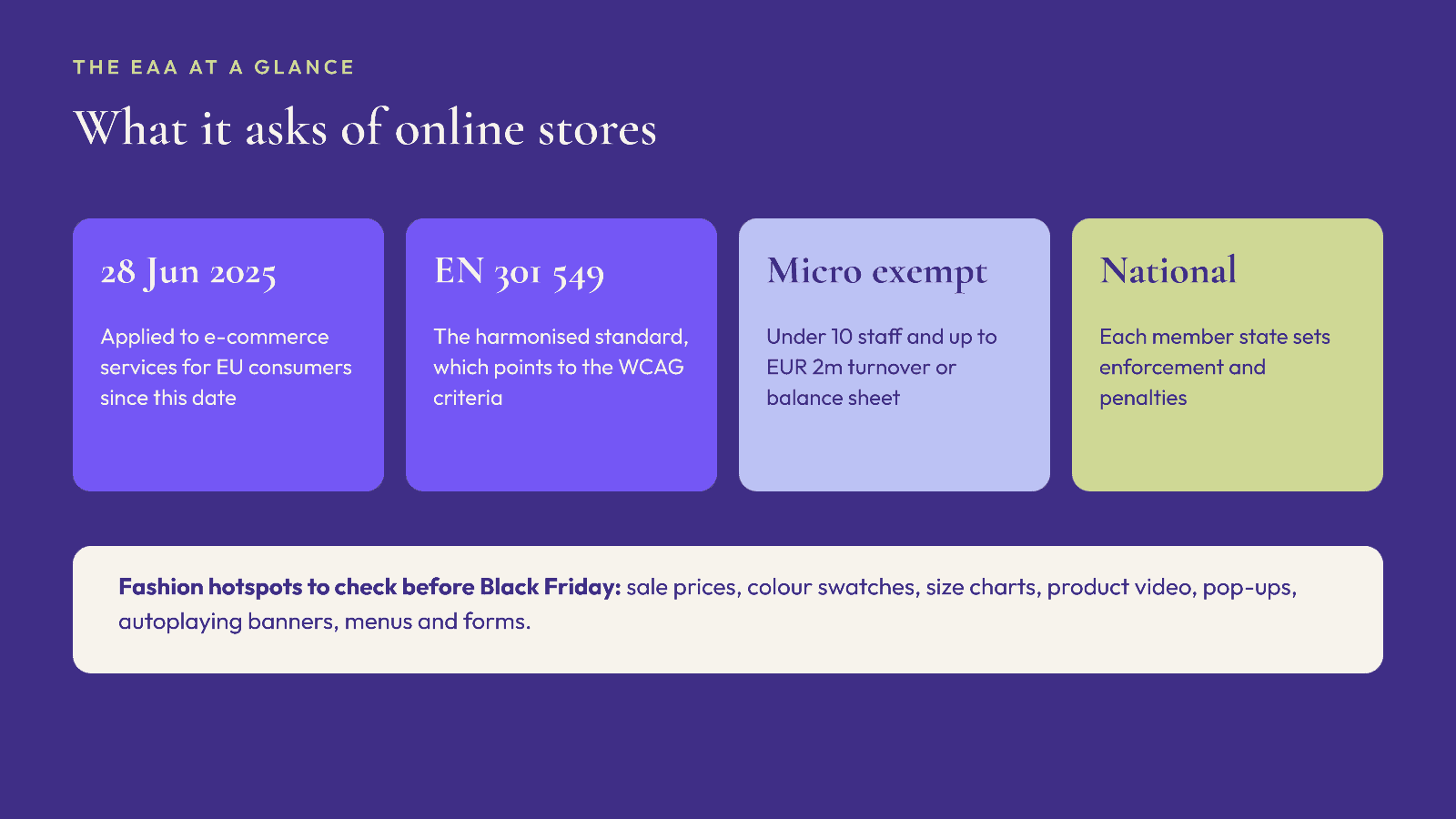
The EAA is an EU directive, so each member state has written it into national law. According to a summary by accessibility consultancy e-include:
It applies to e-commerce. E-include defines covered e-commerce as "selling goods or services to consumers through a website or a mobile application." The type of goods does not matter, so clothing stores are in scope like any other.
It has applied since 28 June 2025.
Microenterprises that provide services are exempt. That means fewer than ten people and an annual turnover or balance sheet total of no more than 2 million euro.
The technical benchmark is EN 301 549, the harmonised European standard, which points to the Web Content Accessibility Guidelines (WCAG). Meeting the standard creates a presumption of conformity with the directive.
Enforcement is national. Each member state sets its own enforcement bodies and penalties, which must be "effective, proportionate and dissuasive," so exposure differs by country. Germany's version, for example, is the Barrierefreiheitsstärkungsgesetz (BFSG).
If you are a small brand under the microenterprise thresholds, the EAA may not apply to you. The checklist below is still worth doing: the same fixes make the store easier for everyone to use on a busy, distracted Black Friday.
Sale prices and badges: make discounts readable
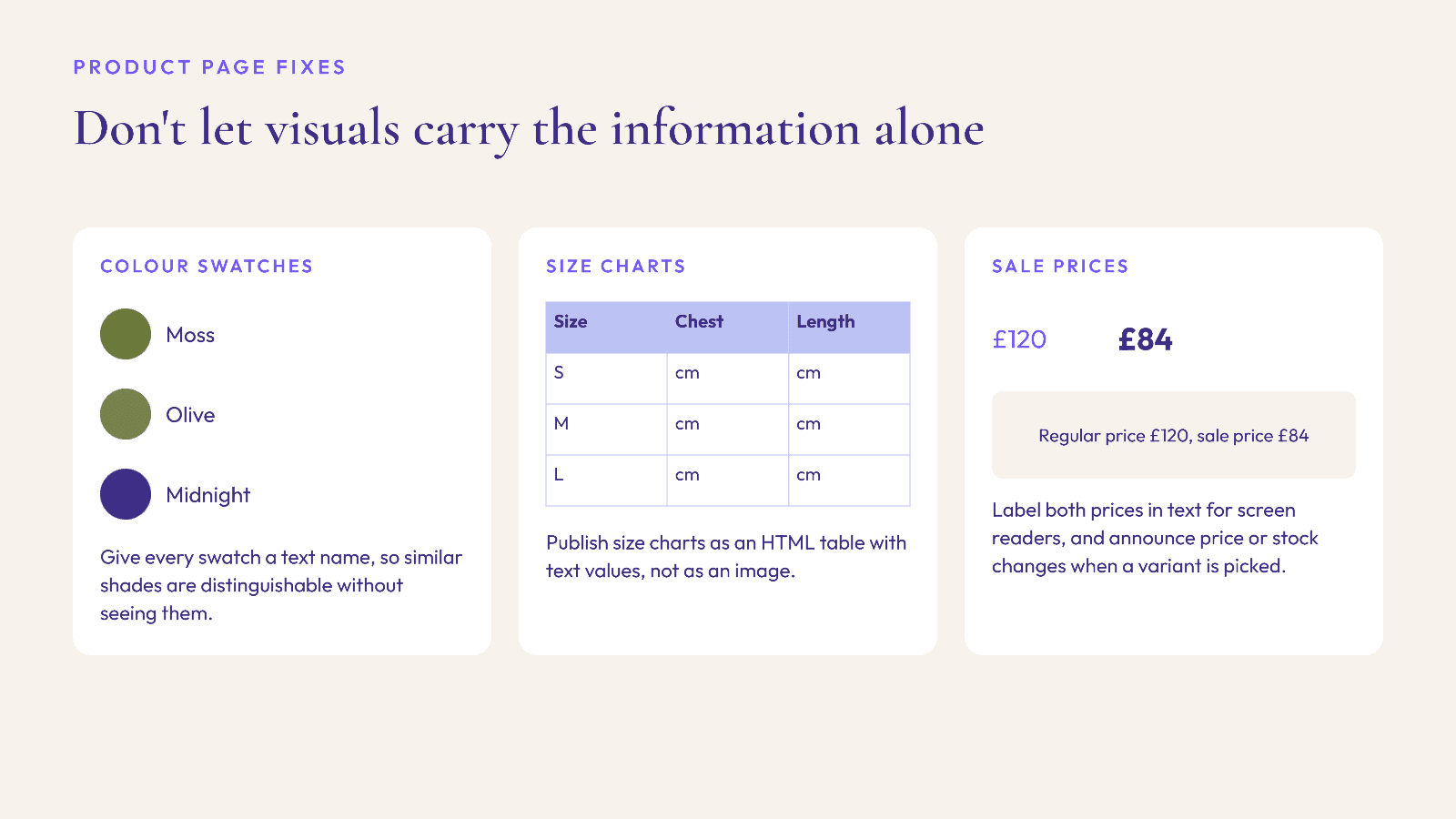
On Black Friday, the most important information on a fashion product page is often the price change. Shopify's theme accessibility best practices for developers say themes "must use visually-hidden text to help discern the regular price from the sales price," and that variant changes to price or availability should be announced to screen readers.
What to check:
Strikethrough prices: a screen reader does not announce a line through a number. Confirm your theme labels the regular and sale price in text, not only with styling.
Sale badges: "-30%" in an image or icon needs a text equivalent.
Variant changes: when a shopper picks a size or colour that changes the price or goes out of stock, the change should be announced, not just shown.
Countdown timers: keep them as plain text, not a constantly re-announced live region, and never make them the only place the offer end date appears.
Swatches, size charts and product media
These are where fashion stores most often depend on visuals alone.
Colour swatches: Shopify's guidance says colour cannot be the only way information is conveyed. Each swatch should have its colour name as a text label or accessible name, so "Moss" and "Olive" are distinguishable without seeing them.
Size charts: a size chart saved as an image is unreadable to a screen reader and hard to zoom on mobile. Publish it as an HTML table, with the measurements as text.
Alt text: Shopify's Help Center says screen reader users "rely on alt text to communicate the content of images." For fashion, describe what a shopper needs to decide: the cut, the length, the fabric's look, how it is styled. Shopify's developer guidance adds that decorative images should use an empty alt attribute.
Video: Shopify recommends closed captions on videos with dialogue, no autoplay, and a way to pause. Campaign films on the homepage are a common miss.
Pop-ups, banners and carousels
Peak-season marketing adds the elements most likely to block keyboard and screen reader users.
Email and SMS capture pop-ups: a pop-up must be reachable and closable by keyboard, and must not trap focus. WCAG's "No Keyboard Trap" criterion (2.1.2) covers this. Test it: open your site, press Tab, and check you can reach and close the pop-up without a mouse.
Autoplaying hero carousels: Shopify's accessibility guidance says slideshows that autoplay need controls to pause, advance or stop. A Black Friday banner rotating every three seconds without a pause button fails this.
Contrast on campaign creative: Shopify's Help Center sets body and button text at a contrast ratio of at least 4.5:1, and headings and large text at 3:1. Light text over a busy lifestyle photo often falls short, so use an overlay or move the text off the image.
Touch targets: Shopify's developer guidance asks for touch targets of at least 44 by 44 pixels on primary controls, which matters for small "close" buttons on mobile pop-ups.
Navigation, forms and checkout
Keyboard focus: Shopify's guidance says all interactive elements need a clear visual focus indicator. Do not remove focus outlines in your theme's CSS to make it look cleaner.
Menus: drop-down menus should open with Enter or Space and close with Escape. Mega-menus added for gift guides are worth testing.
Forms: every field needs a label, required fields should be marked as required, and error messages should be tied to their field and announced. This applies to your newsletter sign-up, account creation and any pre-checkout forms you control.
Headings: Shopify recommends headings in sequential order without skipping levels, which also helps shoppers scan long landing pages.
Shopify hosts the checkout itself, but anything you add around it, such as upsell apps, custom fields or gift message widgets, should be tested with a keyboard and a screen reader.
A five-week plan to Black Friday
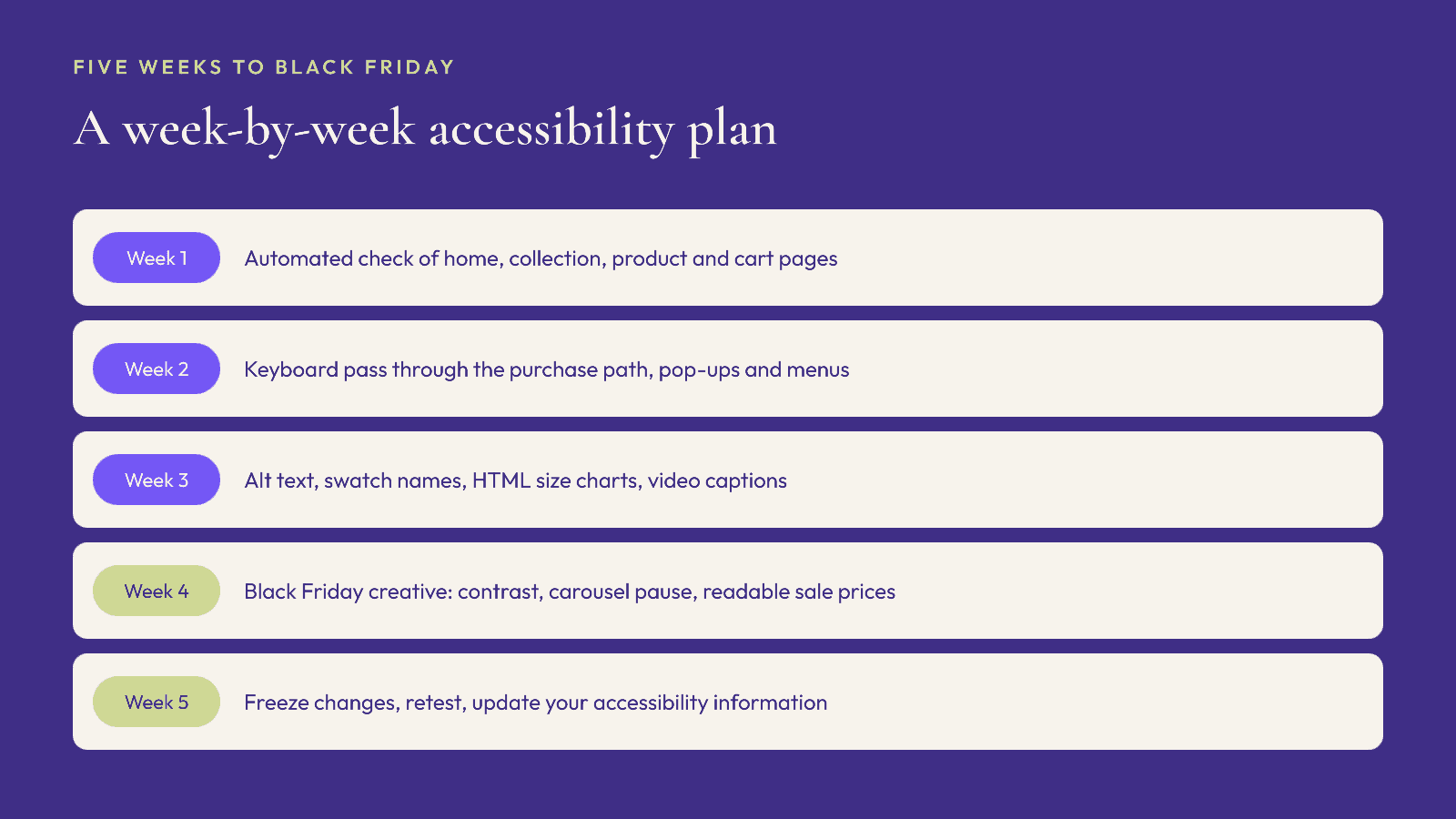
Week 1: Run an automated check (such as Lighthouse or another WCAG checker) on your homepage, a collection page, a product page and the cart. Note issues, but remember automated tools catch only part of the problem.
Week 2: Do a manual keyboard pass: Tab through the whole purchase path, including pop-ups and menus. Fix any traps and missing focus styles.
Week 3: Fix product data: alt text for bestsellers, swatch names, HTML size charts, captions on product videos.
Week 4: Build and test your Black Friday creative: contrast on banners, pause controls on carousels, readable sale prices.
Week 5: Freeze changes, retest the key pages, and publish or update your accessibility information so shoppers know how to contact you if something does not work.
For related peak-season performance work, see our guide to speeding up a Shopify fashion store.
FAQ
Does the European Accessibility Act apply to online clothing stores?
It applies to e-commerce services for consumers in the EU, whatever the goods, so clothing stores are in scope unless they qualify as a microenterprise. Check with a qualified adviser how it applies to your business and markets.
Who is exempt from the EAA?
Microenterprises providing services are exempt, defined as fewer than ten people and an annual turnover or balance sheet total of no more than 2 million euro.
Which standard should a Shopify store follow for EAA compliance?
The harmonised standard is EN 301 549, which points to the WCAG success criteria. Following it creates a presumption of conformity with the directive.
Are Shopify themes accessible by default?
Shopify says its theme guidelines were created with WCAG in mind, but also that following them alone does not guarantee a fully accessible store. Your content, apps and customisations matter too.
What contrast ratio does Shopify recommend?
At least 4.5:1 for body and button text, and 3:1 for headings and large text, according to Shopify's Help Center.
Are Black Friday pop-ups an accessibility problem?
They can be. A pop-up must be reachable and closable by keyboard and must not trap focus. Test every pop-up with the Tab key before launch.
Help every shopper find the right look
Accessible stores are easier for everyone to shop, and so are stores where shoppers can simply say what they need. Elara for Commerce is an AI shopping assistant for Shopify fashion brands that lets shoppers describe an occasion in their own words and get complete looks from your catalog, rather than relying only on filters and visual browsing. As an industry benchmark, Neuwark's 2026 research puts conversion 4x higher with AI shopping assistants. Book a demo or start a 30-day free trial before Black Friday.
Keep reading
Peak Season, Compliance, Shopify
Selling to the EU This Christmas? The GPSR Checklist for Shopify Fashion Brands (2026)
What the EU General Product Safety Regulation means for Shopify fashion brands shipping Christmas orders to the EU: product page information, the EU responsible person, labels, accidents and recalls.

Peak Season, Shopify, Omnichannel
After the Last Shipping Day: A Christmas 2026 Local Pickup and Delivery Playbook for Shopify Fashion Brands
How Shopify fashion brands can keep selling physical products after the Christmas shipping cutoff, with pickup in store, local delivery zones and Google's pickup today annotation.

Peak Season, Reviews, Compliance
BFCM 2026 Review Requests: What the FTC and UK Fake Review Rules Mean for Shopify Fashion Brands
How to ask for, reward and moderate post-Black Friday reviews under the FTC's Consumer Reviews and Testimonials Rule and the UK DMCC Act, with a pre-peak checklist.