New research guide: The Confidence Economy, how AI is changing fashion commerce.
Peak Season, Compliance, Shopify
·
Selling to the EU This Christmas? The GPSR Checklist for Shopify Fashion Brands (2026)
What the EU General Product Safety Regulation means for Shopify fashion brands shipping Christmas orders to the EU: product page information, the EU responsible person, labels, accidents and recalls.
Mehul Agarwal, Founder & CEO
Last updated: October 2026
Quick answer: If your Shopify fashion store sells to shoppers in the EU, the General Product Safety Regulation (GPSR) has applied since 13 December 2024, and it covers clothing. Every EU-facing product page must show the manufacturer's name, postal and electronic address, an EU-based responsible person if the manufacturer is outside the EU, information that identifies the product, and any warnings in a language the shopper understands. Fix your listings, labels and accident process now, before Christmas order volume peaks.
For UK and US labels that ship to the EU, Christmas brings a rush of cross-border orders. It is also the season when a gap in your product information is most likely to be noticed, by marketplaces, by market surveillance authorities, or by a customer who wants to know who to contact. This guide turns the GPSR into a practical checklist for Shopify fashion brands. It is not legal advice, so confirm the details for your products with a qualified adviser.
If you are expanding into new countries more generally, our guide to international expansion for Shopify fashion brands covers markets, duties and currencies. This piece focuses on product safety information.
What the GPSR is and why it applies to clothing
The GPSR, Regulation (EU) 2023/988, replaced the older General Product Safety Directive. As law firm Fieldfisher explains, it applies in the EEA from 13 December 2024 and, because it is a regulation rather than a directive, it applies directly in every member state.
Two points matter most for fashion brands:
It covers everyday consumer products, including clothing. An e-commerce guide from E-Commerce Germany lists clothing and jewellery among typical covered products, and notes there is no exemption for handmade items.
Where you are based does not decide whether it applies. Fieldfisher notes that the scope "does not depend on the location of the economic operator." What matters is whether your offer targets consumers in the EU. A UK or US store that ships to Paris, prices in euros or runs ads in Germany is in scope for those sales.
The product page: what Article 19 requires online
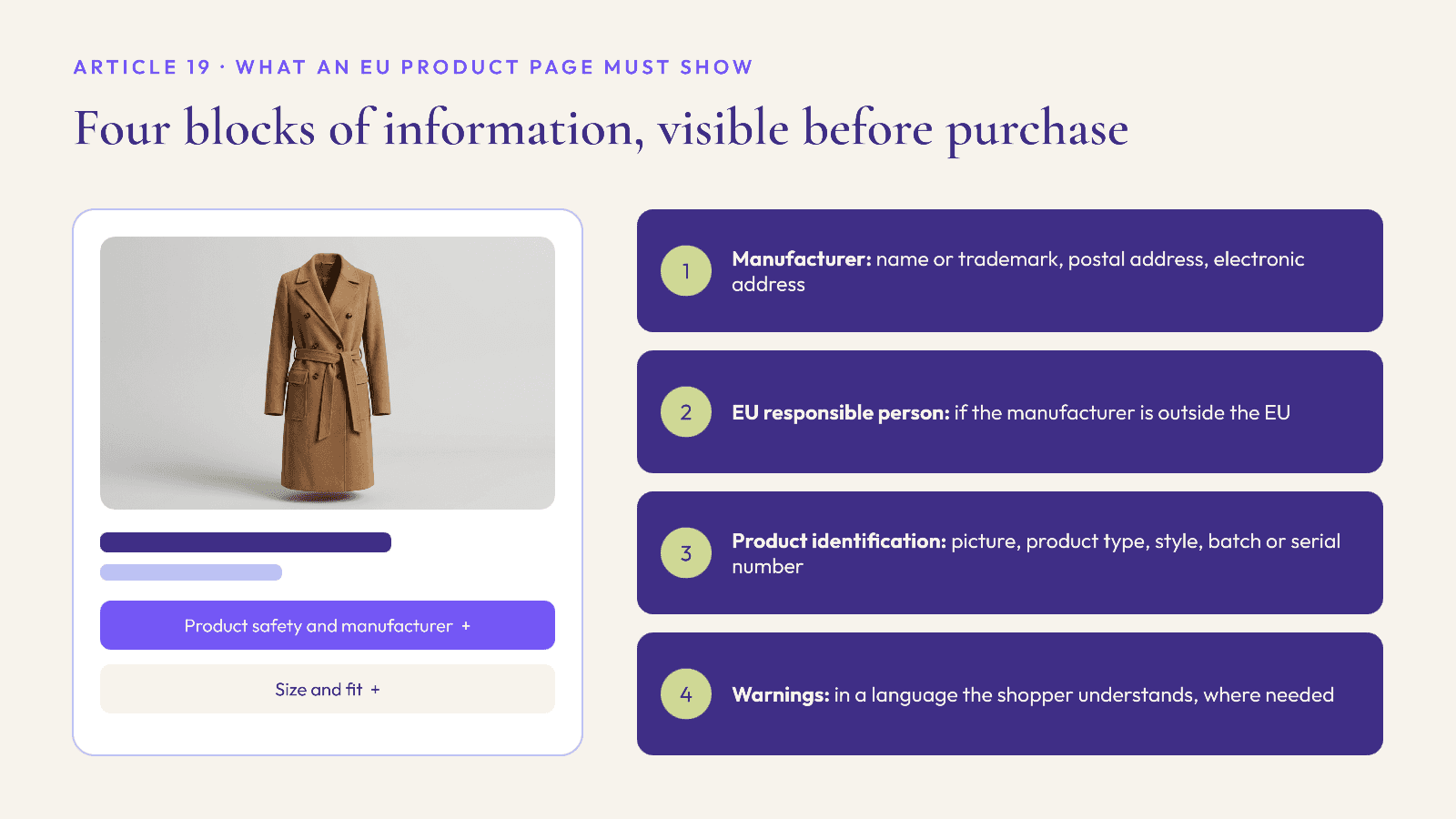
Article 19 sets out what must be visible in an online offer before purchase. Summarising Fieldfisher's and E-Commerce Germany's guidance, each EU-facing product page needs:
Manufacturer details: name, registered trade name or trademark, postal address and electronic address (an email or web contact form). If you sell under your own brand name, you are usually treated as the manufacturer.
The EU responsible person: if the manufacturer is not established in the EU, the name and postal and electronic address of the EU-based economic operator.
Product identification: a picture, the product type and any other identifier, such as a style number, batch or serial number.
Warnings and safety information: in a language consumers in the destination country can easily understand, where the product needs them.
E-Commerce Germany warns that a footer link to a general safety page may not be enough, because the information must be clearly visible in the offer itself. Belgian agency Vimm makes a similar point and notes that in multilingual countries like Belgium, the language requirement often means more than one language.
What this looks like on a fashion product page
For most clothing, the practical additions are small:
A "Product safety and manufacturer" section (an accordion works well) with your brand's legal name, postal address and contact email.
Your EU responsible person's details, if you are based outside the EU.
The style number or SKU, which you probably already show.
Any genuine warnings: drawstrings on children's clothing, small detachable parts like beads and sequins on kidswear, or flammability guidance on certain fabrics.
On Shopify, the cleanest way to manage this across hundreds of products is with metafields: a few product or shop-level fields for manufacturer details, responsible person and warnings, displayed by a block in your product template. That keeps the data in one place and lets you translate it alongside the rest of your store content. GPSR apps in the Shopify App Store can also do this, but check what they actually output on the page.
The EU responsible person: who it can be
Under Article 16, a covered product cannot be placed on the EU market without an economic operator established in the Union. According to E-Commerce Germany's summary, that operator can be:
The manufacturer, if it is established in the EU.
An EU importer.
An authorised representative appointed under a written mandate.
An EU-based fulfilment service provider, but only when none of the above exists.
Two practical notes for UK and US brands:
A UK address is not enough. E-Commerce Germany states plainly that a UK address alone does not satisfy the EU establishment requirement.
A postal address is not enough either. The operator must be able to check compliance information, cooperate with market surveillance authorities and provide documentation on request. Choose a provider that can actually do that, and agree in writing what they will do if an authority contacts them.
If you use an EU warehouse or 3PL for Christmas stock, ask early whether they offer this service. Many brands appoint a dedicated authorised representative instead.
Labels and swing tags: what must be on the product
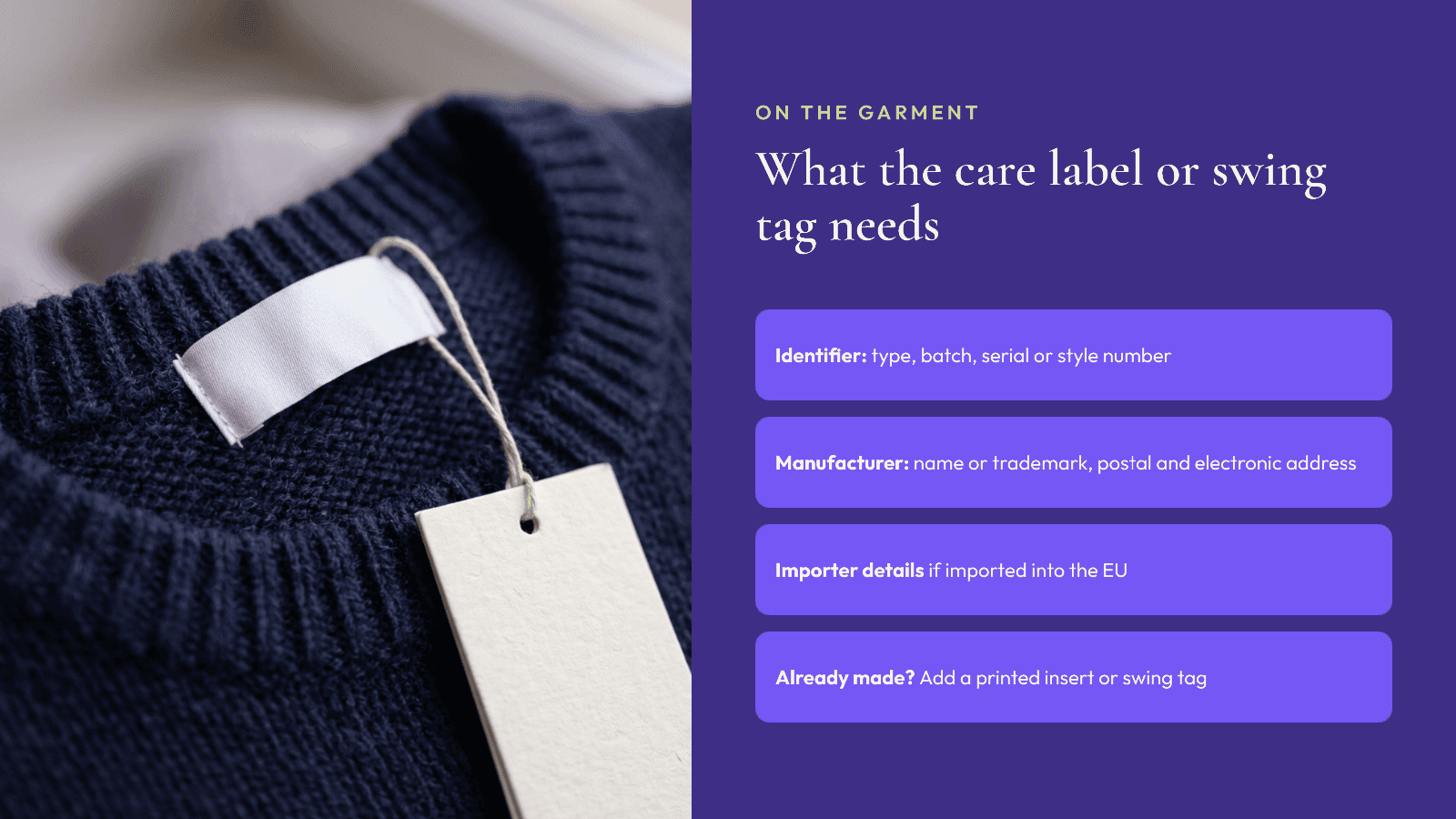
The GPSR also covers what is on the product itself. E-Commerce Germany summarises the rule as:
An identifier on the product, such as a type, batch or serial number, or on the packaging or an accompanying document where the product's size or nature makes that impractical.
The manufacturer's registered name or trademark, postal address and electronic address. Importers add their own details.
For apparel, the natural home for this is the care label or a swing tag, alongside the fibre composition that EU textile labelling rules (Regulation (EU) No 1007/2011) already require. Before your next production run, update your label artwork. For stock already made, a printed insert or swing tag can carry the missing details.
When something goes wrong: accidents and recalls
Christmas volume raises the odds that a problem surfaces, so agree the process now.
Accidents must be reported. Fieldfisher explains that the manufacturer must report an accident caused by a product immediately to the authorities of the member state where it happened, through the EU's Safety Business Gateway. Distributors who learn of an accident must tell the manufacturer.
Recalls must offer real remedies. For a recall the business starts, Fieldfisher notes that consumers must be offered at least two of: repair, replacement with a safe product of at least the same value and quality, or a refund of at least the price paid, free of charge.
In practice, make sure your customer service team knows how to recognise a safety complaint (a skin reaction, a snapped drawstring, a choking-risk part on kidswear) and who to escalate it to. A safety complaint should never be handled like an ordinary return.
A pre-Christmas GPSR checklist
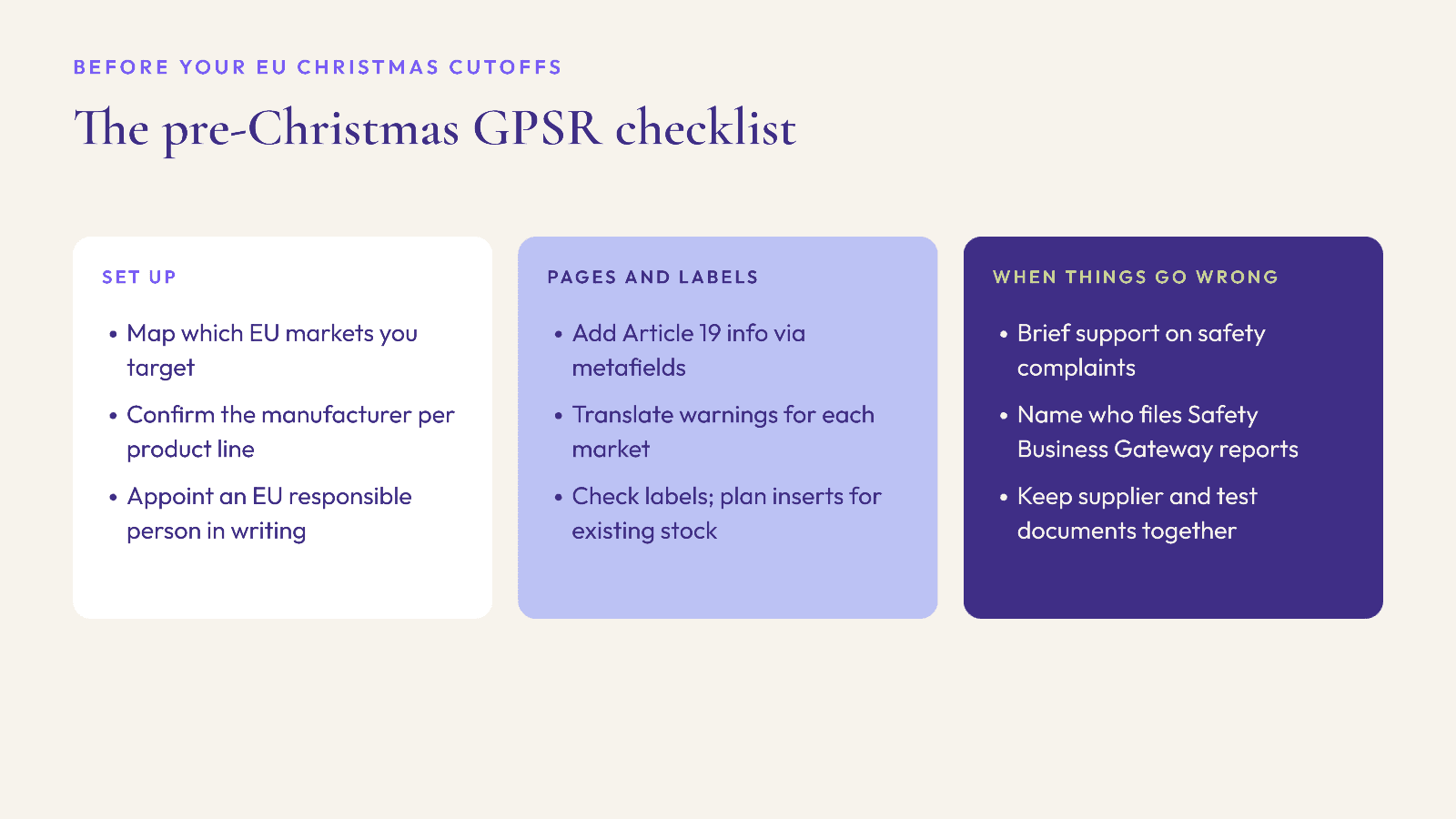
Work through this before your Christmas shipping cutoffs for EU destinations:
Map your EU exposure. Which markets do you ship to, price in or advertise to? Those offers are in scope.
Confirm who the manufacturer is for each product line, especially if you sell other brands or private label.
Appoint an EU responsible person if you are based outside the EU, and get a written agreement.
Add the Article 19 information to every EU-facing product page through metafields and a product template block.
Translate warnings into the languages of the markets you serve.
Check labels and swing tags for an identifier and manufacturer details, and plan inserts for existing stock.
Brief customer service on spotting and escalating safety complaints.
Write down your accident and recall process, including who files a Safety Business Gateway report.
Keep documentation together: supplier details, test reports where you have them, and your risk assessment for higher-risk items like kidswear.
Where this fits in your peak season plan
GPSR work is one-off setup, not a weekly task. Once it is in place, it also makes your product data cleaner for everything else: marketplaces, Google Shopping feeds and AI shopping tools all depend on complete, structured product information. If you are also reviewing how you present prices and discounts for Black Friday, see our guide to Black Friday 2026 discount claims in the US, UK and EU.
FAQ
Does the GPSR apply to clothing?
Yes. Clothing is a typical consumer product covered by the GPSR, and there is no exemption for handmade items. Some product types with their own EU safety rules, such as toys, have additional requirements on top.
Does the GPSR apply to UK or US Shopify stores?
It applies to products offered to consumers in the EU, whatever the seller's location. If your store targets EU shoppers, those sales are in scope, and you will usually need an EU-based responsible person.
What must an EU product page show under the GPSR?
The manufacturer's name and postal and electronic address, the EU responsible person if the manufacturer is outside the EU, information that identifies the product such as a picture and type, and any warnings or safety information in a language the shopper understands.
Can my UK address count as the EU responsible person?
No. The responsible economic operator must be established in the EU. Options include an EU importer, an authorised representative under a written mandate, or, where no other option exists, an EU fulfilment service provider.
Is a link to a safety page in the footer enough?
Guidance from e-commerce compliance specialists suggests not, because Article 19 requires the information to be clear and visible in the offer itself. A section on each product page is the safer approach.
When did the GPSR start to apply?
The GPSR has applied across the EEA since 13 December 2024.
Make your EU product pages work harder
Clean, structured product data does more than keep you compliant. It is also what lets Elara for Commerce, an AI shopping assistant for Shopify fashion brands, turn a shopper's occasion into complete looks from your catalog in a styling conversation, with virtual try-on. If you want to see how that works on your own catalog before peak season, book a demo or start the 30-day free trial.
Keep reading

Peak Season, Promotions, Shopify
BFCM 2026 Discount Stacking on Shopify: How Discount Combinations Actually Calculate
Which Shopify discounts can combine, the order they apply in, the limits that bite during Cyber Week, and a test routine to run before 27 November.

Peak Season, Operations, Shopify
BFCM 2026 Shopify Flow Automations: 7 Workflows Fashion Brands Should Set Up Before Black Friday
The Shopify Flow workflows that take routine Cyber Week jobs off your team: low-stock alerts, size-aware sold-out rules, risk holds, VIP tags and a scheduled end-of-sale clean-up.

Peak Season, Marketing, Compliance
GivingTuesday 2026 Charity Promotions: What Shopify Fashion Brands Must Disclose in the US and UK
Planning a give-back capsule for 1 December? How to state the donation clearly, what US and UK rules expect, product-page copy you can adapt, and a launch checklist.