New research guide: The Confidence Economy, how AI is changing fashion commerce.
Peak Season, Reviews, Compliance
·
BFCM 2026 Review Requests: What the FTC and UK Fake Review Rules Mean for Shopify Fashion Brands
How to ask for, reward and moderate post-Black Friday reviews under the FTC's Consumer Reviews and Testimonials Rule and the UK DMCC Act, with a pre-peak checklist.
Mehul Agarwal, Founder & CEO

Last updated: October 2026
Quick answer: Your Black Friday and Cyber Monday orders will trigger a wave of review requests in December, and two sets of rules now decide what those requests can say. In the US, the FTC's Consumer Reviews and Testimonials Rule (in force since 21 October 2024) bans fake reviews, incentives that depend on a positive (or negative) review, undisclosed staff reviews and review suppression, with civil penalties for knowing violations. In the UK, fake reviews and concealed incentivised reviews have been banned practices under the Digital Markets, Competition and Consumers Act since April 2025, and the CMA can fine up to 10% of global turnover. The safe pattern for a Shopify fashion brand: ask every buyer, never tie a reward to a star rating, label any incentivised review, publish negative fit feedback, and write down your review policy before 27 November.
This article explains published regulator guidance for fashion brands. It is not legal advice; check specifics with your own counsel.
Black Friday falls on 27 November 2026 and Cyber Monday on 30 November. Many post-purchase review flows send a request a week or two after delivery, so for fashion brands with a big Cyber Week, December can become the busiest review month of the year. That is also the moment when growth teams are tempted to sweeten the ask with a discount code, push only happy customers to public review sites, or tidy up a wave of "runs small" complaints.
Regulators on both sides of the Atlantic have made those exact tactics a priority. On 14 October 2026, the UK Competition and Markets Authority (CMA) said its open review investigations include Autotrader, Feefo, Dignity, Just Eat and Pasta Evangelists, and that "Businesses that host or use reviews should have effective systems to prevent misleading content." This guide translates the US and UK rules into a review playbook you can set up before peak.
What is actually in force: the US and UK rules at a glance

United States: the FTC Consumer Reviews and Testimonials Rule
The FTC announced the final rule on 14 August 2024 and, according to its staff Q&A, it took effect on 21 October 2024. The rule (16 CFR Part 465) prohibits:
Fake reviews and testimonials, including reviews from people who do not exist. The FTC's announcement says the rule is designed in part to "deter AI-generated fake reviews."
Incentives tied to sentiment. You cannot offer compensation conditioned, expressly or by implication, on a review being positive (or negative).
Undisclosed insider reviews. Reviews from officers, managers, employees or their relatives must clearly disclose the relationship.
Company-controlled "independent" review sites that are presented as independent.
Review suppression through intimidation, groundless legal threats or certain false accusations, and misrepresenting what is shown as representative of all reviews.
Fake social media indicators, such as bought followers or views.
The rule lets courts impose civil penalties for knowing violations. It does not create a private right of action.
United Kingdom: the DMCC Act and the CMA's fake reviews guidance
The CMA's new direct enforcement powers came into force in April 2025, and the CMA's announcement says it can fine firms up to 10% of global turnover for consumer protection infringements. Fake reviews were added to the list of practices that are banned outright. The CMA's guidance (CMA208, April 2025) covers three things:
Submitting or commissioning fake reviews, meaning reviews that purport to be based on a genuine experience but are not.
Concealed incentivised reviews. A review is incentivised if the reviewer was commissioned to write it, and the CMA says that includes discounts, vouchers and free products, not just cash. Incentivised reviews are not banned if the incentive is clearly disclosed and the review still reflects a genuine experience.
Publishing reviews in a misleading way, plus a duty on businesses that publish reviews to take reasonable and proportionate steps to prevent and remove banned reviews. The CMA says there is no "tick box" approach and the duty applies to small traders too.
The BFCM review playbook: what you can and cannot do
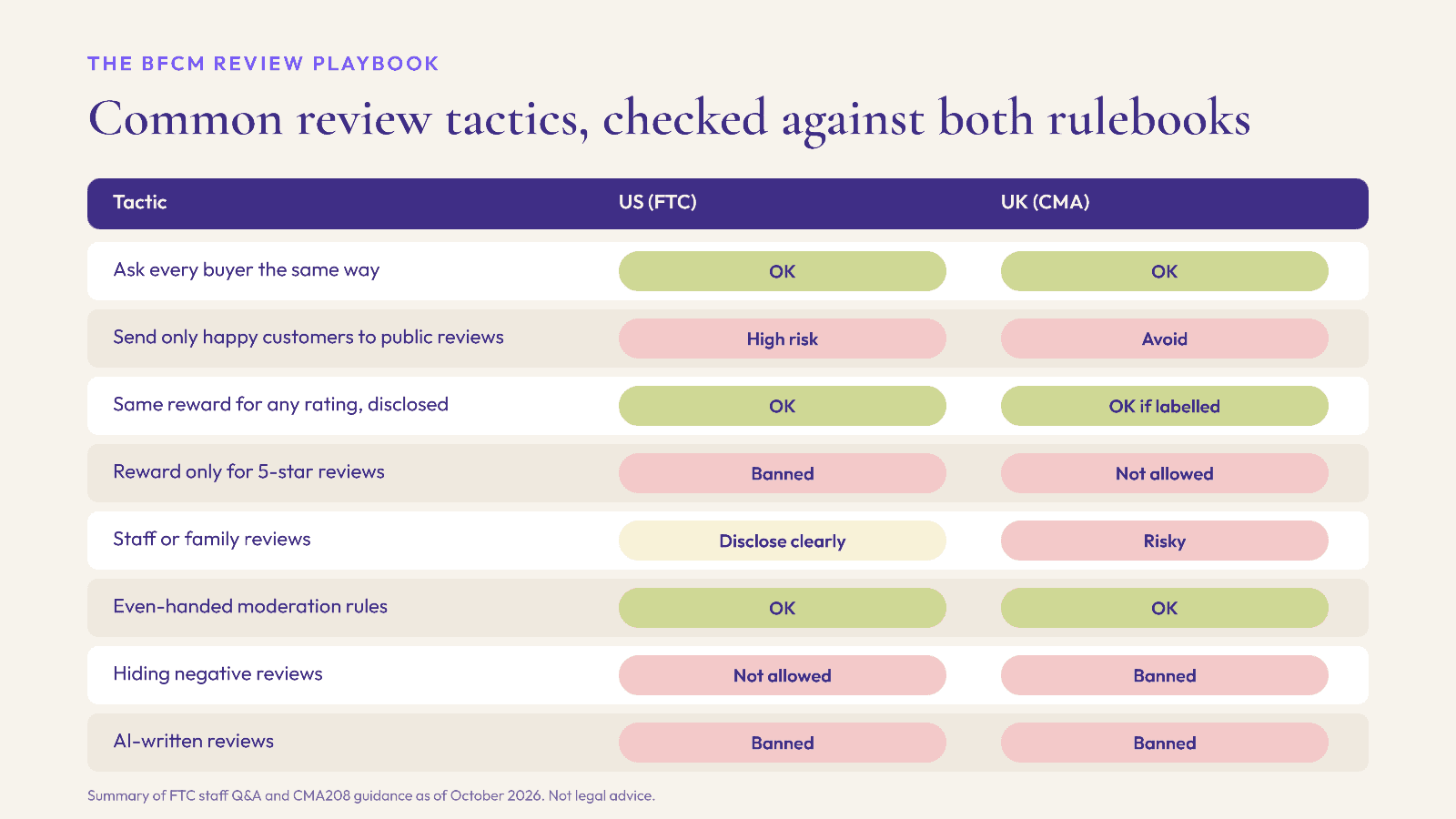
Here is how the rules apply to the review tactics fashion brands actually use in December.
Asking every customer for a review
Allowed in both markets. The CMA says generally asking customers for reviews is fine as long as the request does not predetermine the content or sentiment. The FTC rule targets incentives and requests tied to a particular sentiment, not neutral requests. Send the same request to every buyer, not a filtered list.
Review gating (sending only happy customers to public review sites)
High risk. The FTC's Q&A notes the rule has no specific gating ban but says the practice "could violate the FTC Act." The CMA's guidance is more direct: publishers should not cherry-pick reviews, for example by encouraging only satisfied customers to leave them. A post-purchase survey that routes 5-star answers to a public review page and 1-star answers to a private support form is exactly the pattern to retire before peak.
Discount codes or loyalty points for reviews
Possible, with care. In the US, an incentive is generally permitted if there is no express or implied requirement for a particular sentiment, though the FTC notes undisclosed incentives can still violate the FTC Act. In the UK, the incentive must be clearly disclosed, usually with a prominent label. Practical rule for both: same reward for a 1-star and a 5-star review, say so in the email, and label incentivised reviews on the product page. The CMA notes that entry into a prize draw is generally not treated as commissioning.
Staff, friends and gifted creators
Disclose or do not post. The FTC rule requires insider reviews to disclose the relationship clearly, and the FTC says disclosures must be unavoidable rather than hidden behind a click. The CMA's October 2026 update warns that unlawful conduct "could include a business requesting members of staff to write reviews about its products or services." Brief your team before the launch email goes out.
Moderating and filtering reviews
Allowed when it is even-handed. The FTC Q&A says ordering reviews by helpfulness is not suppression, and you may exclude reviews that are about the wrong business or that only discuss customer service, as long as positive and negative reviews are treated the same way. Hiding negative reviews, or making them hard to find, is the problem.
AI-written reviews
Do not. The FTC rule targets reviews that misrepresent who wrote them, including AI-generated ones. If you use AI to summarise reviews on a product page, make sure the summary reflects the full spread of ratings, including the critical ones.
Fashion-specific: make honest fit reviews work for you
Fashion has an advantage here: the most useful reviews are about fit, and fit feedback is honest by nature. Instead of fighting "runs small" reviews, structure your request to collect them.
Ask structured fit questions: true to size, runs small, runs large; and the reviewer's usual size. This turns complaints into data the next shopper can use.
Show fit reviews prominently on the product page, not just the star average. It is more helpful for shoppers, and it avoids any impression that you are curating only favourable content.
Route product feedback back to merchandising. A cluster of "runs small" reviews on one style during December is a signal to update size advice before January sales.
Time the request after the try-on moment. For gifts, the buyer may not be the wearer; a message that invites the recipient's fit feedback is more useful than a rating from the gift-giver.
For the rest of your peak compliance work, our guide to showing was prices and countdown timers legally covers the pricing side, and BFCM email deliverability covers getting those review emails into the inbox.
Your pre-Black Friday review checklist
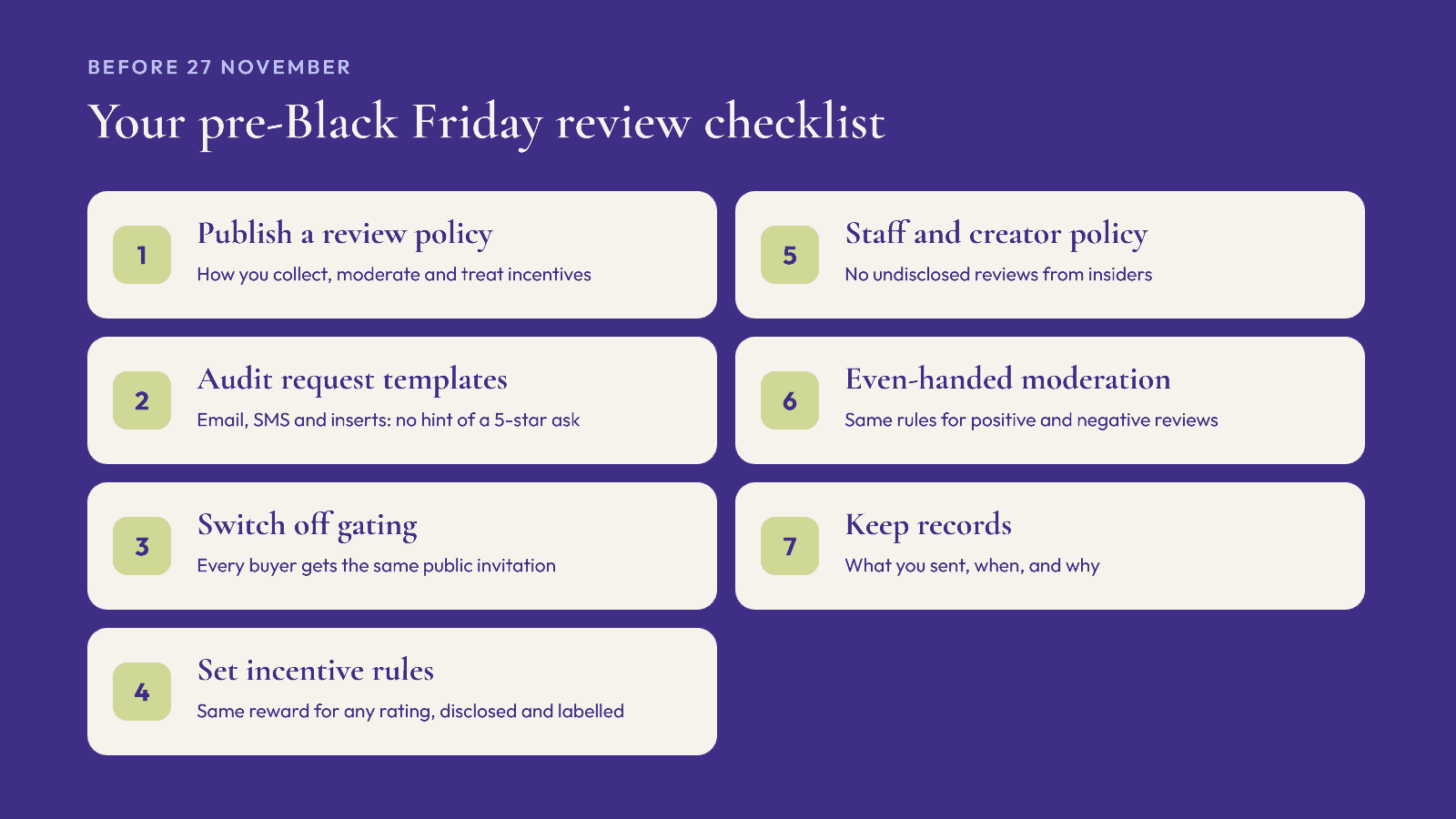
Publish a review policy on your site: how you collect reviews, that you do not accept fake reviews, how you treat incentivised reviews and how you moderate. The CMA expects a published policy from businesses that host reviews.
Audit every review request template (email, SMS, packaging inserts) for wording that implies a positive review is expected.
Switch off gating logic in your review or survey app so every customer gets the same public invitation.
Set incentive rules: identical reward regardless of rating, disclosed in the request and labelled on the review.
Write a staff and creator policy: no undisclosed reviews from employees, relatives or gifted creators.
Document your moderation rules and apply them equally to positive and negative reviews.
Keep records of what you sent and why, so you can show your process if a regulator or platform asks.
FAQ
Can I give a discount code for leaving a review?
In the US, generally yes, if the reward does not depend on the review being positive and is disclosed. In the UK, an incentivised review must be clearly disclosed, typically with a label, and still reflect a genuine experience. Offer the same reward for every rating.
Is review gating illegal?
The FTC says it "could violate the FTC Act," and the CMA's guidance says businesses should not cherry-pick reviews by encouraging only satisfied customers. Treat it as off-limits in both markets.
When did the FTC fake review rule take effect?
21 October 2024, according to the FTC's staff Q&A. Courts can impose civil penalties for knowing violations.
What can the CMA fine for fake reviews in the UK?
Under the DMCC Act regime in force since April 2025, the CMA can fine firms up to 10% of global turnover for consumer protection infringements, and fake reviews are a banned practice.
Can employees review our products?
Only with a clear, unavoidable disclosure of the relationship under the FTC rule. The CMA has warned that asking staff to write reviews could be unlawful.
Can we remove negative reviews?
You can apply even-handed moderation rules, such as removing reviews about the wrong business. You cannot suppress genuine negative reviews or make them hard to find.
Turn December reviews into fewer January returns
Honest fit reviews are most valuable when they reach shoppers before they buy. Elara for Commerce is an AI shopping assistant for Shopify fashion brands that styles complete looks from your catalog in conversation, with virtual try-on, so shoppers can picture fit and pairing before checkout. Industry benchmarks put conversion with AI shopping assistants at 4x (Neuwark 2026) and average order value 25% higher (Rep AI 2025). Book a demo or start a 30-day free trial before Black Friday.
Keep reading

Peak Season, Promotions, Shopify
BFCM 2026 Discount Stacking on Shopify: How Discount Combinations Actually Calculate
Which Shopify discounts can combine, the order they apply in, the limits that bite during Cyber Week, and a test routine to run before 27 November.

Peak Season, Operations, Shopify
BFCM 2026 Shopify Flow Automations: 7 Workflows Fashion Brands Should Set Up Before Black Friday
The Shopify Flow workflows that take routine Cyber Week jobs off your team: low-stock alerts, size-aware sold-out rules, risk holds, VIP tags and a scheduled end-of-sale clean-up.

Peak Season, Marketing, Compliance
GivingTuesday 2026 Charity Promotions: What Shopify Fashion Brands Must Disclose in the US and UK
Planning a give-back capsule for 1 December? How to state the donation clearly, what US and UK rules expect, product-page copy you can adapt, and a launch checklist.