New research guide: The Confidence Economy, how AI is changing fashion commerce.
Peak Season, Pricing, Compliance
·
Black Friday 2026 Discount Claims: How to Show Was Prices and Countdown Timers Legally in the US, UK and EU
Your Shopify compare-at price is a legal claim. Here is what the EU 30-day rule, the UK CMA and the FTC require before Black Friday, plus an eight-step pricing audit.
Mehul Agarwal, Founder & CEO

Quick answer: A Black Friday "was" price must be a real former price, not a number you put in Shopify's compare-at field to make the discount look bigger. In the EU, any announced price reduction must show the lowest price you charged in the 30 days before the reduction, including any earlier promotions. In the UK, the CMA now fines directly (up to 10% of global turnover) and has just fined Wayfair over countdown timers on deals that did not actually end. In the US, the FTC's pricing guides require a former price to be one you offered genuinely, for a reasonably substantial period, and California adds its own three-month test. Set honest compare-at prices, let timers mean what they say, and keep records.
Black Friday falls on 27 November 2026. It is the week fashion brands run their deepest promotions, and also the week regulators watch pricing claims most closely. This year the timing is pointed: on 14 October 2026, the UK Competition and Markets Authority announced £6 million in fines against three firms for misleading sales tactics, including £4.8 million against Wayfair over countdown timers on deals where products "stayed at the same or a lower price after the stated deadline."
This guide explains the rules that apply to discount claims in the EU, UK and US, and what they mean for how you set up prices in Shopify. It is general information, not legal advice; Shopify's own help page on the topic carries the same caveat. If you are still building your BFCM plan, start with our BFCM 2026 site readiness checklist.
Why compare-at prices are the risk point
Shopify's compare-at price field is simple: the help centre says it must be "higher than the value in the Price field," and your theme decides how the sale is displayed. Nothing in the field checks whether that higher price was ever genuinely charged. That is the gap regulators care about. A strikethrough price is a factual claim to the shopper, and in all three markets below it has to be true.
EU: the 30-day lowest price rule
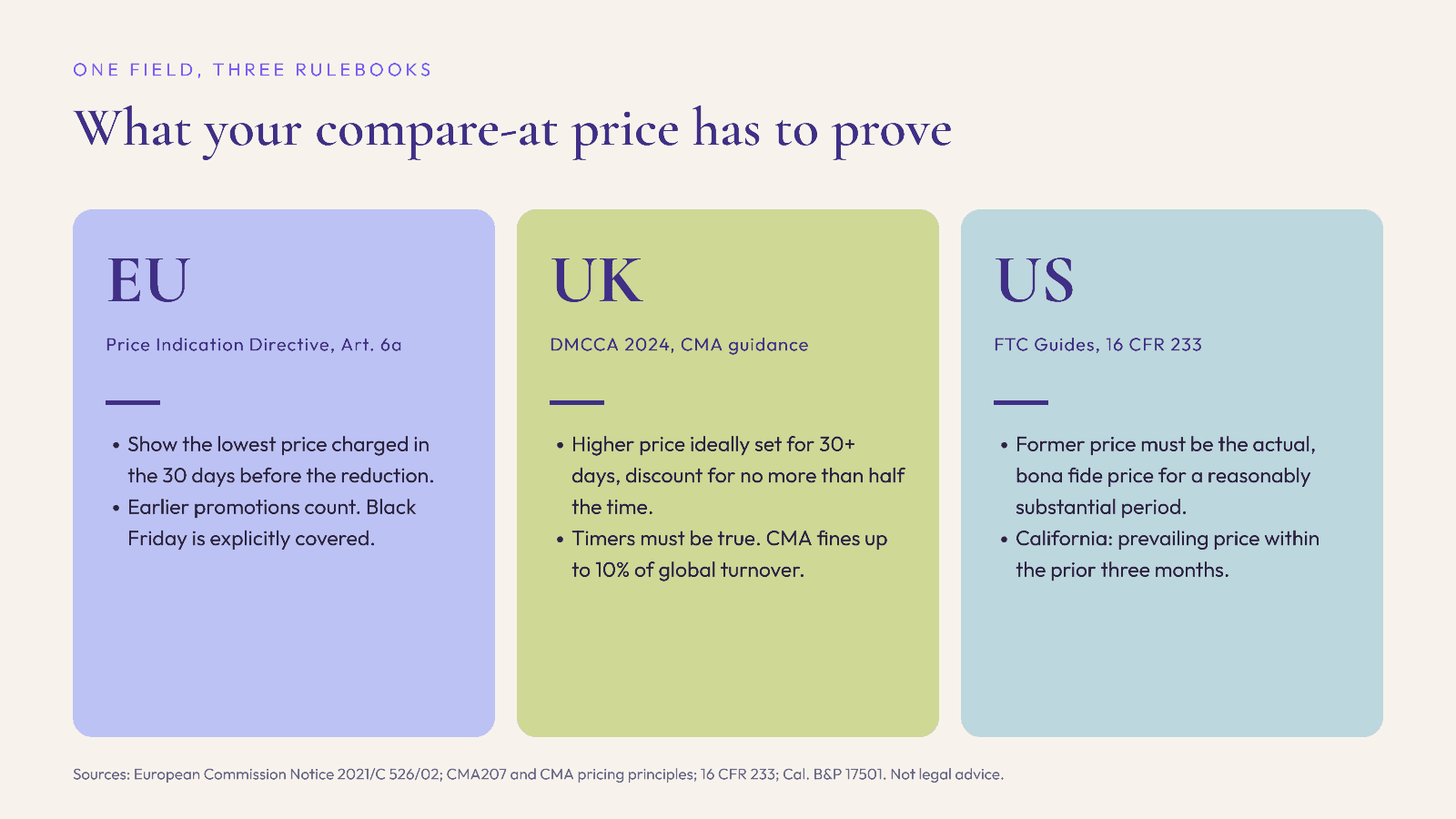
Article 6a of the EU Price Indication Directive, added by the Omnibus Directive, says "any announcement of a price reduction shall indicate the prior price applied by the trader." The prior price means "the lowest price applied by the trader during a period of time not shorter than 30 days prior to the application of the price reduction."
The European Commission's guidance (Notice 2021/C 526/02) makes several points fashion brands should note:
Black Friday is explicitly covered. "Black Friday offers" that create the impression of a price reduction are subject to Article 6a.
Earlier promotions count. Ignoring prices "applied during any previous promotional periods" breaches the rule. If you ran an early-November sale, your Black Friday "was" price may have to be that sale price, not the full price.
Progressive reductions are narrow. Member states may allow a reference to the price before a series of reductions, but the Commission says this must be "interpreted narrowly" and only applies when the price is reduced "progressively, without interruptions."
New arrivals are not exempt. Member states can shorten the period for products on the market for less than 30 days, but cannot exempt them, and re-offered seasonal goods are not "new."
Loyalty discounts can be outside the rule. The guidance says Article 6a does not apply to customer loyalty programmes, but codes most customers can use are covered.
Each EU country implemented the options differently, so check local rules for your biggest markets.
How to do it in Shopify
Shopify's help page on the Price Indication Directive says you need to display "the lowest price that you previously charged for a product within the last 30 days or more," and that you can use the compare-at price for this, entering the lowest 30-day price manually. To show both a regular price and the lowest prior price, Shopify suggests metafields or theme changes. Shopify does not say it tracks the lowest price automatically, which is why third-party "Omnibus" price-history apps exist on the Shopify App Store.
UK: direct CMA fines, fake urgency and drip pricing
Since 6 April 2025, the Digital Markets, Competition and Consumers Act 2024 lets the CMA enforce consumer law directly, with fines of "up to 10% of your business' global turnover or £300,000 (whichever is greater)."

Countdown timers and limited-time claims
The CMA's unfair commercial practices guidance (CMA207) lists as a banned practice "falsely stating that a product will only be available for a limited time" to push an immediate decision. Its own example: "When the time runs down, the offer does not in fact end, but continues and the countdown clock restarts." The guidance also flags fake scarcity, such as "Be quick! We've sold 10 in the last 5 mins" when stock is actually plentiful.
This is not theoretical. In May 2026, the CMA announced a High Court order in which Emma Sleep admitted its countdown timers and "high demand" messages broke the law and agreed to stop running "limited time" deals when similar deals continue afterwards. The October 2026 Wayfair fine shows the CMA now issues penalties for countdown timers directly.
Reference prices
The CMA's discount and reference pricing principles (published in 2024 alongside its mattress cases) say compliance is "more likely" if a higher price was established for "at least 30 days," and that the discount period "should be no more than 50% of the total time." The Chartered Trading Standards Institute's guidance for traders on pricing practices (updated 2026) is non-statutory but adds that a comparison is more likely compliant when it runs for the same or a shorter period than the higher price, and that you "should avoid changing the end date unless circumstances arise that could not reasonably have been foreseen." Note that the old "28-day rule" was dropped from that guidance in 2016.
Drip pricing and fake reviews
CMA guidance on price transparency (CMA209) says the headline price should include "all mandatory charges" and that drip pricing "is prohibited." Fake reviews are also banned outright under the DMCCA. If your Black Friday pages show star ratings, make sure they are genuine and not selectively filtered.
US: FTC pricing guides and state law
The FTC's Guides Against Deceptive Pricing (16 CFR Part 233) say a former price comparison is legitimate when the former price is "the actual, bona fide price at which the article was offered to the public on a regular basis for a reasonably substantial period of time." The guides do not set a fixed number of days, so document how long the higher price ran.
California is stricter: under Business and Professions Code section 17501, according to a law firm summary, a "former price" must be the prevailing market price within the three months immediately before the ad, unless you state when it applied.
Fake urgency has no specific FTC rule, but deceptive claims fall under general FTC Act deception principles.
Reviews: the FTC's Consumer Reviews and Testimonials Rule (16 CFR Part 465), in effect since 21 October 2024, bans fake and AI-generated reviews, review suppression and incentives conditioned on positive sentiment, and allows civil penalties for knowing violations.
Fees: the FTC's Rule on Unfair or Deceptive Fees, in effect since 12 May 2025, applies only to live-event ticketing and short-term lodging, so it does not cover fashion ecommerce. Clear, upfront pricing is still the safer habit.
A pre-BFCM pricing audit for Shopify fashion brands
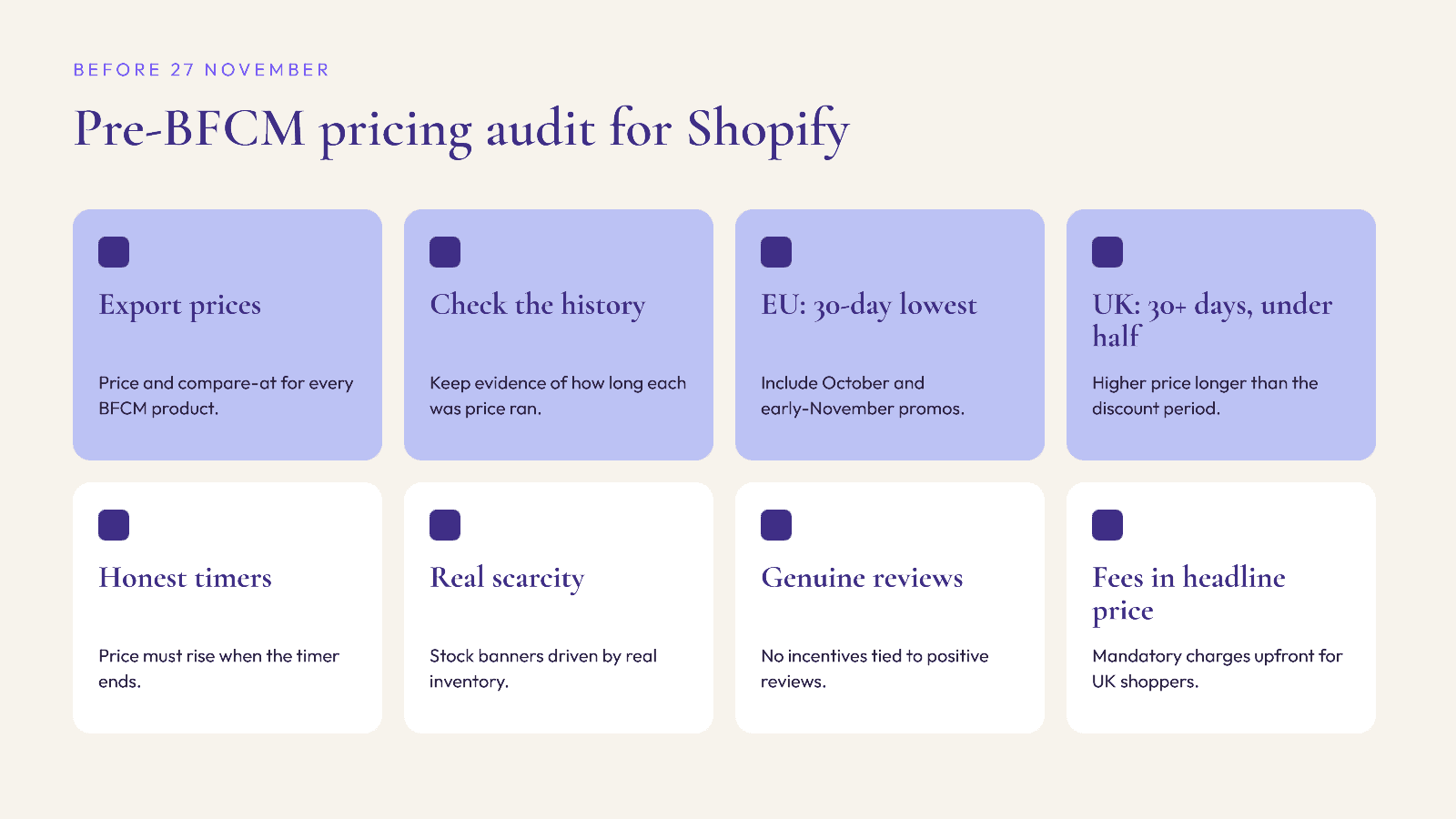
Export prices and compare-at prices for every product in your Black Friday collections.
Check the history. For each compare-at price, confirm when and for how long it was the actual selling price. Keep screenshots or exports as evidence.
EU stores: replace compare-at with the lowest price of the last 30 days, including any October or early-November promotions, or use a price-history app.
UK stores: check that the higher price ran for at least 30 days and longer than the discount period, in line with the CMA principles.
Countdown timers: only show a timer if the price genuinely goes up when it ends. Do not restart timers or roll the same deal into a "new" one.
Scarcity messages: remove "selling fast" or "only 2 left" banners unless they are driven by real inventory data.
Reviews: stop any incentive tied to positive reviews, and show negative reviews alongside positive ones.
Shipping and fees: show mandatory charges in the headline price for UK customers.
FAQ
Can I use Shopify's compare-at price for Black Friday discounts?
Yes, but the compare-at price must be a genuine former price. In the EU it must be the lowest price you charged in the previous 30 days, including earlier promotions. Shopify's field does not check this for you.
What is the EU 30-day lowest price rule?
Article 6a of the Price Indication Directive requires any announced price reduction to show the lowest price you applied in at least the 30 days before the reduction. The European Commission says Black Friday offers are covered.
Are countdown timers legal in the UK?
Only when they are true. The CMA's guidance bans falsely claiming an offer is available for a limited time, and in October 2026 it fined Wayfair £4.8 million over timers on deals that continued after the deadline.
How long must a "was" price run before a sale in the US?
The FTC requires a former price to be offered genuinely for a "reasonably substantial period" without setting a fixed number of days. California law uses a three-month test for advertised former prices.
What are the penalties under the UK DMCCA?
The CMA can fine up to 10% of global turnover or £300,000, whichever is greater, without going to court first.
Does the FTC fees rule apply to fashion stores?
No. It covers only live-event ticketing and short-term lodging. General deception law still applies to how you present prices.
Win Black Friday on styling, not just discount depth. Elara for Commerce is an AI shopping assistant for fashion brands on Shopify. It engages shoppers proactively, understands the occasion they are buying for, and builds complete outfits from your catalog with virtual try-on, so shoppers buy the look, not just the markdown. As industry benchmarks, AI shopping assistants are associated with a 4x conversion rate (Neuwark 2026) and 25% higher AOV (Rep AI 2025); these are not Elara results. Book a demo or start the 30-day free trial.
Keep reading

Peak Season, Compliance, Shopify
Selling to the EU This Christmas? The GPSR Checklist for Shopify Fashion Brands (2026)
What the EU General Product Safety Regulation means for Shopify fashion brands shipping Christmas orders to the EU: product page information, the EU responsible person, labels, accidents and recalls.

Peak Season, Shopify, Omnichannel
After the Last Shipping Day: A Christmas 2026 Local Pickup and Delivery Playbook for Shopify Fashion Brands
How Shopify fashion brands can keep selling physical products after the Christmas shipping cutoff, with pickup in store, local delivery zones and Google's pickup today annotation.

Peak Season, Accessibility, Conversion
Black Friday 2026 Accessibility Check: What the European Accessibility Act Means for Shopify Fashion Stores
What the European Accessibility Act asks of online stores, and a five-week plan to fix sale prices, swatches, size charts, pop-ups and forms on a Shopify fashion store before Black Friday.